Quick answer
Start with the candle you already own: if it is a Diptyque classic model, choose a holder or photophore explicitly made for that size, then add care tools like a matchbox, wick trimmer, and snuffer. For most homes, a turned-wood pillar holder is the easiest everyday upgrade, while a hand-blown photophore is the display piece you bring out for evenings.
Why fit comes before style
Candle accessories fail for one boring reason: they do not fit. A holder that is too wide lets the candle wobble; one that is too narrow will not seat the base. Before you fall for a finish or silhouette, confirm the accessory is designed for the candle size you burn most. Diptyque holders and photophores are often labeled for the classic model, which is the safest starting point.
If a listing does not state compatibility, treat that as a limitation, not a hint. You can measure your candle's base diameter and compare it to the accessory opening, but you cannot assume a universal fit. When in doubt, buy the accessory that names your candle model.
Matchbox and lighting tools: the small things you use daily
A matchbox is the least glamorous accessory and the one you touch most. Long matches let you reach the bottom of a jar without burning your fingers, and a covered matchbox keeps matches dry and tidy on a shelf. Pair it with a wick trimmer so you can cut the wick to roughly 5 mm before each burn, and a snuffer to put the candle out without blowing smoke across the room.
These tools do not need to match your decor, but they do need a home. A small tray near the candle keeps the matchbox, trimmer, and snuffer together so you are not hunting for them with a lit match in hand.
Photophore vs. open holder: two different jobs
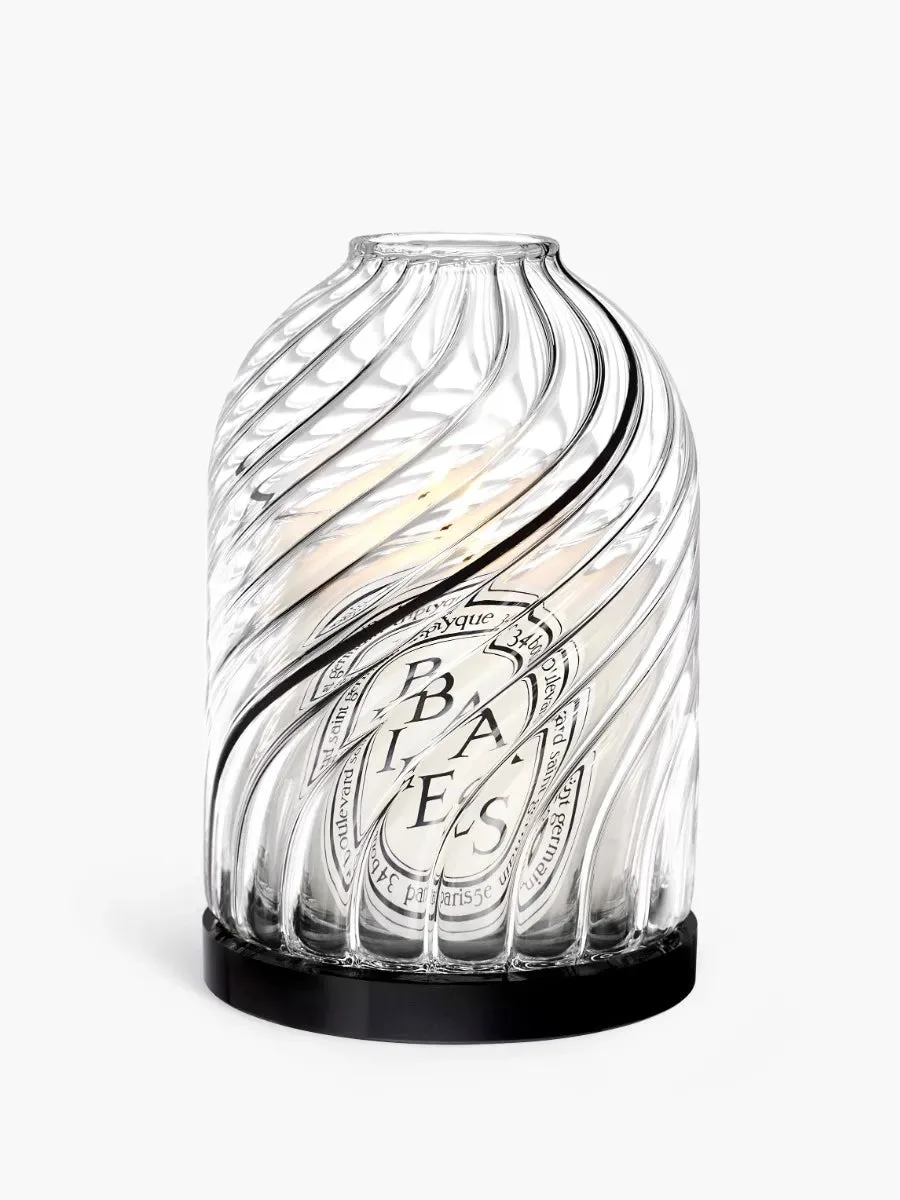
An open holder displays the candle and lifts it off the surface. A photophore encloses it, turning the flame into a soft, glowing lantern. The trade-off is airflow and access: open holders are easier to light and trim, while photophores create a more dramatic light but usually need the candle placed inside before lighting.
Choose based on how you actually burn candles. If you light one most evenings and trim wicks in place, an open holder is more practical. If candles come out for dinners and baths, a photophore earns its shelf space.
Materials and where they are made
Material affects weight, care, and how the piece ages. Turned wood is warm, light, and easy to move; hand-blown glass is heavier, more fragile, and more reflective. Neither is better in the abstract — they suit different rooms and rituals.
Provenance can also guide you. Some Diptyque accessories are made by workshops recognized for preserving French craftsmanship, which often means traditional techniques and small-batch production. That context does not change fit, but it does explain why two holders at similar sizes can feel very different in hand.
How many accessories do you actually need?
Most people need three things: one holder that fits their main candle, one way to light it, and one way to extinguish it. Everything else is optional. A second holder or photophore is worth adding only if you display candles in more than one room or want a different mood for evenings.
If you are building from zero, buy the fit-critical piece first, then the care tools, then the display piece. That order prevents the common mistake of owning a beautiful photophore with no candle that fits inside it.
Decision rules for buying candle accessories
- Rule 1: Match the candle model first: Only buy a holder or photophore that names the candle size you own. If compatibility is not stated, do not assume it. Checkpoint: can you name the candle model this accessory is made for?
- Rule 2: Choose open or enclosed by routine: Open holders suit frequent lighting and trimming; photophores suit occasional, display-focused burning. Checkpoint: how often will you light the candle in this accessory?
- Rule 3: Buy care tools before a second holder: A matchbox, wick trimmer, and snuffer improve every burn. A second holder only helps if you have a second placement. Checkpoint: do you already have a way to light and extinguish the candle cleanly?
- Rule 4: Let material follow the room: Turned wood for shelves and side tables you rearrange often; hand-blown glass for a fixed focal point. Checkpoint: will this piece be moved weekly or stay put?
Product facts
- Photophore Torsades - Pour bougie modèle classique: Designed by the studio Jean-Marc Gady and hand-blown in a Vendée workshop of master glassmakers. A hand-blown photophore is a display object first; expect to handle it carefully and place the candle before lighting.
- Bougeoir Pilier noir - Pour bougie modèle classique: A black pillar holder for classic model candles, turned in the Jura region by an Entreprise du Patrimoine Vivant. Turned wood is light and easy to reposition, and the black finish suits most decor without competing with the candle.
- Mousses - Bougie modèle classique: Mousses is a classic model candle with forest notes: damp undergrowth, old trees, and mushrooms in the humus. A classic model candle is the reference size when checking holder and photophore compatibility.
Who should buy which accessory
Best for
- Owners of a Diptyque classic model candle who want a holder that fits without guesswork
- Anyone building a small, practical set of candle care tools for daily burns
- Shoppers looking for a display photophore for dinners, baths, or evening rituals
Not for
- Buyers who want a universal holder for many candle brands and sizes
- Anyone who prefers to leave candles in their original jars with no accessories
- Shoppers who need a candle included with the holder