Quick answer
Most in-ear monitors don't need a dedicated DAC amp; a phone, laptop, or dongle drives them loudly enough. But two groups benefit: IEMs with very low impedance and high sensitivity that pick up background hiss, and low-sensitivity models that need more voltage than a headphone jack can deliver. If you hear hiss or can't reach a comfortable volume, a DAC amp is the fix.
What sensitivity and impedance actually tell you
Sensitivity (dB/mW or dB/V) tells you how loud an IEM gets for a given power input; impedance (ohms) tells you how much voltage it takes to deliver that power. A 120 dB/mW, 16-ohm IEM will hit painful levels from almost any phone, while a 95 dB/mW, 60-ohm model may struggle on a weak laptop jack. The tricky part is that high sensitivity also amplifies the noise floor of whatever is driving it, so a phone with a noisy output can make an efficient IEM hiss even at low volume.
When a DAC amp solves a real problem
Buy a DAC amp if you hear a constant hiss or buzz between tracks, if you have to run your phone at 90–100% volume to get acceptable loudness, or if you want a wired connection to a computer that has a poor onboard jack. A DAC amp won't change the fundamental tuning of your IEMs, but it can lower the noise floor, provide more clean headroom, and add features like a physical volume knob or balanced output. If none of those symptoms apply, your money is better spent on tips or a spare cable.
Matching a DAC amp to specific IEMs
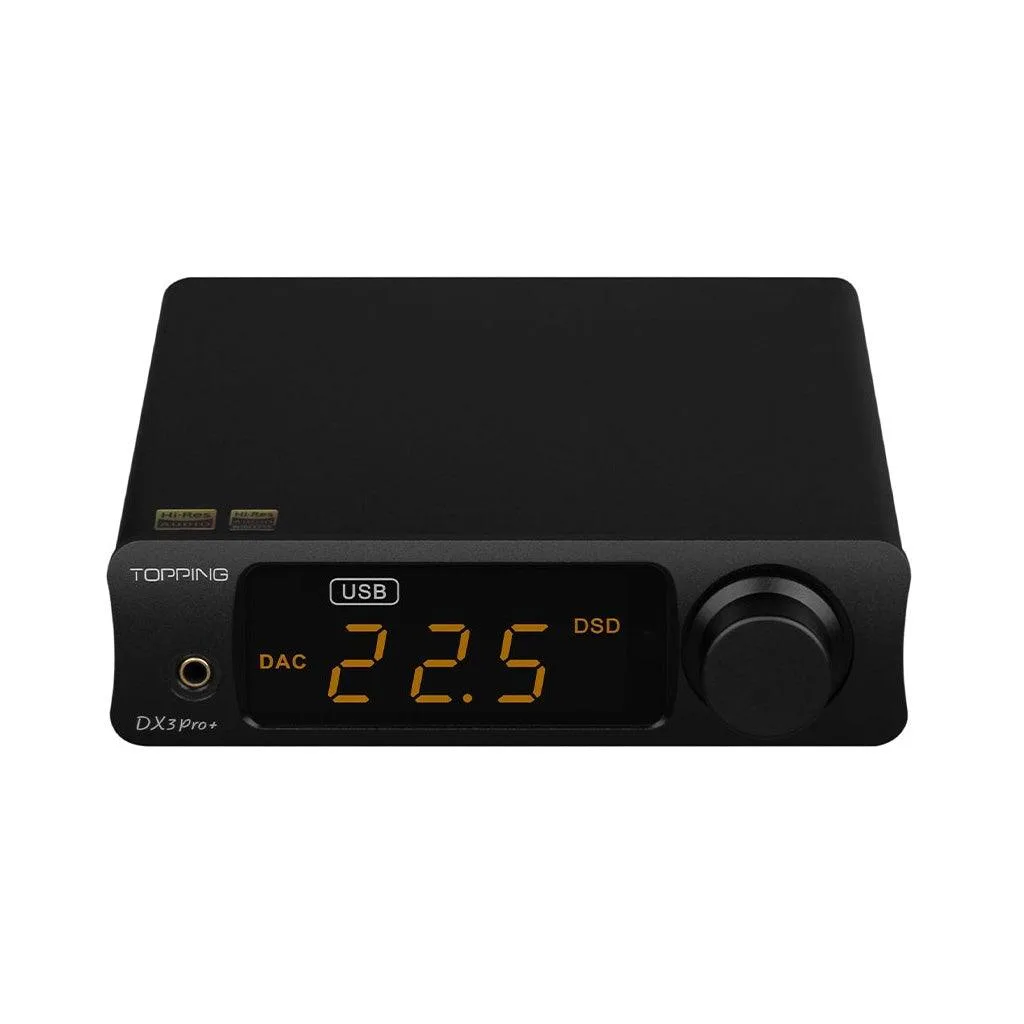
Start with the IEM's rated impedance and sensitivity. For a low-impedance, high-sensitivity model, look for an amp with a low output impedance (under 1 ohm is a safe target) and a low noise floor; high output impedance can shift the frequency response of balanced-armature IEMs. For a low-sensitivity model, prioritize voltage swing and gain settings. The Topping DX3 Pro+ gives you two gain settings and four output modes, so you can use it as a pure DAC, a headphone amp, or a preamp as your setup changes. If you mainly listen on the go, a compact dongle DAC with a 4.4mm or 3.5mm output is often enough.
Do you need a desktop amp for IEMs?
Usually no, but a desktop unit can make sense if you also drive full-size headphones or want a fixed home listening station. The tradeoff is that desktop amps often have higher gain, which can leave you with very little usable volume range on sensitive IEMs. Check for a low-gain mode or an IEM-friendly output before buying. If your IEMs are your only headphones, a portable DAC amp or a good dongle is the more practical choice.
IEM and DAC amp FAQ
Will a DAC amp make my IEMs sound better?
Only if your current source is adding noise or running out of clean volume. A DAC amp lowers the noise floor and adds headroom, but it won't retune your IEMs. Fix the source problem first, then judge the sound.
What output impedance should I look for?
Under 1 ohm is a safe target for low-impedance, multi-driver IEMs. Higher output impedance can shift the frequency response, especially on balanced-armature models. Check the spec sheet before buying.
Do I need a balanced cable and output?
Balanced output can provide more voltage for hard-to-drive IEMs and sometimes a lower noise floor, but it isn't required for most efficient models. Match the connector to your IEM's stock cable.
Can a desktop amp hiss with sensitive IEMs?
Yes. High-gain desktop amps often have too much gain for efficient IEMs, leaving a narrow volume range and audible noise. Look for a low-gain mode. If there's no low-gain option, consider a portable DAC amp instead.
Products that fit this decision
- Topping DX3 Pro+ Desktop DAC & Headphone Amplifier: Four output modes: Headphone Amp, Headphone Amp+Line out, DAC, and Pre-amplifier; two gain settings; 32ohm load: 1800mW x2, 300ohm load: 250mW x2. The two gain settings let you run sensitive IEMs on low gain to avoid hiss, while the higher gain and power output handle harder-to-drive headphones later.
- Hisenior Audio Mega5-EST In-Ear Headphones: Tribrid model with a dynamic driver, balanced armatures, and electrostatic tweeters; comes with a 4.4mm cable by default. Because it ships with a 4.4mm balanced cable, you'll want a DAC amp or dongle with a 4.4mm output to use it without an adapter.