Quick answer
A proper EDC belt should resist twisting and bending when you try to flex it one-handed, and it should keep your holster pressed firmly against your body without sagging or tilting.
Why stiffness matters for concealed carry
A floppy belt lets your holster tilt outward, creating a visible print and making the draw slower. This is especially critical for appendix carry where the muzzle, grip, and magazines compete for space around the front of your waistline.
The trade-off: an overly stiff belt can feel uncomfortable during long sitting hours, but a soft belt risks safety and concealment. You want a belt that holds shape under the weight of a loaded firearm during movement.
When a ratchet belt helps with stiffness
Traditional hole-based belts often loosen over time because the buckle teeth migrate toward a looser notch. Ratchet belts eliminate that problem entirely—micro adjustments let you cinch exactly to the tension that keeps your holster locked in place.
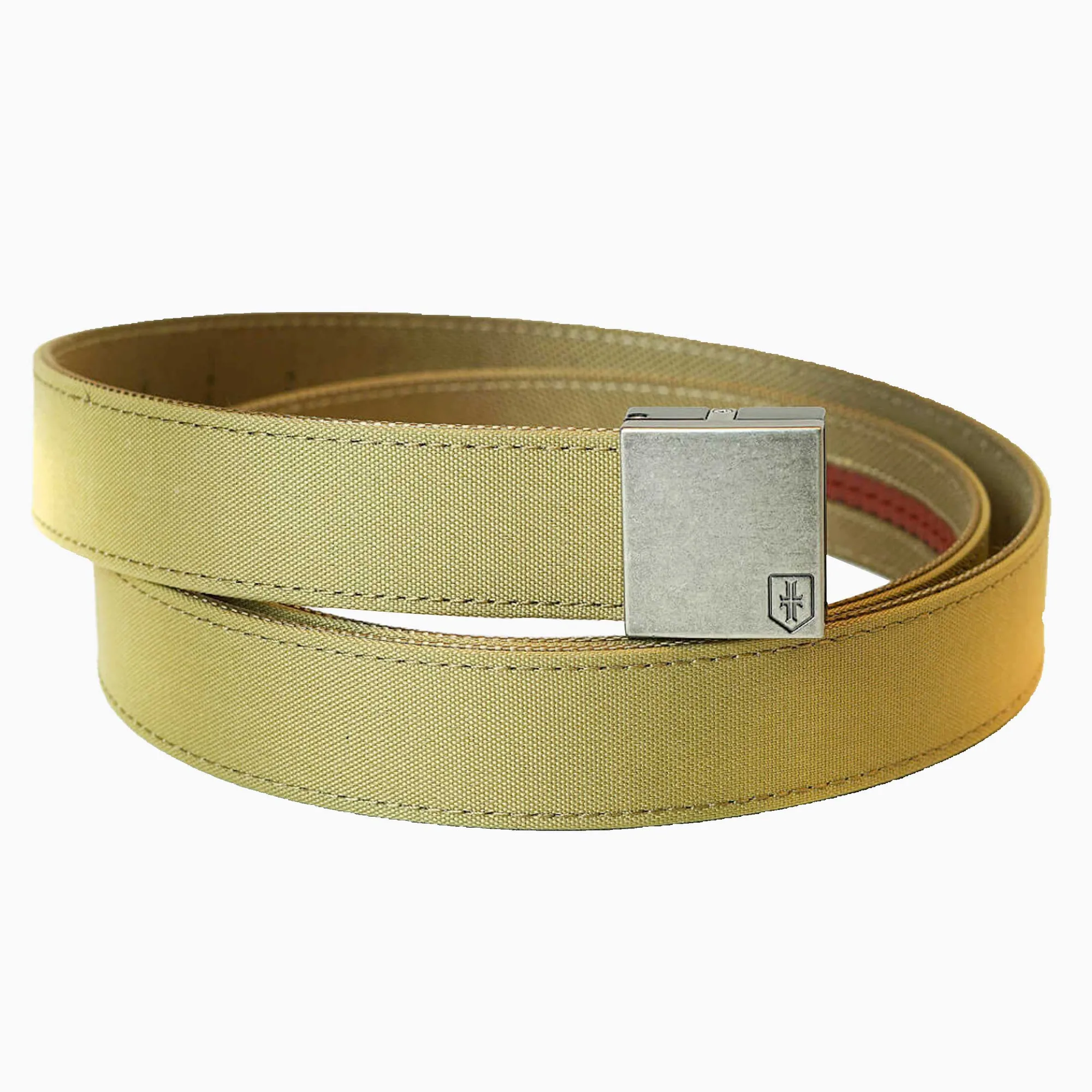
The Nexbelt WPS Supreme Appendix Carry Ratchet Belt, for example, pairs a stiff nylon core with a micro-adjustable ratchet buckle. Its compact 1.5-inch buckle reduces bulk in the front, allowing the stiff strap to do the support work without pushing into your abdomen.
How to test your gun belt stiffness at home
- The one-hand twist test: Hold the belt by one end at waist height, letting the other end hang. Try to twist the free end 90 degrees using only one hand. If it twists easily with little resistance, the belt is too flimsy for a heavy firearm. A rigid ratchet belt should require noticeable effort to twist 90°.
- The side-flex test: Buckle your belt as if wearing it, then grab the front center between both hands. Try to bend it sideways (as if bowing it). If the belt collapses into a U-shape with light pressure, it lacks the stiffness needed to support a holster. The belt should resist lateral bending until you apply moderate force.
- The holster lean test: With the belt buckled, attach your empty holster in your preferred carry position. Tilt the holster by its grip toward you. If the holster pivots away from your body more than 1.5 inches, the belt is not rigid enough. A stiff belt keeps the holster flush even as you bend and twist.
Product spotlight
-
WPS Supreme Appendix Carry Ratchet Belt 1.5" [38mm]: The WPS Supreme Appendix Carry Ratchet Belt features the smallest buckle available at 1 1/2 x 1 11/16 inches. A smaller buckle is less likely to dig into your stomach when carrying in the appendix position, while the stiff strap still provides the holster support you need.
WPS Supreme Appendix Carry Ratchet Belt 1.5" [38mm]