Quick answer
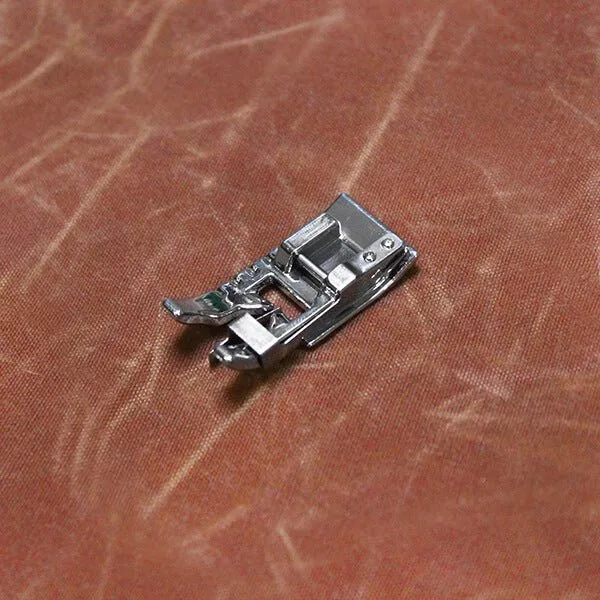
An edgestitch presser foot, also called a stitch-in-the-ditch foot, lets you sew a perfectly straight line parallel to a fabric edge or seam. It works by guiding the edge against a metal flange or blade on the foot. For bag makers, it is the best presser foot for topstitching because it keeps rows even without drawing lines. It is not a replacement for a walking foot when sewing thick or sticky materials like waxed canvas.
What an edgestitch foot does that a standard foot cannot
A standard presser foot gives you a general seam allowance guide, but it does not hold your fabric edge against a fixed reference point. An edgestitch foot has a vertical flange or blade that rides along the fabric edge or a seam line. That physical stop means your needle always lands the same distance from the edge, so topstitching stays parallel even around curves. For bag makers, this is the difference between a professional-looking strap and one that wanders.
When to choose an edgestitch foot over a walking foot
Use an edgestitch foot when your fabric layers are manageable and you need precise, visible topstitching along a seam or edge. Use a walking foot when you are sewing thick, sticky, or heavily layered materials like waxed canvas, leather, or multiple layers of webbing. A walking foot feeds all layers together to prevent shifting, but it does not have the edge guide. Some bag makers switch to an edgestitch foot for the final topstitching pass after assembling bulky sections with a walking foot.
How to adjust an edgestitch foot for your machine
Most edgestitch feet attach like a standard snap-on foot. The key adjustment is the needle position: you move the needle left or right to set the distance from the edge. Always turn the handwheel toward you by hand first to check that the needle clears the foot and lands where you want. If your machine has a low shank, the foot may need a different adapter. Check your manual for the correct shank type before buying.
Step-by-step: using an edgestitch foot for topstitching
- Attach the foot and set your needle position: Snap on the edgestitch foot. Select a straight stitch with a length of 2.5 to 3 mm. Move the needle to the left or right so the flange sits against the fabric edge or seam you want to follow. Common mistake: forgetting to lock the needle position, so it drifts mid-seam. Turn the handwheel by hand to confirm the needle enters the fabric just inside the edge without hitting the flange.
- Align the flange against the edge or seam: Place your fabric under the foot so the metal flange rides along the raw edge, folded edge, or seam line you are topstitching. Keep light tension with your left hand to guide the fabric against the flange. Common mistake: pushing the fabric too hard against the flange, which stretches the edge and causes wavy stitching. Let the foot do the guiding. Your hands only support the fabric; they do not steer.
- Sew slowly and watch the flange, not the needle: Sew at a moderate speed, keeping your eye on the flange as it follows the edge. The needle will land consistently without you watching it. Common mistake: watching the needle instead of the flange, which leads to overcorrecting and uneven lines. If the flange slips off the edge, stop, lift the foot, reposition, and continue. Do not try to force it back while sewing.
- Check the first few inches before continuing: After a few inches, stop and look at the stitch line. Is it parallel to the edge? If not, adjust the needle position and test again on a scrap. Common mistake: sewing the entire seam before checking, then having to unpick. Always test on a scrap of the same fabric and thickness. Waxed canvas and leather behave differently from quilting cotton.
- Switch to a walking foot for bulky or sticky layers: If the fabric shifts, the needle struggles, or the feed dogs leave marks, stop. Switch to a walking foot for that section. You can often switch back to the edgestitch foot for the final topstitching pass once the bulk is reduced. Common mistake: forcing an edgestitch foot through thick waxed canvas, which bends the needle and damages the foot. Match the foot to the job. The edgestitch foot is for precision, not for feeding heavy layers.
Product facts
- Edgestitch Presser Foot: Compatible with most modern Singer, Brother and Janome sewing machines, but compatibility depends on the machine having a low shank. Check your machine's shank type before ordering; if you have a high shank or slant shank machine, this foot may not fit without an adapter.