Quick answer
Start with the Lacing Animals if your toddler is just beginning to thread and needs a calm, repetitive challenge. Choose the Fishing Game when your child already enjoys active, two-step play and is ready to coordinate a magnetic rod with moving targets. Both build fine motor skills, but they train different parts of the same developmental puzzle.
What each toy actually trains
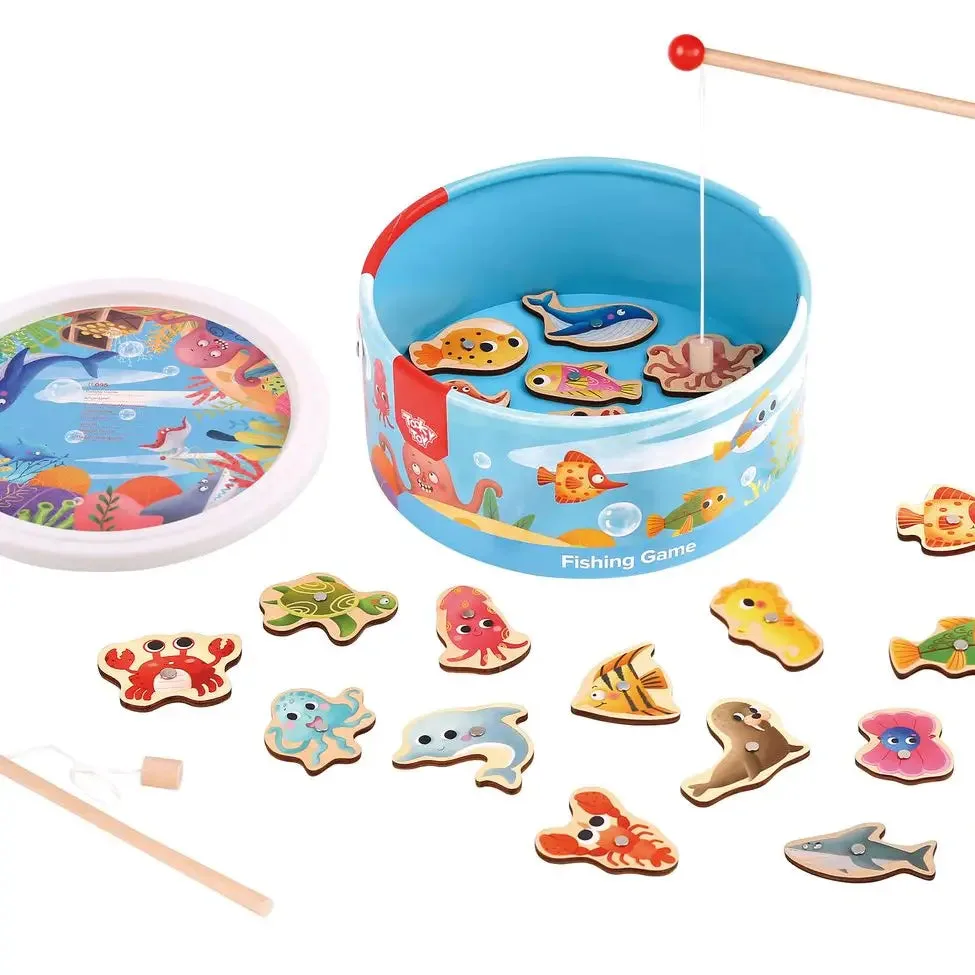
The Fishing Game asks a toddler to hold a rod, aim at a fish, and lift it with a magnet. That sequence builds hand-eye coordination, focus, and the kind of motor planning that comes before writing. Because the fish are loose, the toy also invites imaginative play and turn-taking.
Lacing Animals, by contrast, is a quieter threading task. A child pushes a lace through an animal opening and pulls it through, repeating the motion until patience and grip strength develop. It is less about chasing a target and more about steady, repetitive control.
When to introduce each toy
If your toddler still mouths small parts or gets frustrated by a moving target, Lacing Animals is the lower-pressure starting point. The threading motion is predictable, and the wooden animal shapes give little hands something solid to hold. Once your child can thread two or three animals without help, the Fishing Game becomes a natural next step because it adds a tool (the rod) and a moving goal.
If your child already stacks, sorts, and grabs small objects with a pincer grip, the Fishing Game can come first. It rewards persistence with a clear catch, which keeps active toddlers engaged longer than a quiet threading task might.
Trade-offs to weigh before you buy
- Active vs calm play: The Fishing Game keeps a toddler moving and aiming, which can be exciting but overstimulating for some children. Lacing Animals is slower and more repetitive, which builds patience but may bore a child who needs action. Match the toy to your child's energy level, not just their age.
- Tool use vs direct hand control: The Fishing Game introduces a rod as an extension of the hand, adding a coordination layer. Lacing Animals works directly with fingers, so the motor practice is more immediate and easier to self-correct. Choose the rod only after your toddler can already grip and release small objects reliably.
- Portability and setup: Lacing Animals is a single compact piece at 6.5 × 27 cm, so it travels well. The Fishing Game has multiple loose fish, which means more pieces to gather and store after play. If you need a diaper-bag toy, Lacing Animals is the simpler pick.
Product facts at a glance
- Fishing Game: The wooden Fishing Game uses a magnetic rod to catch colorful fish, supporting hand-eye coordination, focus, and motor skills during imaginative play. Size: 22 × 9 cm (8.66 × 3.54 in). The rod adds a tool-use step that threading toys skip, so it suits toddlers ready for aim-and-lift play rather than simple push-and-pull.
- Lacing Animals: The wooden Lacing Animals set helps kids develop fine motor skills, hand-eye coordination, and focus. Each colorful animal teaches threading, patience, and creativity. Size: 6.5 × 27 cm (2.56 × 10.63 in). The longer, narrow shape packs easily for travel or quiet time, and the threading motion is repetitive enough for beginners to practice without a moving target.
Which one fits your toddler?
Best for
- Toddlers who are new to threading and need a calm, repetitive challenge
- Families who want a compact, travel-friendly fine motor toy
- Children who respond well to quiet, focused table play
Not for
- Toddlers who still mouth small parts or need constant supervision with laces
- Children who lose interest in repetitive tasks and need a moving target
- Parents looking for a toy that encourages active, whole-body play