Why a Matching Puzzle Works as a First Puzzle
A toddler's first puzzle should be simple, rewarding, and frustration-free. Matching puzzles, where each piece fits only one board, give clear success cues without the struggle of traditional jigsaw assembly. The Forest Babies I Love You Match-Up Puzzles by Mudpuppy is designed exactly for this stage: each of the 6 boards has one uniquely shaped piece that fits only its matching parent animal board, so your child gets instant feedback and a sense of accomplishment.
This set is recommended for ages 1 to 3 years, making it a solid choice for a first puzzle experience. The extra-thick, durable boards can handle enthusiastic handling, and the warm animal theme - baby animals connecting with their parents - gives you a natural conversation starter during play.
What You Get in the Set
-
Forest Babies Matching Puzzles: This set includes 6 puzzle boards where toddlers match each baby animal with its parent. Each board has one uniquely shaped piece that fits only its corresponding board. The one-piece-per-board design removes the overwhelm of many small pieces. Your toddler learns the matching concept without needing to sort multiple pieces at once.
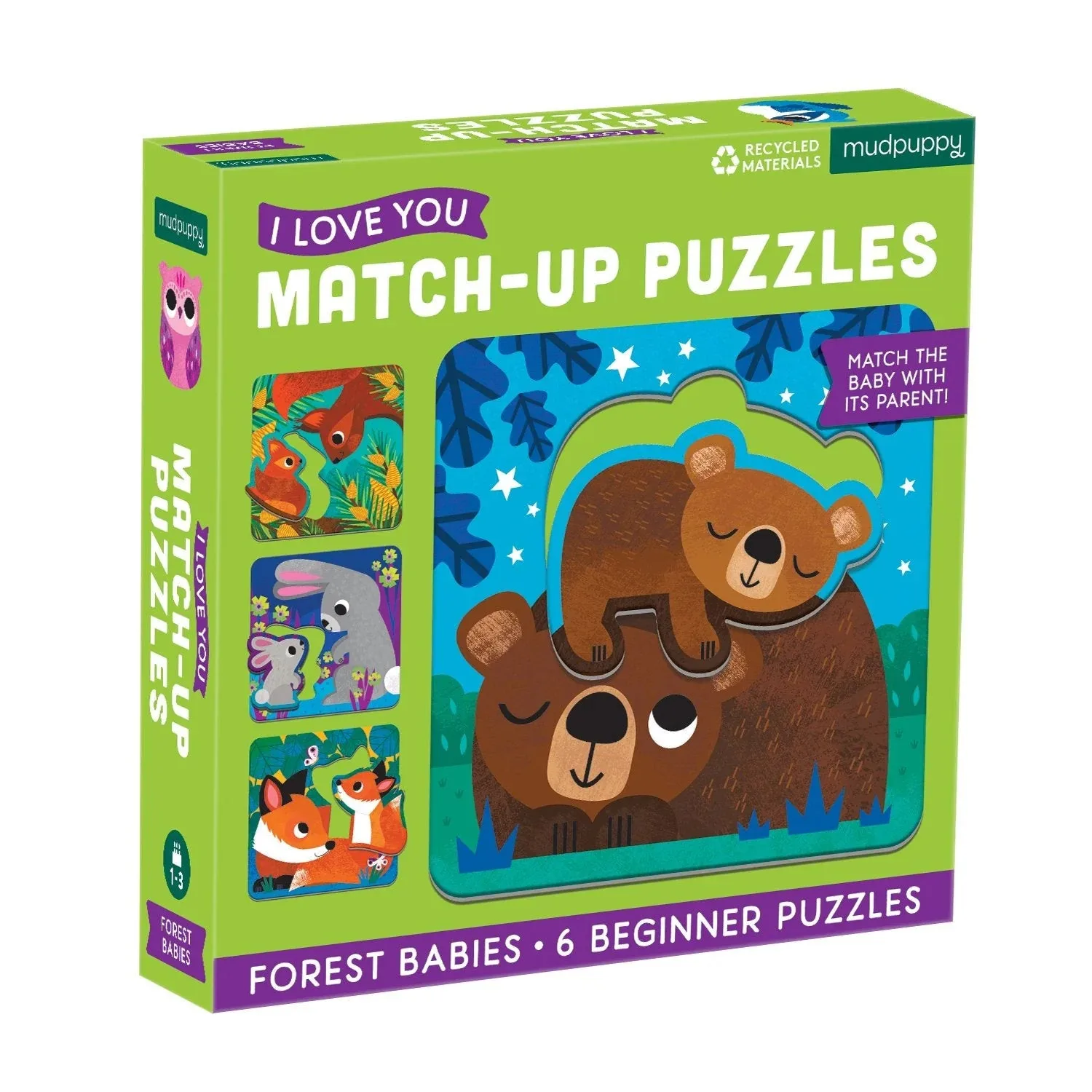
Forest Babies Matching Puzzles
-
Forest Babies Matching Puzzles: The boards are extra-thick and durable, built to withstand curious hands. Toddlers explore with their whole bodies. Thick boards survive drops, bends, and the occasional chew without falling apart.
How to Introduce the Puzzle to Your Toddler
Start with one board and its matching piece. Let your child explore the piece freely before showing how it fits. Follow these steps to build confidence.
- Start with one board: Choose one puzzle board and its matching piece. Place the board in front of your child and hand them the piece. Let them turn it over, feel the shape, and try to place it. If they struggle, gently guide their hand to show how the piece clicks in.
- Add a second board: Once your child can confidently place the first piece, introduce a second board and its piece. Place both boards side by side and hand them both pieces. They'll need to figure out which piece goes where - this is the matching challenge.
- Gradually increase to all six: As your toddler masters two boards, add more one at a time. You don't need to use all six boards every session. Let your child's interest guide the pace. Some toddlers enjoy repeating the same two boards for weeks before wanting more.
What to Expect During Play
Toddlers learn through repetition and trial-and-error. Your child may try to force a piece into the wrong board - that's normal. The shaped piece design makes wrong attempts obvious because the piece simply won't fit, so your child gets clear feedback without needing verbal correction.
The animal theme (baby and parent pairs) gives you a natural way to talk about the puzzle: "The baby fox goes to the mama fox. Where does the baby rabbit go?" This language builds vocabulary and reinforces the matching concept. You don't need to invent a lesson plan - just narrate what you see as you play together.
What We Don't Know from the Listing
The product description does not specify whether the puzzle pieces are made of wood, cardboard, or another material. The boards are described as extra-thick and durable, but we don't have confirmation of specific material certifications or whether the set is dishwasher-safe. If material composition or cleanability is a deciding factor for you, check the packaging or manufacturer website for details.
Also, the listing does not mention whether the puzzle images are printed or applied as stickers. For a toddler product, printed images typically last longer than stickers. Again, confirming this with the manufacturer before purchase can be helpful if durability is a top concern.