Quick Answer
The Luna promo adds a Moon tile and new observation cards that let you score bonus points by tracking lunar phases during the game.
What the Luna Promo Adds
The Luna promo introduces a Moon tile that sits beside the main board. During setup, you place phase markers on it to represent the Moon's changing appearance. This expansion ties into Galileo Galilei's historical theme: Galileo's telescope revealed craters and mountains on the Moon, disproving the ancient idea of its perfect smoothness. In game terms, you earn bonus points when your observation cards match the current lunar phase.
One trade-off: the Luna tile adds a small layer of timing pressure. You'll need to plan your observations around the phase track, which shifts each round. If you ignore it, you might miss easy scoring opportunities. But the rules are simple enough that it won't slow down experienced players.
How to Use the Luna Promo
- Set Up the Moon Tile: Place the Luna tile next to the main board. Put the phase markers on the starting space indicated in the promo rules (usually the new moon position). Make sure you have the correct starting phase; a common mistake is placing markers on the wrong end of the track.
- Shuffle the Luna Observation Cards: Take the new observation cards from the promo pack and shuffle them into the main observation deck. These cards show specific lunar phases instead of regular celestial bodies. Don't remove any base-game cards unless the promo rules say so—keeping the full deck maintains balance.
- Advance the Phase Each Round: At the start of each new round, move the phase marker one step forward on the Luna tile. The phase sequence matches the real lunar cycle: new, waxing crescent, first quarter, waxing gibbous, full, waning gibbous, third quarter, waning crescent. If you forget to advance the phase, you'll score incorrectly. Set a reminder, like placing a token on the round track.
- Score Luna Observation Cards: When you complete an observation card that shows a lunar phase, check the current phase on the Luna tile. If it matches, you score the bonus points listed on the card. If not, you still get the base observation points but lose the bonus. Timing is key—waiting for the right phase can pay off, but don't hold cards so long that you miss other scoring opportunities.
- End-Game Scoring: At game end, count any remaining Luna observation cards in your hand. Each card with a lunar phase that matches the final phase marker gives you a small bonus. Cards that don't match give nothing extra. Plan your final observations to align with the last phase; a common oversight is ignoring the end-game bonus until it's too late.
Product Details
-
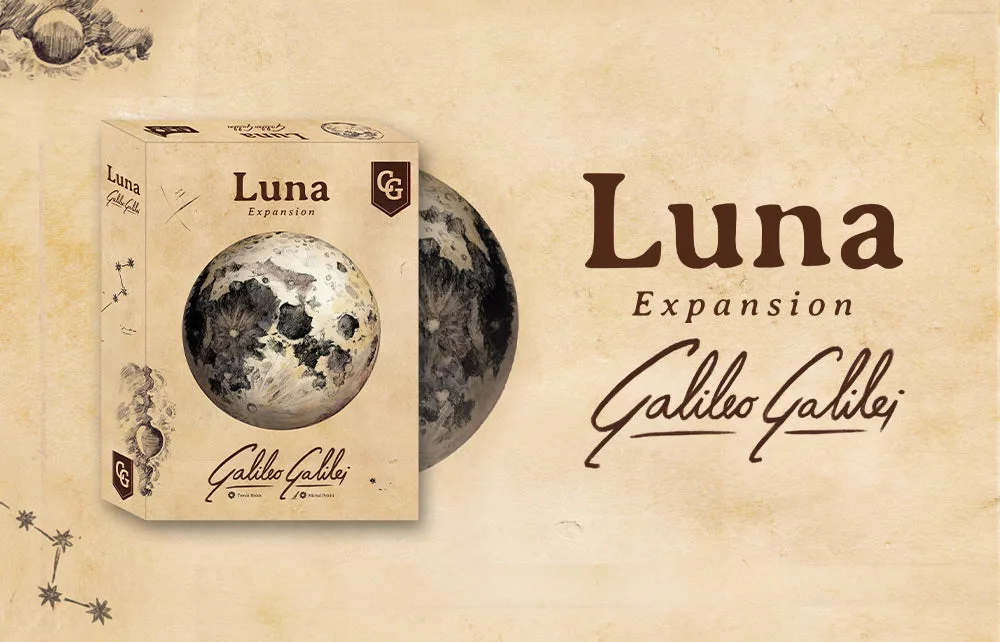
Galileo Galilei – Luna: In the 16th century, astronomers like Tycho Brahe studied the Moon’s movements and phases using precise measurements and simple instruments. Galileo Galilei’s telescope revealed craters and mountains on the Moon, thereby disproving the ancient hypothesis of its perfect smoothness. This historical context is directly reflected in the Luna promo's phase-tracking mechanism, making the expansion feel thematic rather than tacked-on.
Galileo Galilei – Luna