Quick answer
Match the anchor to the ground, not to habit. On firm, level grass, ground stakes driven through the frame's anchor points are usually enough. On loose dirt or any slope, concrete footings or a properly dug level pad hold far better. Whatever you choose, anchor all four corners and re-check them after the first week of use.
Read the ground before you buy hardware
Push a screwdriver into the soil at each corner. If it slides in easily, the ground is soft and stakes alone may work loose. If it stops within a few inches, you have compacted soil or rock and will need to dig or drill. On a slope, measure the drop from the high corner to the low corner. A drop of more than a few inches means you should level the footprint first rather than fight the grade with longer stakes.
Stakes, concrete, or a level pad: pick one per corner
Ground stakes are the fastest option and suit level, well-drained grass. Concrete is heavier and better for loose dirt or windy sites. A level pad—a dug and compacted rectangle—is the only approach that truly solves a slope, because it gives the frame a flat base before you anchor. Mixing methods across corners is a common mistake; it can twist the frame as the ground shifts.
Where a safety pad fits into the job
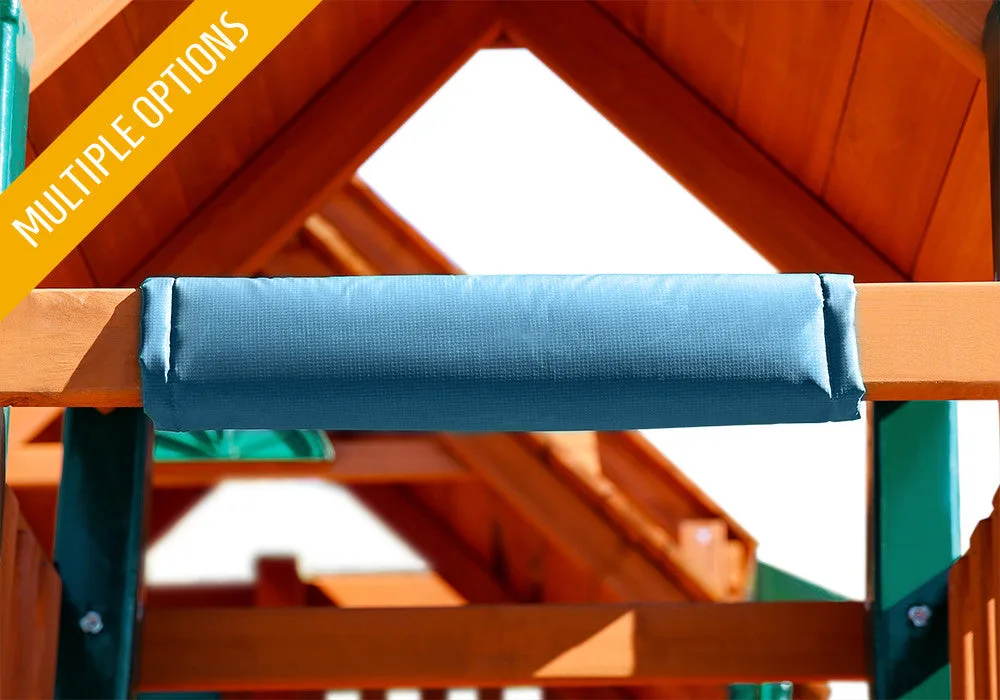
Anchoring and padding solve different problems. Anchors keep the set from tipping; padding covers the hard edges kids brush against. If your set has exposed solid wood boards or slats at a fall zone, wrap a pad around the board so it faces the play area. This is a finishing step, not a substitute for anchoring.
Anchoring steps by ground type
- Level grass: drive ground stakes at every corner: Place a stake through each factory anchor point and drive it flush with the ground. Common mistake: skipping the rear corners because they are hard to reach. Checkpoint: push each stake sideways. If it wiggles, the soil is too soft for stakes alone.
- Loose dirt: pour concrete footings: Dig below the frost line where required, set the anchor bracket in concrete, and let it cure before attaching the frame. Common mistake: backfilling with the same loose dirt instead of concrete. Checkpoint: the frame should not move when you push the top of a swing leg.
- Slope: dig and compact a level pad first: Cut into the high side and fill the low side, compacting in layers until all four corners sit on the same plane. Then anchor with stakes or concrete. Common mistake: shimming a low corner with a block, which shifts under load. Checkpoint: a spirit level across the frame should show no gap at any corner.
- Add edge padding after the frame is secure: Wrap a safety pad around any exposed solid wood board or slat that faces the play area, especially near slide exits and climbing walls. Common mistake: padding a board before anchoring, then having to remove it to reach the anchor point. Checkpoint: pads should sit tight against the board and face the child, not the outside of the set.
Product facts
- Swing Set Safety Pad: The Swing Set Safety Pad wraps around solid wood boards or wood slats to cover the area you want protected. Useful on exposed frame boards near a slide exit or climbing wall, where a hard edge sits inside the fall zone.