Quick answer
To assemble a wooden mandala puzzle for relaxation, treat the process as a slow, mindful ritual rather than a race. Focus on the meditative repetition of sorting, matching, and connecting pieces, letting the mandala's layered symbolism guide your attention inward.
Why a mandala puzzle is different from a standard jigsaw
Unlike a typical landscape or photograph puzzle, a mandala puzzle uses concentric rings and repeating radial patterns. This structure naturally encourages a meditative, circular focus rather than a linear left-to-right approach. The absence of a clear top or bottom means you can rotate the entire assembly as you work, which reduces frustration and keeps your mind in a flowing state.
The wooden material also changes the experience. Wooden pieces have a warm, natural feel and a satisfying tactile weight that cardboard lacks. This sensory feedback can deepen your focus and make each connection feel intentional.
Common mistake: rushing the sorting phase
Many people want to dive straight into connecting pieces, but a mandala puzzle rewards patience during sorting. Because the pattern repeats in rings, mixing pieces from different rings can lead to confusion later. Take the time to separate pieces by color family or edge shape before you begin building.
Step-by-step assembly guide for relaxation
- Create your space: Clear a flat surface and dim the lights or use a single warm lamp. Place the puzzle box within easy reach and take three slow breaths before opening it. This signals to your brain that this is a calm activity, not a task to finish quickly. Checkpoint: If you feel rushed, pause and reset with one more breath before moving on.
- Sort pieces by color zone: Turn all pieces face up and group them by the dominant color or shade. For a mandala, you will typically have distinct rings or petals. Keep the edge pieces separate only if the puzzle has a defined border; many mandalas do not. Common mistake: mixing pieces from different rings early on, which forces you to backtrack later. Checkpoint: If a piece could belong to two groups, set it aside in a maybe pile rather than forcing it into one.
- Build from the center outward: Find the smallest, innermost ring and assemble it first. Work ring by ring, moving outward. This matches the mandala's spiritual symbolism and prevents the disorientation that comes from jumping between sections. Common mistake: trying to connect a piece from the outer ring to the center before the middle rings are in place. Checkpoint: After completing each ring, take a moment to admire the symmetry before moving to the next.
- Rotate the assembly as needed: Since a mandala has no fixed orientation, feel free to spin the entire puzzle to find the angle that makes the next piece fit. This keeps your neck and shoulders relaxed and reduces eye strain. Common mistake: keeping the puzzle locked in one position and twisting your body to reach. Checkpoint: If you feel tension in your neck or shoulders, rotate the puzzle instead of your body.
- End with a closing ritual: Once the last piece clicks in, sit with the completed mandala for a minute. Notice the full pattern and the colors you assembled. Then gently disassemble it if you plan to rebuild later, or seal it with puzzle glue to display as art. Common mistake: immediately starting another puzzle or checking your phone, which undoes the relaxation. Checkpoint: The closing moment is the whole point — do not skip it.
Product spotlight
-
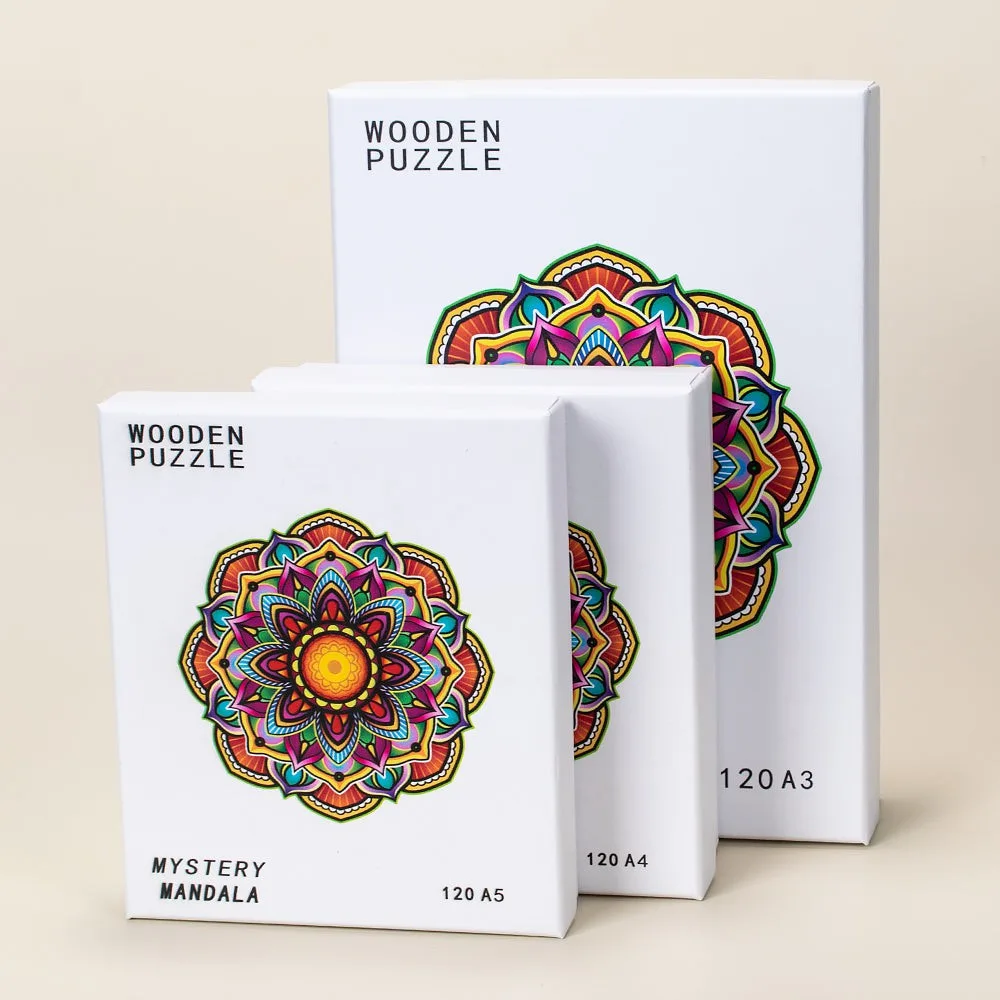
Wooden Mandala Puzzle: This wooden mandala puzzle uses mandala symbolism to represent a spiritual journey from the outer edge to the inner core. Assembling from the outer ring inward mirrors the meditative concept of turning your attention from the external world toward your inner self, reinforcing the relaxation goal.
Wooden Mandala Puzzle