Quick answer
Assemble the Human Heart Anatomy Jigsaw Puzzle by sorting pieces by color and shape, building the outer heart structure first, then filling in the internal anatomy like the aorta and ventricles.
Why a shaped puzzle is different
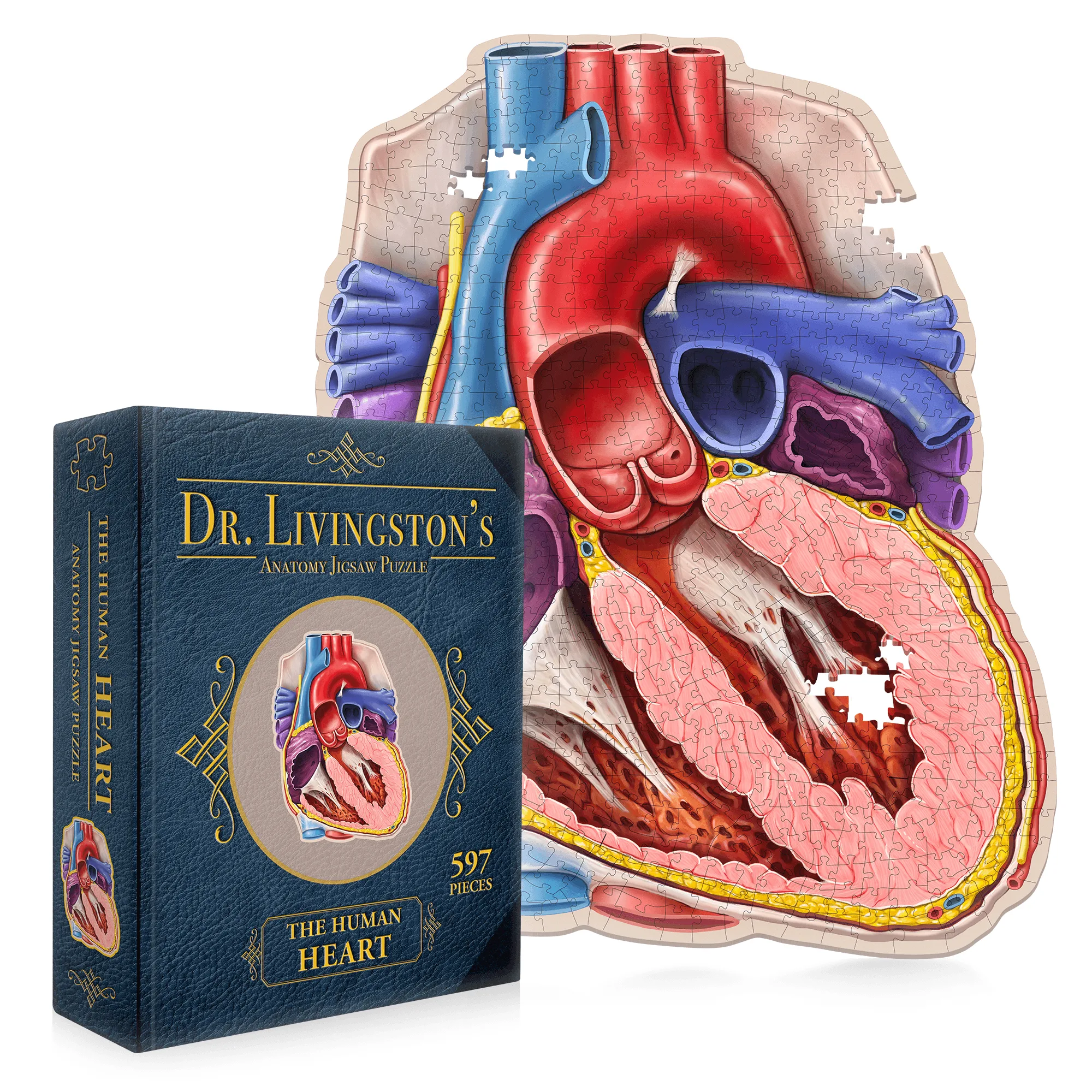
Unlike traditional rectangular jigsaws, the Dr. Livingston's Human Heart puzzle is die-cut to follow the actual outline of the organ. This means no straight edges to start with, so you'll rely more on color and piece shape.
The puzzle is also magnified 600%, making each piece large enough to see detailed anatomy labels and illustrations.
Step-by-step assembly guide
- Sort pieces by color and anatomy zone: Separate pieces into piles: red/pink for heart muscle, blue for veins, and white for labels or background. Also group pieces with straight-ish edges or unique shapes. Common mistake: mixing similar red shades. Use a bright desk lamp to distinguish tones.
- Build the outer heart silhouette: Assemble the curved outer edge pieces first. Since there's no rectangular border, look for pieces with a smooth, convex or concave edge that matches the heart's shape. Checkpoint: the outer ring should form a recognizable heart outline before moving inward.
- Fill in major internal structures: Attach the aorta (thick, curved pieces), then the ventricles (larger chambers) and atria (smaller chambers). Use the medical illustration as a reference. Common mistake: forcing a piece that almost fits. If it doesn't click smoothly, try a different orientation or piece.
Product facts
-
Human Heart Anatomy Jigsaw Puzzle | Dr. Livingston's Unique Shaped Science Puzzles: The puzzle features 597 pieces and is set 1 of 5 in the Dr. Livingston Series, illustrated by a certified medical illustrator from Johns Hopkins University. The medical accuracy helps you identify structures like the aorta and ventricles as you assemble, turning the puzzle into a learning tool.
Human Heart Anatomy Jigsaw Puzzle | Dr. Livingston's Unique Shaped Science Puzzles