Quick answer
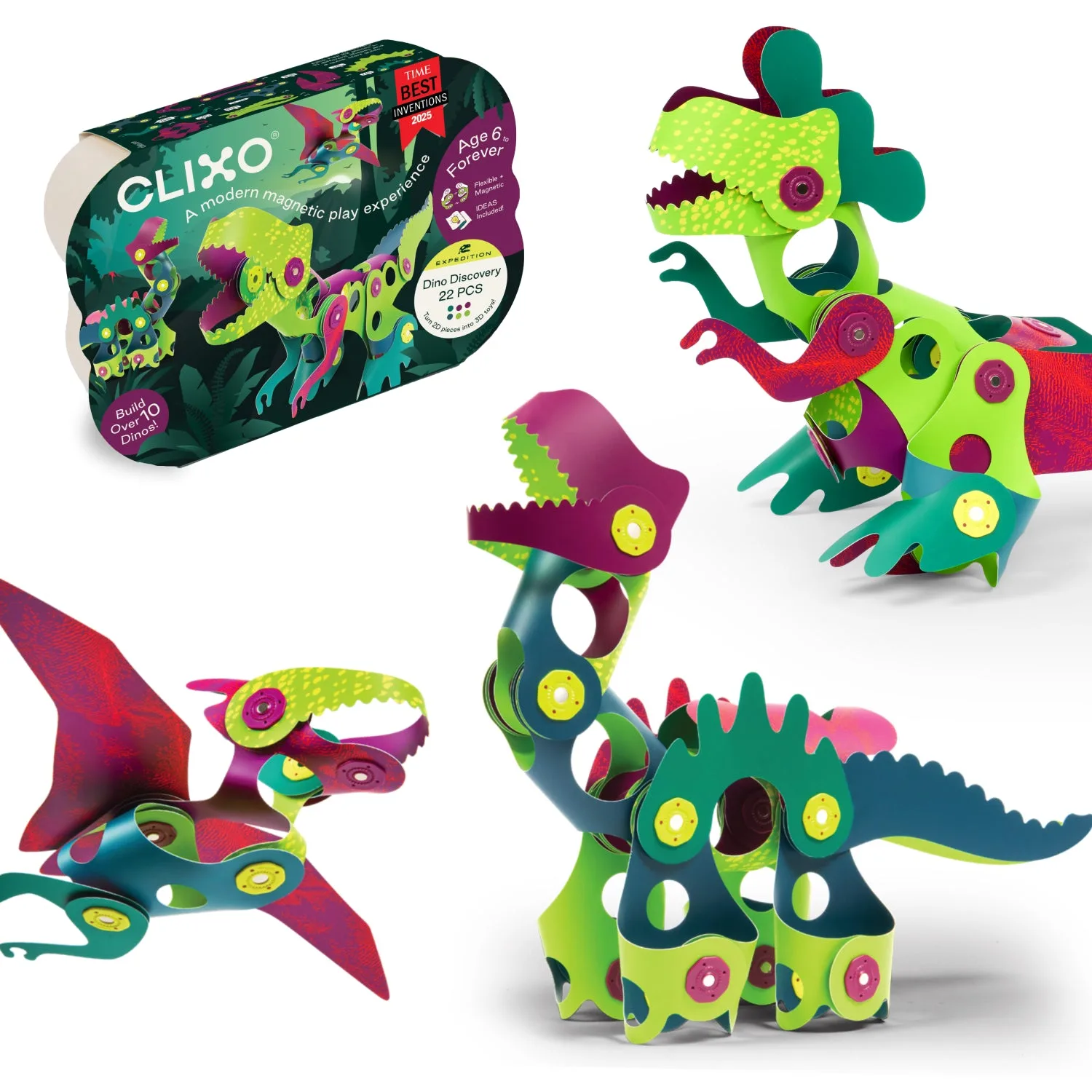
To build a Clixo dinosaur with the Dino Discovery Pack, start with the body as a compact core, add legs or wings for stability, then attach the neck and head last. Build on a flat surface and press each connection until you hear a click. The pack includes enough pieces to make a roaring T-rex, a soaring pterodactyl, or a towering long-neck one at a time.
What you need before you start
The Dino Discovery Pack comes with a mix of Clixo shapes and colors, but the exact piece count and shape list are not published in the catalog. Treat the pack as a flexible building set rather than a fixed model kit. You will use the same pieces differently for each dinosaur. Clear a flat, hard surface like a table or floor. Carpet makes pieces wobble and hides the click. Sort pieces loosely by shape and color so kids can find what they need without digging.
- Work on a table or hard floor, not carpet.
- Keep pieces within arm's reach to avoid frustration.
- If a piece feels loose, check for a speck of dust or a bent edge before forcing it.
Step 1: Build the body core
Start with the torso. Connect two or three large pieces into a compact shape that fits in one hand. This core is the anchor for everything else. For a T-rex, make the body slightly longer front-to-back. For a pterodactyl, keep it shorter and rounder. For a long-neck, a medium oval works well. Press each connection until you feel or hear a click. If pieces pop apart, you are probably rushing the press or using too few connection points.
Step 2: Add legs or wings for stability
Attach legs to the bottom of the body core. Two legs are enough for a T-rex if you angle them slightly outward. For a pterodactyl, attach wings to the sides instead. Use symmetrical connections so the dinosaur can stand or balance without tipping. A common mistake is attaching legs to a single thin piece. That creates a wobbly base. Instead, connect each leg across at least two points on the body. Test the stance by letting go. If it falls over, widen the leg angle or add a small foot piece.
Step 3: Attach the neck and head
Build the neck by linking two or three pieces in a gentle curve. For a long-neck, use more pieces and curve upward. For a T-rex, keep the neck short and angle it forward. Attach the head at the top. The head can be a single piece or a small cluster that suggests a jaw or beak. Check the balance again. If the head is too heavy, the dinosaur will nose-dive. Shift the body core back or use a lighter piece for the head. This is the step where kids often want to rush. Slow down and press each neck joint firmly.
Step 4: Add tail and finishing touches
Attach a tail to the back of the body. A short tail works for a T-rex, while a longer, tapering tail suits a long-neck. For a pterodactyl, you can skip the tail or add a small one. Use leftover pieces to add spikes, plates, or a crest. The Dino Discovery Pack includes multiple colors, so kids can swap pieces to change the look. Once built, let the dinosaur stand on its own for a few seconds. If it holds, you are done. If not, adjust the leg angle or move the tail closer to the body.
Build steps at a glance
- Build the body core: Connect two or three large pieces into a compact torso that fits in one hand. Checkpoint: the core should feel solid and not flex when you press it.
- Add legs or wings: Attach legs to the bottom or wings to the sides, using at least two connection points per limb. Checkpoint: the dinosaur should stand or balance briefly when you let go.
- Attach neck and head: Link two or three pieces for the neck, then add the head at the top. Checkpoint: if the head droops, shift the body core back or use a lighter head piece.
- Add tail and details: Attach a tail to the back and use leftover pieces for spikes, plates, or a crest. Checkpoint: the finished dinosaur should stand on its own for a few seconds.
About the Dino Discovery Pack
- Dino Discovery Pack: The Dino Discovery Pack lets kids snap together multiple dinos at once, including a roaring T-rex, soaring pterodactyl, or towering long-neck giant. You can build one dinosaur, take it apart, and build another without needing extra pieces. This makes it a good single-pack option for kids who like to switch between models.
- Dino Discovery Pack: The pack is designed to inspire creative confidence and foster STEAM learning through play. The open-ended pieces encourage experimentation, so kids can invent their own dinosaur shapes instead of following a single fixed model.