Quick answer
For toddlers, choose a mini memory game with large, sturdy cards, simple illustrations, and a theme your child loves. Consider the eeBoo Mini Memory Game Assortment for its variety and portable size.
Why card size and durability matter for toddlers
Toddlers explore with their hands, so card size and sturdiness are key. Cards that are too small can be a choking hazard or hard to grip. Look for cards that are thick and easy to turn, with rounded corners to avoid sharp edges.
A mini memory game is designed for portability, but that often means smaller cards. Check the card dimensions if listed, and consider your child's dexterity. Some toddlers may struggle with very small cards, so a slightly larger card could be worth the trade-off in portability.
Age and difficulty: matching pairs vs. more complex rules
Most toddler memory games involve finding matching pairs, which is perfect for developing visual memory and concentration. For younger toddlers (2-3 years), start with fewer pairs to keep the game manageable. As they grow, you can add more pairs or introduce turn-taking.
The eeBoo Mini Memory Game Assortment includes four themes with 18 pairs each, which might be too many for a very young toddler. You can start with just a few pairs and gradually increase the number as your child's skills improve.
Themes and illustrations: what captures a toddler's interest
Toddlers are drawn to bright colors and familiar subjects. Choose a theme that aligns with your child's interests, such as animals, fairytales, or dinosaurs. The eeBoo assortment features themes like Dinosaurs, Butterflies, Fairytales, and Wild Animals, illustrated by Linda Bleck and Monika Forsberg, which are visually engaging for young children.
Consider whether your child prefers realistic images or whimsical illustrations. Some toddlers respond better to bold, simple graphics, while others enjoy detailed scenes. Look at the artwork before buying to ensure it matches your child's taste.
Decision rules for picking a mini memory game
- Card size and safety: Check the card dimensions. For toddlers under 3, ensure cards are large enough to avoid choking and easy to grip. If dimensions aren't listed, contact the seller or choose a game known for toddler-friendly sizing. Measure the cards against your child's hand if possible.
- Number of pairs: Start with a game that has 6-10 pairs for ages 2-3. Games with 18 pairs, like the eeBoo Mini Memory Game, are better for ages 4+. You can always remove pairs to simplify. Look for a game that allows you to adjust the number of pairs.
- Theme and illustrations: Pick a theme your toddler loves—animals, fairytales, or dinosaurs. Bold, clear illustrations are easier for young children to recognize and remember. Show your toddler pictures of the game before buying to gauge interest.
- Portability vs. durability: Mini games are great for travel, but ensure the cards are thick and sturdy to withstand rough handling. Consider a tin or box that keeps cards organized. Check the storage container for durability and ease of use.
Product facts
-
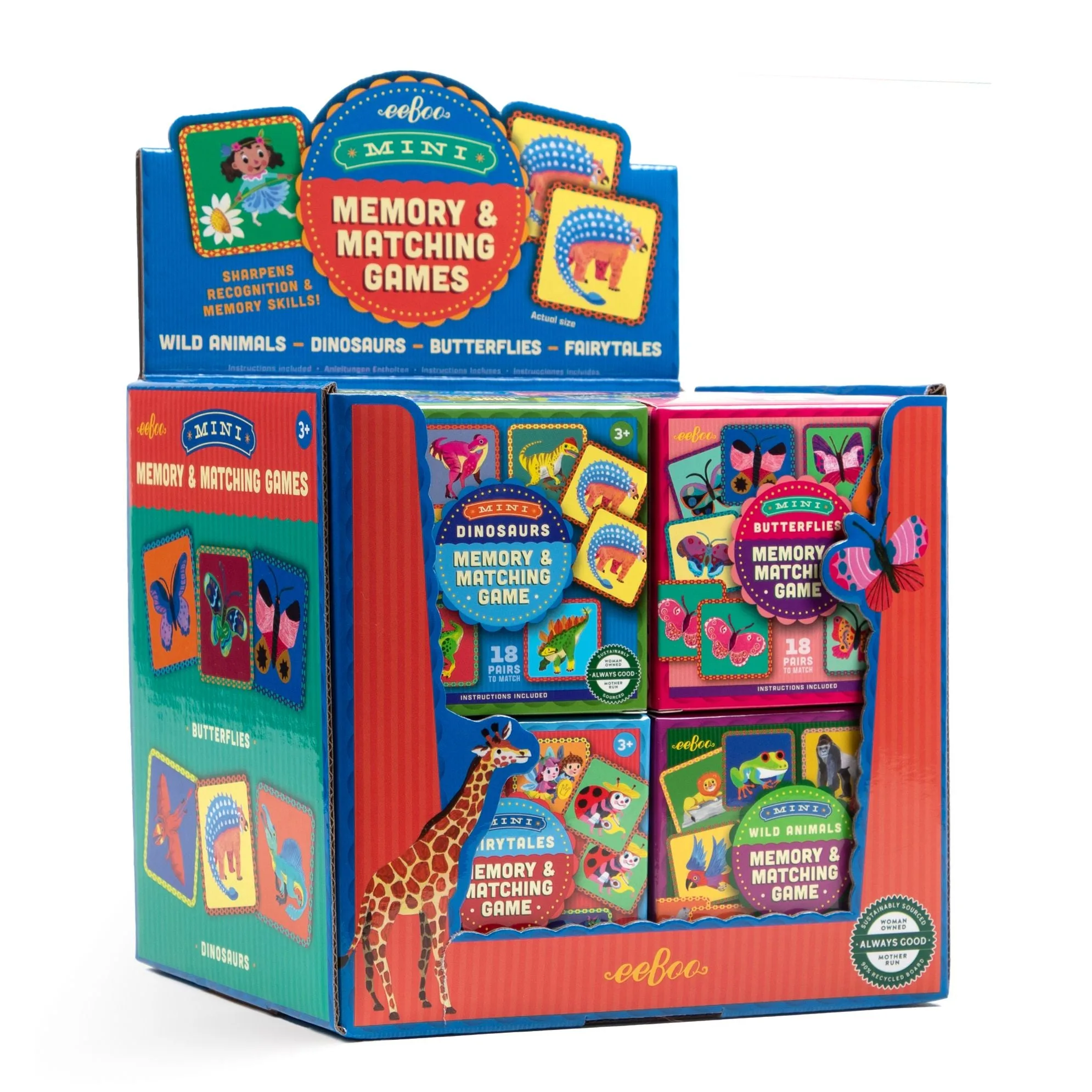
Mini Memory Game Assortment (16): The Mini Memory Game Assortment includes four mini matching games featuring Dinosaurs, Butterflies, Fairytales, and Wild Animals, illustrated by Linda Bleck and Monika Forsberg. This variety lets you pick a theme your toddler loves or rotate games to keep interest high.
Mini Memory Game Assortment (16)
-
Mini Memory Game Assortment (16): Each set challenges the player to find the 18 matching pairs, and the assortment includes 16 mini games total. The 18 pairs per set may be too many for a beginner, but you can start with fewer pairs and scale up as your toddler's memory improves.
Who is this game for?
Best for
- Parents looking for a portable, travel-friendly memory game for toddlers
- Families who want a variety of themes in one purchase to keep toddlers engaged
Not for
- Toddlers under 2 who might put small cards in their mouths
- Those seeking a single, large-format memory game with oversized cards