Quick answer
Choose your veil after the dress, not before. Start with the gown's neckline and back detail, then match veil length to the train, lace style to the dress fabric, and tulle weight to the season and venue. A veil should frame the dress, not compete with it.
A veil is the one accessory that changes how your wedding dress reads in photos, in motion, and in person. The right one adds romance without hiding the details you paid for; the wrong one fights the gown's lines, covers its back, or feels heavy all day.
This guide walks you through a practical order of decisions, from neckline to hem, so you can shop with confidence instead of guessing. Along the way, you'll see how real veil styles like the Brigette French lace mantilla cathedral veil and the Heirloom blusher sheer Firm Silk Tulle veil solve different dress problems.
Step 1: Read the dress before you shop for a veil
Before browsing, note three things about your gown: the neckline, the back, and the train. A high neck or illusion back needs a sheer veil that lets those details show through, while a strapless or sweetheart gown can carry more lace at the edge. The train length tells you how far the veil can fall without puddling or competing.
Checkpoint: if you can't describe your dress's back in one sentence, you don't know it well enough to choose a veil yet. Take a photo of the back and front, and bring both to your appointment.
- Write down neckline, back style, and train length before you look at veils.
- If your dress has a dramatic back, prioritize sheer tulle over dense lace.
Step 2: Match veil length to your train and height
Veil length should relate to your train, not just your taste. A cathedral veil can extend past a cathedral train for a dramatic sweep, while a chapel or fingertip veil keeps the focus on a shorter gown. If you are petite, a very long veil can visually shorten you unless it is sheer and light.
The Heirloom blusher sheer Firm Silk Tulle veil in Ivory is a useful reference point: it is a cathedral-length 108-inch veil with a 30-inch blusher, made from fine silk tulle with a raw edge. That combination gives delicate coverage while still showing off gown details, which matters if your dress has lace or beading you want visible.
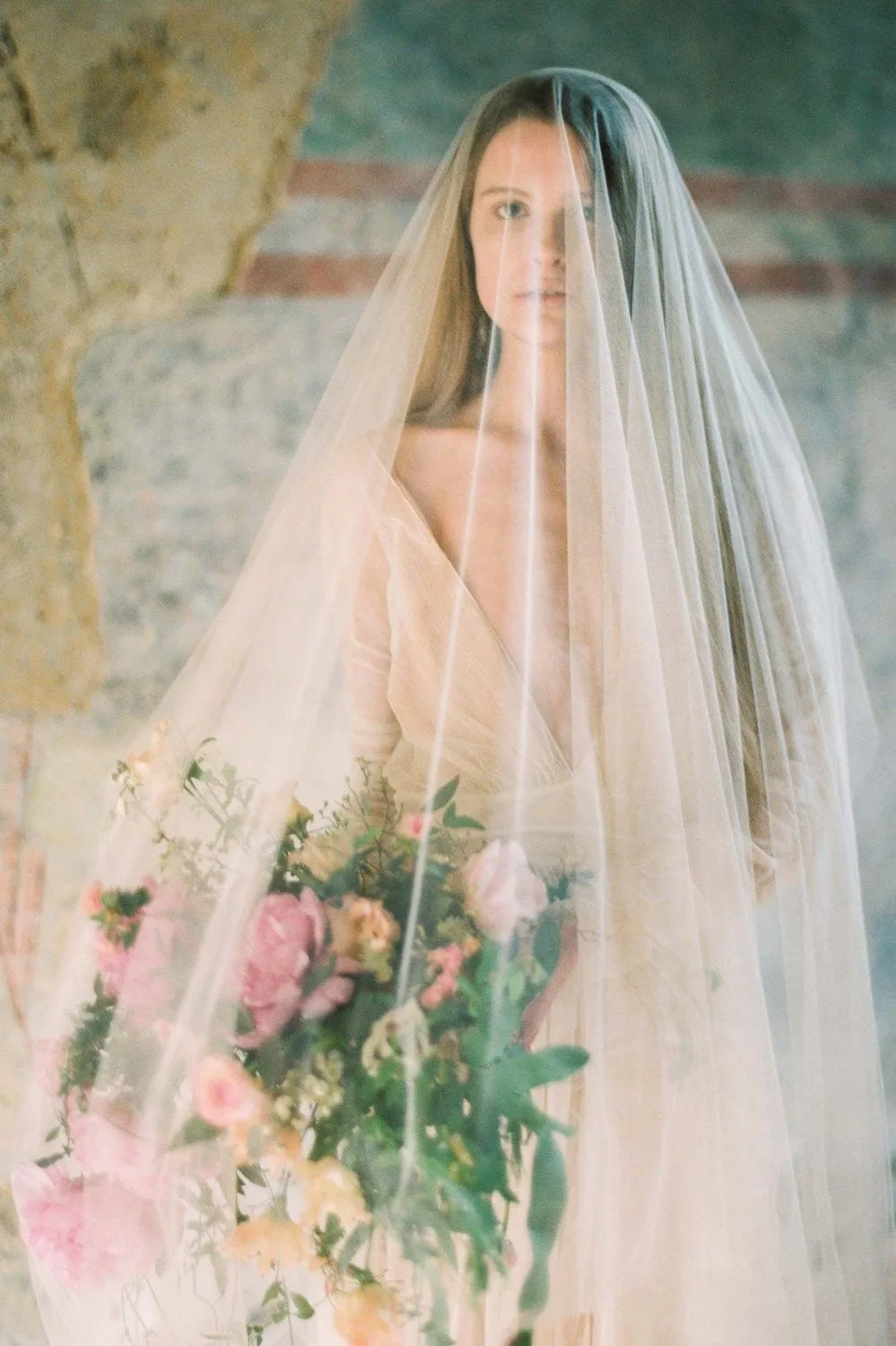
Heirloom blusher sheer Firm Silk Tulle veil in Ivory
- Cathedral veils suit cathedral and chapel trains; fingertip veils suit tea-length and sheath gowns.
- A blusher adds tradition but can cover your face in photos, so decide if you want it lifted or removed for the ceremony.
Step 3: Choose lace or tulle based on your dress fabric
Lace veil matching is about scale and placement, not just color. If your gown is heavily embroidered, a lace-edged veil can echo the motif; if your gown is clean satin or crepe, a lace veil may be the only texture you need. Sheer tulle veils are the safest pairing because they add volume without adding pattern.
A mantilla-style veil like the Brigette French lace mantilla cathedral veil in Off white uses soft Italian tulle finished with delicate French lace. That structure drapes beautifully and adds romance without overwhelming a gown, which is why it works for both modern and traditional dresses.
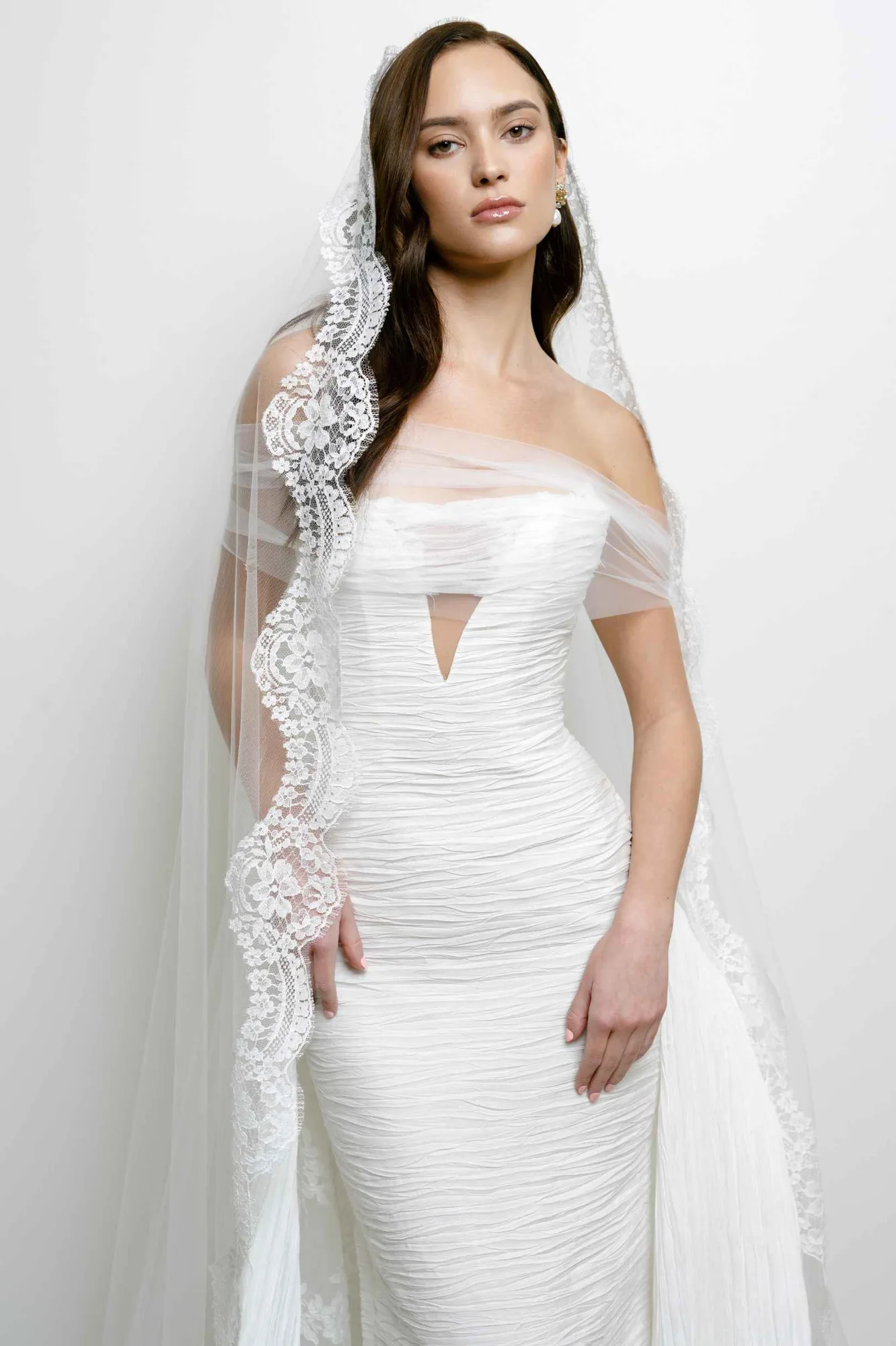
Brigette French lace mantilla cathedral veil in Off white
- Match lace scale: fine lace for delicate gowns, bolder lace for structured gowns.
- If your dress already has a lace bodice, consider a plain tulle veil to avoid pattern overload.
Step 4: Test the veil with your hairstyle and accessories
The veil attaches at the comb, so your hairstyle decides how it sits. Updos can support a heavier veil and a higher placement; loose hair often works better with a lightweight veil and a lower comb. If you plan to wear a bridal jacket or cover-up, check that the veil doesn't bunch at the shoulders.
Checkpoint: bring your hair clip, earrings, and any cover-up to the fitting. A veil that looks perfect alone can clash with a high-neck lace jacket or a statement earring.
- Place the comb where your hairstyle is strongest, not where the veil is heaviest.
- If you wear a bridal jacket, choose a veil that sits below or above the collar line.
Step 5: Confirm color, care, and timing before you commit
Veil color should relate to your dress, not your skin tone alone. Ivory, off white, and blush read differently against white, ivory, and blush gowns, and lighting at your venue changes them again. Ask for a fabric swatch or photo in daylight before ordering.
Also confirm production time and care. Handmade veils may need extra weeks, and silk tulle needs gentle handling. If you are ordering close to the date, ask what is ready to ship rather than assuming every style is in stock.
- Compare veil and dress fabrics in daylight, not just under fitting-room lights.
- Ask whether the veil is ready to ship or made to order before you set your timeline.
Your veil decision checklist
- Photograph your dress front and back: Note the neckline, back detail, and train length before you shop. This prevents you from falling for a veil that covers the details you love. If you can't describe your dress back in one sentence, review it again before buying.
- Set a length range based on your train: Match veil length to train length and your height. Cathedral veils suit long trains; fingertip and chapel veils suit shorter or cleaner gowns. A veil that ends at an awkward point on your train will distract in photos.
- Choose lace or tulle by dress texture: Use lace to echo embroidery or add romance to a plain gown. Use sheer tulle to add volume without pattern. If your dress is heavily patterned, a plain tulle veil is usually the safer pairing.
- Test with hair, jewelry, and cover-up: Attach the veil with your planned hairstyle and accessories. Check that it doesn't bunch at the shoulders if you wear a jacket or wrap. A veil that works alone can still clash with a high-neck jacket or large earrings.
- Confirm color and timeline in daylight: Compare veil and dress fabrics in daylight, and ask whether the veil is ready to ship or made to order. Ordering late limits your options; ready-to-ship styles are the safer choice close to the date.
Veil styles worth knowing
- Brigette French lace mantilla cathedral veil in Off white: Crafted from soft Italian tulle and finished with delicate French lace; handmade in the USA. The soft tulle and lace edge drape gracefully and complement a gown without hiding its details, making it a strong choice for both modern and traditional dresses.
- Heirloom blusher sheer Firm Silk Tulle veil in Ivory: A sweeping blusher veil made from fine silk tulle with a raw edge and a blusher; cathedral length 108 inches with a 30-inch blusher; 100% silk tulle imported from Europe. The sheer silk tulle adds delicate coverage while showing off gown details, and the blusher gives you a traditional option you can lift or remove for photos.
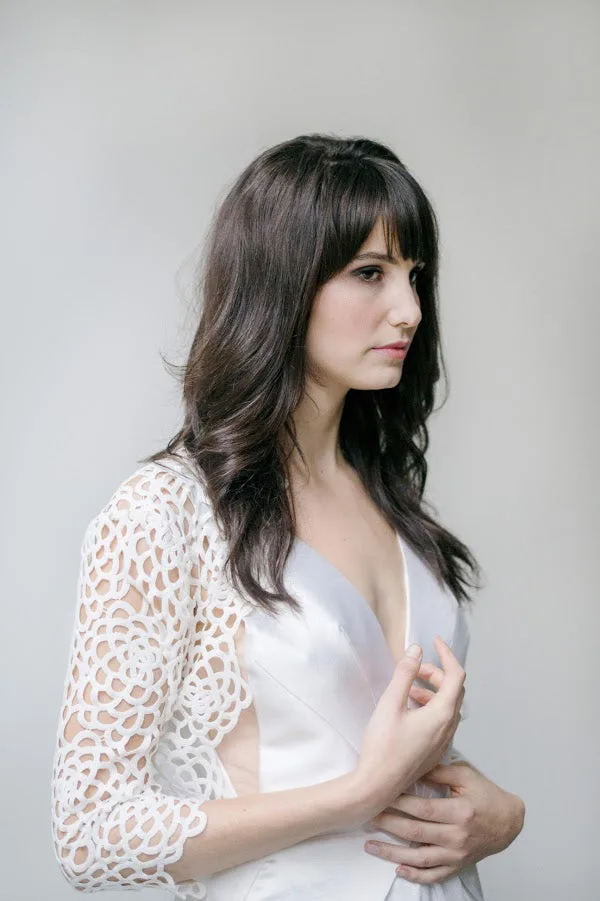
- Loop Loop lace bridal jacket (customized: full shirt, high neck, 3/4 sleeves): Designed in Italian Guipure lace with Loop rose embroidery, high neck, 3/4 sleeves, and scalloped edges; size S/M is ready to ship in Black and Ivory and fits bust up to 37 inches. If you plan to wear a lace jacket over your gown, choose a veil that sits above or below the collar so the two pieces don't compete at the neckline.
Choosing a veil is a sequence, not a single guess. Start with the dress, match length and fabric, test it with your hair and accessories, and confirm color and timing before you commit. Done in that order, the veil will frame your gown instead of covering it.