Quick answer
Choose a carbon fiber tripod that supports your spotting scope's weight, extends high enough for comfortable viewing, folds compact for travel, and offers a stable head. The Vanguard VEO 3+ 303CBS is a top choice for its multi-angle column and 25kg load capacity.
Why carbon fiber for spotting scopes?
Carbon fiber tripods are lighter than aluminum models, making them easier to carry on long hikes or birding trips. They also dampen vibrations better, which is critical when you're trying to hold a steady image at high magnification. The trade-off is cost: carbon fiber tripods typically cost more than aluminum equivalents.
Key specs to compare
Load capacity must exceed the weight of your spotting scope and head combined. A tripod rated for at least 5kg is usually safe for most scopes, but heavier scopes need more. Maximum height should let you view without stooping. Folded length matters if you pack the tripod in a backpack or carry-on.
How to choose a carbon fiber tripod for your spotting scope
- Check the load capacity: Add the weight of your spotting scope and head. Choose a tripod rated for at least 1.5 times that total. For a typical 2kg scope, a 3.5kg tripod like the Vanguard Vesta 233AP works, but a 25kg-rated model like the VEO 3+ 303CBS gives far more stability and future-proofing. Common mistake: buying a tripod that barely supports the scope, leading to shake at high magnification.
- Measure the maximum height: Stand naturally and measure from the ground to your eye. The tripod's maximum height should be close to that measurement without raising the center column. The VEO 3+ 303CBS extends to 165cm, which suits most average-height users. Checkpoint: using the center column fully extended reduces stability; aim for a tripod that reaches your eye height with the column partly lowered.
- Consider folded length and weight: If you hike or fly with your gear, look for a tripod that folds under 70cm and weighs under 2kg. The VEO 3+ 303CBS folds to 67cm and includes a padded bag for travel. Aluminum tripods are heavier for the same size. Common mistake: choosing a tripod that is too long to fit in a carry-on or too heavy to carry all day.
- Choose the right head: For spotting scopes, a fluid pan head or a ball head with separate panning knobs works well. The VEO 3+ 303CBS includes an Arca-compatible ball head with two 360° panning knobs, which gives smooth tracking. A 3-way head is also an option but can be slower to adjust. Checkpoint: ensure the head has a quick-release plate compatible with your scope's foot or adapter.
- Test the leg locks and center column: Twist locks are faster to operate and less likely to snag on gear than flip locks. A multi-angle center column, like the 360° column on the VEO 3+ 303CBS, lets you shoot at low angles without spreading the legs wide. This is useful for ground-level wildlife or macro work. Common mistake: ignoring the center column design, which can limit creative angles or add instability.
Products mentioned
-
Vanguard VEO 3+ 303CBS Carbon Fiber Tripod with BH-250S Ball Head: Extends to 165cm, folds to 67cm, and supports 25kg load capacity. This gives you a tall, stable platform that still packs small enough for travel.
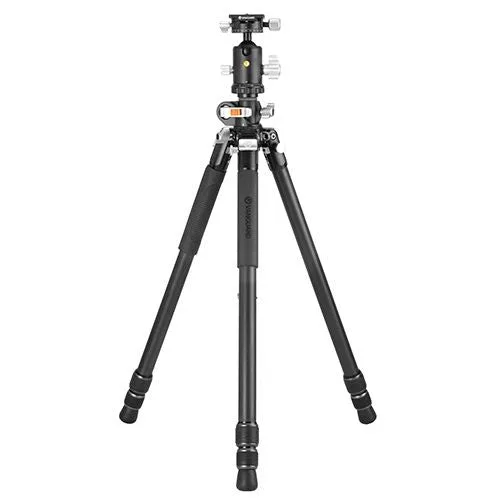
Vanguard VEO 3+ 303CBS Carbon Fiber Tripod with BH-250S Ball Head
-
Vanguard Vesta 233AP Aluminium Tripod with PH-23 Pan Head: Supports up to 3.5kg load and has anti-slip rubber feet for uneven terrain. It's a budget-friendly aluminum option for lighter scopes, but the lower capacity may not suit heavier glass.
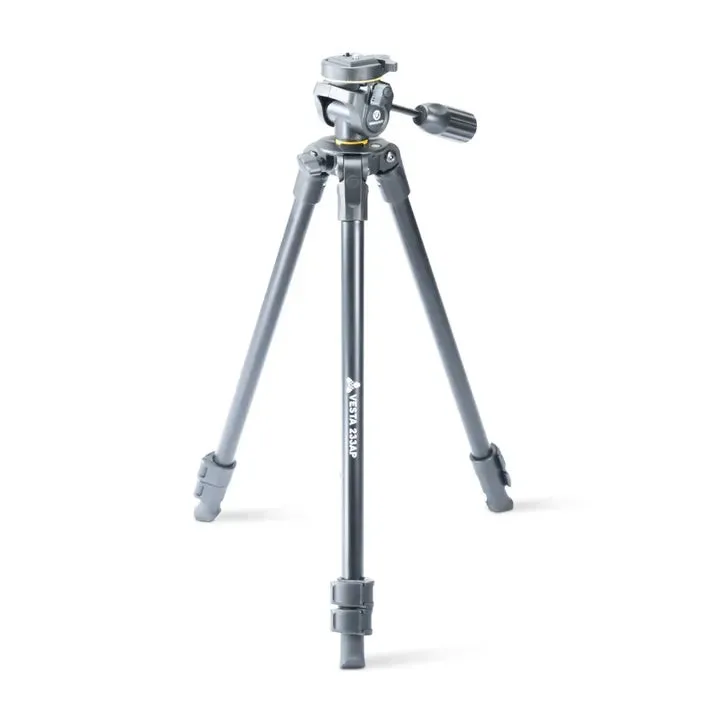
Vanguard Vesta 233AP Aluminium Tripod with PH-23 Pan Head