Quick answer
For most color darkroom work, choose a resin-coated RA-4 paper like ADOX Color Mission for its glossy finish, consistent quality, and compatibility with both tray and minilab processing.
Surface and finish: why gloss matters
The surface of your paper affects how colors appear and how the print is viewed. Glossy resin-coated paper delivers the widest tonal range and highest perceived saturation, making it a favorite for color work where you want vivid, punchy prints.
Matte or textured papers reduce glare but can soften highlights and make colors look less vibrant. If you plan to frame prints under glass, glossy can cause reflections, but it still offers the most 'classic' photographic look.
Size and quantity: matching your output
RA-4 paper comes in a range of sizes and sheet counts. Smaller sizes like 5x7 or 8x10 are ideal for test prints, proof sheets, or small portfolios. Larger sizes like 12x16 or 20x24 suit exhibition prints or work that you intend to mat and frame.
Buying in bulk (100-sheet boxes) lowers the cost per sheet, but only makes sense if you print regularly. If you are just starting out, a smaller pack lets you test the paper without a big commitment.
Processing: tray versus minilab
RA-4 paper is designed for chemical processing, either in trays or in automated minilab machines. Not all papers handle both equally well. ADOX Color Mission is explicitly designed for both traditional tray processing and minilab workflows, giving you flexibility.
If you process in trays, you need precise temperature and time control. If you use a minilab, the paper must feed reliably and produce consistent results across long runs. Check the paper's specifications to confirm it suits your equipment.
Decision rules for choosing RA-4 paper
- Surface: Choose glossy resin-coated paper for maximum color saturation and sharpness; choose matte only if you need to reduce glare for display under glass. Glossy is the default for color; matte is the exception.
- Size: Start with 8x10 for test prints and small work; move to 12x16 or 20x24 for larger display prints. Buy 5x7 for proof sheets or contact prints. Match sheet size to your intended output; larger sizes cost more per sheet.
- Processing method: If you tray process, confirm the paper works at the temperatures you can maintain. If you use a minilab, choose paper rated for that workflow, like ADOX Color Mission. Verify the paper's processing compatibility before buying.
- Quantity: Buy 100-sheet boxes only if you print regularly; otherwise, choose a smaller pack to test without overspending. Quantity should follow your printing frequency.
Product facts: ADOX Color Mission RA-4 paper
-
ADOX Color Mission RA-4 Paper High Gloss Resin Coated 8 x 10in 100 Sheets: ADOX Color Mission RA-4 Paper High Gloss Resin Coated 8 x 10in 100 Sheets is produced from genuine master rolls and cut in Germany to professional lab standards. This size is a practical choice for test prints and small portfolios, and the 100-sheet box offers a lower cost per sheet for regular printing.
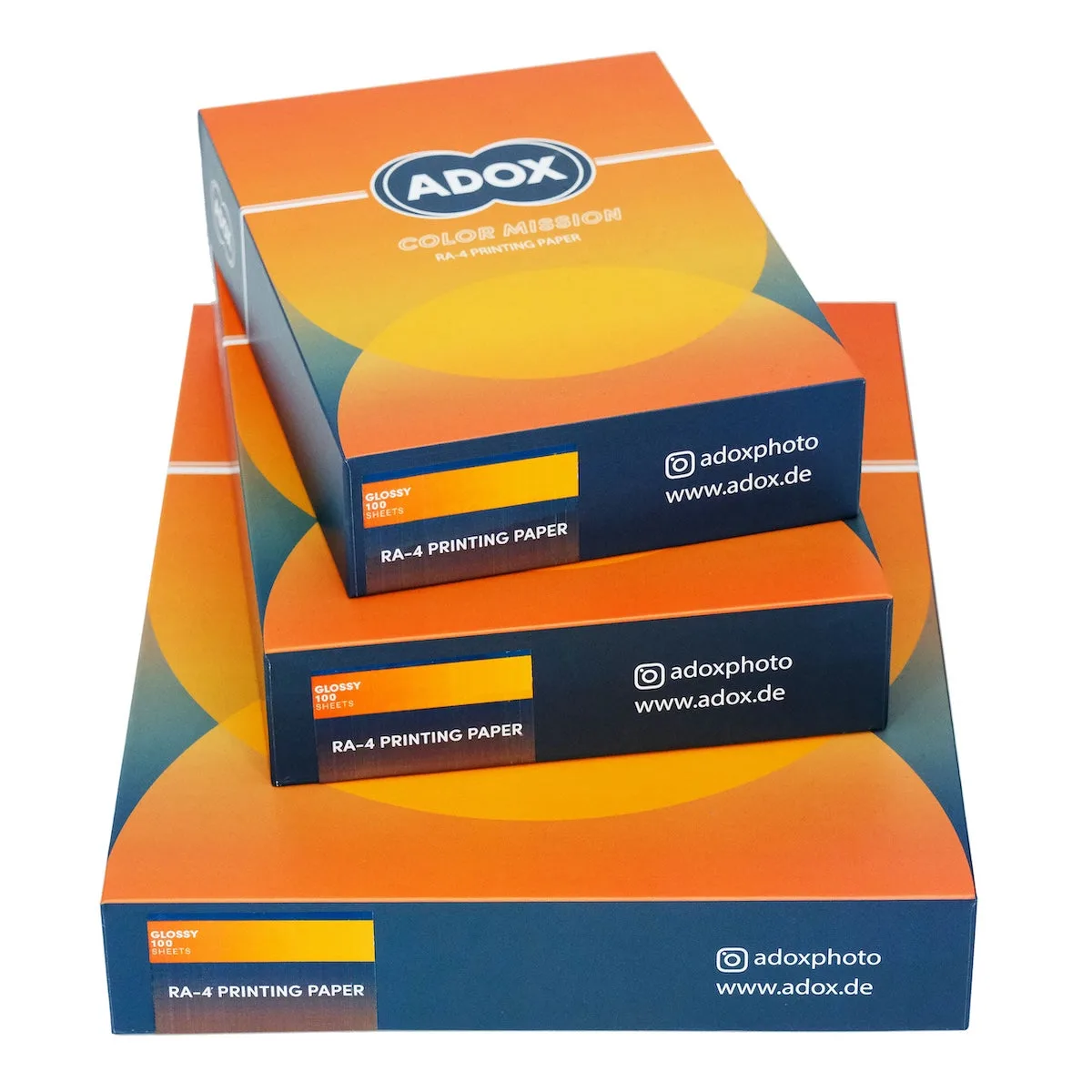
ADOX Color Mission RA-4 Paper High Gloss Resin Coated 8 x 10in 100 Sheets
-
ADOX Color Mission RA-4 Paper High Gloss Resin Coated 12 x 16in 50 Sheets: ADOX Color Mission RA-4 Paper High Gloss Resin Coated 12 x 16in 50 Sheets is designed for both traditional tray processing and minilab workflows, delivering clean whites and strong color saturation. This mid-size format suits exhibition prints that you might mat or frame, and its dual-process compatibility fits both home darkrooms and lab settings.
ADOX Color Mission RA-4 Paper High Gloss Resin Coated 12 x 16in 50 Sheets
Who is this paper for?
Best for
- Color darkroom printers who want vivid, glossy prints with a classic look.
- Photographers who process in trays or use a minilab and want a paper that works in both.
Not for
- Printers who need a matte or textured surface to reduce glare in framed displays.
- Those who rarely print and would be better served by a smaller pack to test.