Quick answer
Measure your room and the furniture the rug must anchor before you shop. In a living room, a rug should sit under the front legs of all main seating; in a bedroom, it should extend at least 18 to 24 inches beyond each side of the bed. For a dining table, add 24 inches of rug on every side so chairs stay on the rug when pulled out. Runners should leave 4 to 6 inches of floor visible on each side of a hallway.
Start with furniture, not floor dimensions
The most common sizing mistake is buying a rug that is too small because it was chosen by room dimensions alone. A rug works as an anchor: it should visually group the furniture sitting on it. Measure the footprint of your seating group or bed first, then add the overhang you want. For a sofa and two chairs, measure from the front of the sofa to the front of the chairs. That distance plus 6 to 12 inches on each side is your minimum rug width. For a bed, measure the bed width and add 36 to 48 inches total for a balanced overhang.
Living room rug placement: front legs or all legs
In a living room, the safest rule is to place the rug under the front legs of every main piece of seating. This makes the rug feel connected to the furniture instead of floating in the middle of the floor. If the room is large enough, place all legs of the sofa and chairs on the rug for a more generous look. Leave 12 to 18 inches of bare floor between the rug edge and the walls in a small room, or 18 to 24 inches in a larger room, so the space does not feel carpeted wall to wall. For an open-plan room, use the rug to define the seating zone and keep the dining zone on a separate rug or bare floor.
Bedroom rug size: beyond the bed
A bedroom rug should extend at least 18 to 24 inches beyond each side of the bed so you step onto softness when you get up. A common mistake is choosing a rug that only covers the foot of the bed; that size looks like a bath mat next to a queen or king bed. For a queen bed, a 5 by 8 foot rug can work if you place it under the lower two-thirds of the bed, but an 8 by 10 foot rug gives a more balanced look with nightstands. If you have a king bed, an 9 by 12 foot rug is usually the minimum for a full surround. If the rug will sit at the foot of the bed only, choose a runner or a small rectangle that is at least as wide as the bed frame.
Dining table rug dimensions: chairs must stay on
For a dining table, add 24 inches of rug on every side of the table so chairs remain on the rug when pulled out. This is the most important measurement in the room because a chair that catches on the rug edge is a daily annoyance. Measure your table, then add 48 inches to both the length and width. A 6-foot rectangular table needs a rug at least 8 by 10 feet; a round table that is 48 inches in diameter needs a round rug at least 8 feet in diameter. Leave at least 12 inches of bare floor between the rug edge and the wall so the rug does not look wall-to-wall. If the room is too small for those clearances, use a rug that sits entirely under the table and accept that chairs will come off the rug, or skip the rug in that room.
Runner rug size for hallways and kitchens
A runner should leave 4 to 6 inches of floor visible on each side of a hallway. In a kitchen, a runner should run parallel to the counter and leave 4 to 6 inches of floor on each side, and it should not extend past the ends of the counter. For a hallway, measure the width of the hallway and subtract 8 to 12 inches to get your runner width. Standard runner lengths are 6, 8, 10, and 12 feet; choose the longest length that leaves at least 4 inches of floor at each end. A common mistake is buying a runner that is too wide, which makes the hallway feel narrower and causes the edges to curl.
Check the pile height and material for the room
Pile height affects both comfort and clearance. A low-pile or flatweave rug is easier to clean and works well under dining tables and in high-traffic hallways because chairs and doors move over it without catching. A plush or high-pile rug feels softer underfoot in a bedroom or living room but can be harder to vacuum and may show vacuum marks. For rooms with pets or kids, a washable or low-pile rug is more practical. If you are layering a rug over carpet, choose a low-pile rug with a nonslip pad to prevent shifting. If you are placing a rug over a hard floor, a rug pad also adds cushioning and extends the life of the rug.
Step-by-step rug sizing process
- Measure the room and furniture footprint: Use a tape measure to record the room's length and width, then measure the width and depth of the main furniture group or bed. Write these numbers down before you shop. Checkpoint: if you do not have the furniture footprint, you cannot choose a rug size accurately.
- Decide the rug's job in the room: Choose whether the rug will anchor a seating group, sit under a bed, hold a dining set, or run through a hallway. Each job has a different overhang rule. Mistake to avoid: buying a rug that only covers the center of the room and leaves furniture half on and half off.
- Apply the overhang rule for that room: Living room: front legs of all seating on the rug. Bedroom: at least 18 to 24 inches beyond each side of the bed. Dining: 24 inches on every side of the table. Runner: 4 to 6 inches of floor on each side. Checkpoint: measure the rug's actual dimensions, not the nominal size, because sizes can vary by a few inches.
- Mark the rug size on the floor with tape: Use painter's tape to outline the rug's dimensions on the floor. Walk around the outline and pull out chairs to test clearances before you buy. Mistake to avoid: skipping the tape test and discovering the rug crowds the room after delivery.
- Choose pile height and material for the room's use: Pick low-pile or flatweave for dining rooms and hallways, and plush or high-pile for bedrooms and living rooms where softness matters more than easy cleaning. Checkpoint: if the rug will sit under a door, measure the door clearance and keep the pile height below it.
- Add a rug pad and test the final placement: Place a nonslip pad under the rug, then set the furniture back and check that the rug edges are straight and the overhang is even on both sides. Next step: if the rug slides or curls, a pad usually fixes it; if the size is wrong, return it before the room is fully set up.
Product facts to consider
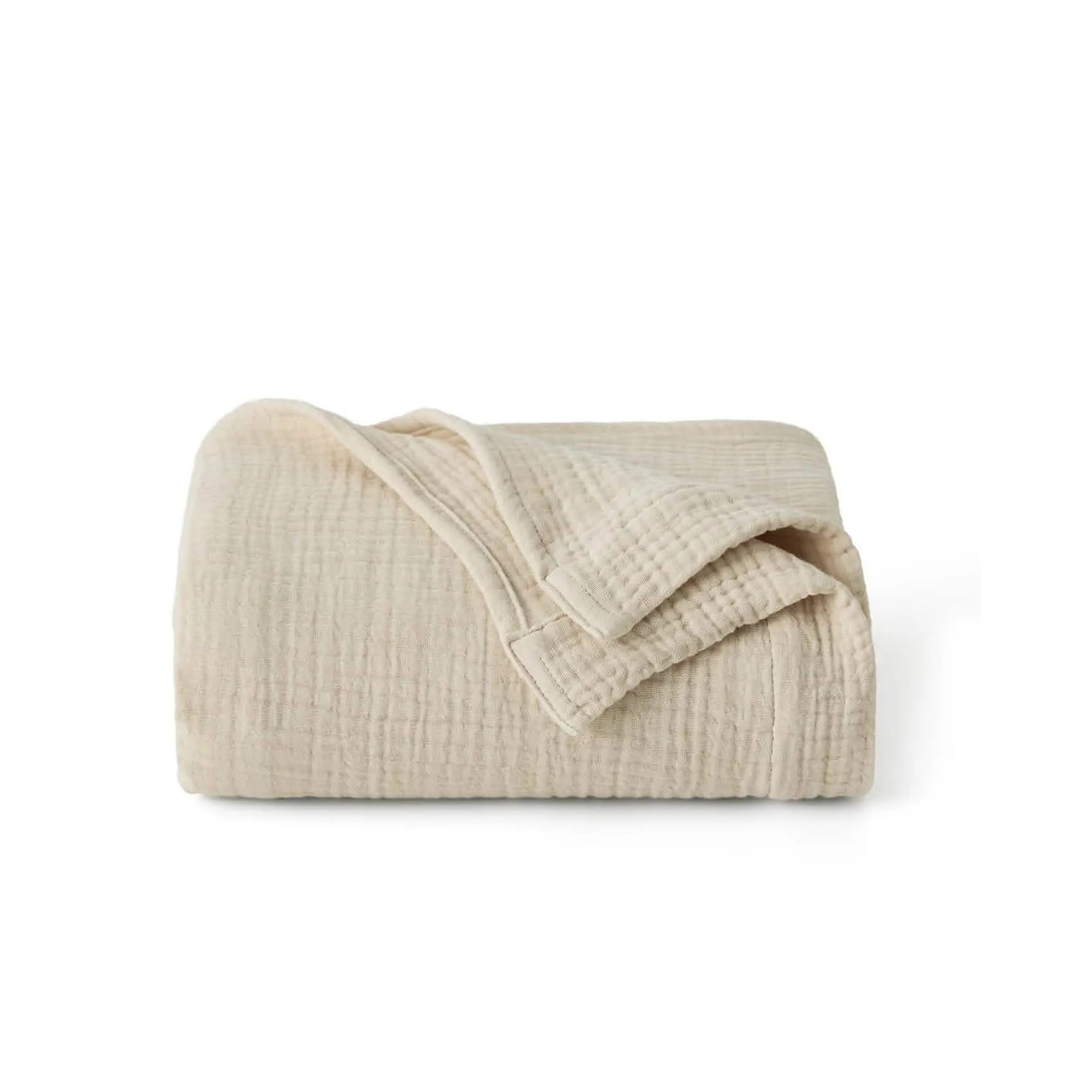
- 100% Cotton Gauze Spring Throw Blanket: 100% Cotton Gauze Spring Throw Blanket features a lightweight, airy jacquard muslin fabric with four-layer construction and anti-static cotton that grows softer with each wash. A breathable cotton throw can be used as a lightweight layer on a bed or sofa, and its anti-static cotton is a practical choice near a rug where you may sit on the floor.