Quick answer
Match the bowl's width to your dog's muzzle so their snout clears the rim without pressing against the sides, then match capacity to one meal plus about 20 percent headroom. Most small dogs do well with a bowl roughly 5 to 6 inches wide holding 1 to 2 cups, medium dogs around 7 to 8 inches holding 3 to 4 cups, and large dogs 9 inches or wider holding 5 cups or more. If your dog inhales food in under a minute, bowl design matters more than bowl size.
Bowl size is really two measurements: how wide the opening is and how much it holds. Width decides whether your dog can eat comfortably; capacity decides whether you're refilling mid-meal or leaving food sitting out. Get both wrong and you'll see the symptoms fast, from kibble scattered across the floor to a dog who walks away from a bowl that's technically full.
This guide walks through how to measure your dog, how to translate that into a bowl size, and when a different bowl design solves the problem better than a bigger bowl would. It also covers the cases where sizing up is the wrong move.
Measure your dog before you shop
You need two numbers. First, the width of your dog's muzzle at its widest point, measured with a soft tape or a piece of string you then lay against a ruler. Second, the volume of one meal in cups, which you can read off your food scoop or bag. A bowl opening should be noticeably wider than the muzzle so your dog isn't scraping their nose on the rim or pushing kibble out with their jaw.
For flat-faced breeds, muzzle width matters more than head size, since a wide head with a short snout needs a shallow, wide bowl rather than a deep one. For long-snouted dogs, depth is usually fine, but a bowl that's too narrow forces them to angle their head awkwardly to reach the bottom.
- Measure muzzle width at the widest point, not at the nose tip.
- Measure one meal in cups, not a full day of food.
- If your dog wears a collar tag that clinks against the rim, add an inch of width.
Translate muzzle width and meal volume into a bowl size
As a rough rule, the bowl opening should be at least 1.5 times your dog's muzzle width. A dog with a 3-inch muzzle is comfortable with a bowl around 5 inches wide; a dog with a 5-inch muzzle wants something closer to 8 inches. Capacity should cover one meal plus roughly 20 percent headroom so kibble doesn't spill over the edge as your dog eats.
That headroom matters more than people expect. A bowl filled to the brim invites spillage and makes it harder for your dog to pick up the last few pieces. Slightly under-filling a correctly sized bowl is easier on everyone than over-filling a bowl that's too small.
- Small dog bowl: roughly 5 to 6 inches wide, 1 to 2 cups.
- Medium: roughly 7 to 8 inches wide, 3 to 4 cups.
- Large: 9 inches or wider, 5 cups and up.
When bowl design beats bowl size
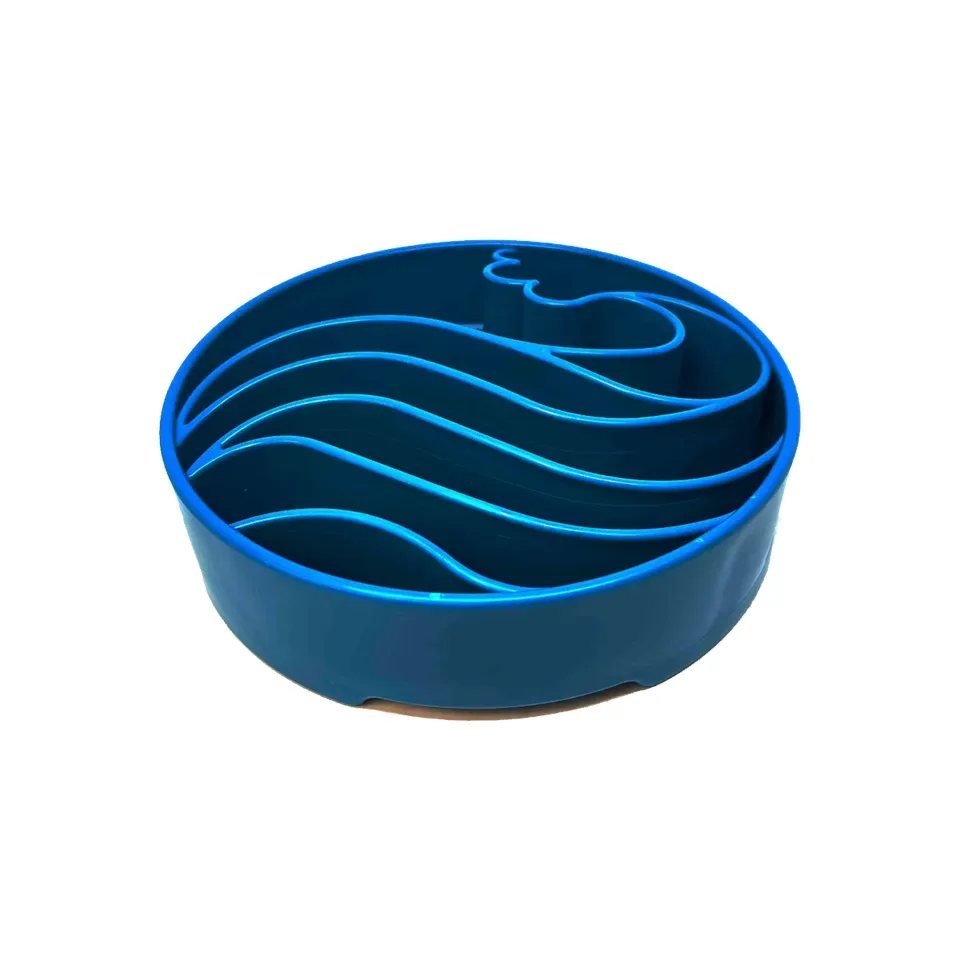
If your dog finishes a meal in under a minute, gulps air, or vomits shortly after eating, the problem isn't capacity. A slow feeder changes how food is presented rather than how much fits. The Wave Bowl Enrichment Slow Feeder Bowl uses a segmented design that's deliberately harder to navigate than a standard slow feeder, which lengthens the meal instead of just adding a single obstacle.
The tradeoff is real: a segmented bowl takes longer to clean than a smooth one, and some dogs get frustrated and walk away if the challenge is too steep at first. Start with a normal portion and give your dog a few meals to adjust before deciding it doesn't work.
- Choose a slow feeder for speed eating, not for a dog who eats at a normal pace.
- Keep a plain bowl on hand for water and for days when you need a fast meal.
Material, height, and other sizing-adjacent decisions
Material affects durability and noise more than size, but it interacts with sizing in one way: heavy ceramic and stoneware bowls are harder to tip, which matters for large dogs and enthusiastic eaters. Lightweight plastic is easier to knock around and can develop scratches that hold onto residue over time.
Height is a separate question from width. Raised bowls are sometimes recommended for large dogs or dogs with joint issues, but the evidence for routine elevation is mixed, so treat it as a comfort preference rather than a requirement. If you do elevate, keep the bowl at roughly chest height when your dog stands, and recheck as they grow.
- For puppies, buy for their adult size or plan to replace the bowl within a few months.
- Non-slip bases matter more than bowl width for dogs who push their bowl across the floor.
Decision rules for picking a bowl size
- If kibble ends up on the floor: The bowl opening is too narrow or too shallow for your dog's muzzle and eating style. Size up in width before you size up in depth.
- If your dog finishes in under a minute: Capacity isn't the bottleneck. A segmented slow feeder changes the pace of the meal. Fix the speed problem with design, not with a bigger bowl.
- If your dog leaves food behind: The bowl may be too deep for their snout, making the last portion hard to reach. Try a wider, shallower bowl before switching foods.
- If you're buying for a puppy: Adult size is unknown, and bowls are inexpensive relative to most dog gear. Buy for the size you expect at 12 months and replace if needed.
Product facts worth knowing
- NEW! Wave Bowl Enrichment Slow Feeder Bowl: The Wave Bowl uses a segmented design that is more difficult than other slow feeder bowls, intended to promote slower eating for dogs that eat too quickly. If your dog's issue is speed rather than portion size, this addresses the behavior directly instead of just holding more food.
- NEW! Tough Rubber Treat Holder & Chew Toy: This rubber treat holder works as both a treat dispenser and a chew toy, providing entertainment, mental stimulation, and oral health benefits. A useful companion to a slow feeder for dogs who need occupying during the day, not just at mealtime.
Who this sizing approach fits
Best for
- Owners of adult dogs who want one bowl that fits for years
- Owners of fast eaters who need a slow feeder sized to their dog's muzzle
- Owners replacing a bowl that spills, tips, or gets ignored
Not for
- Owners looking for a single bowl that works for a multi-dog household of very different sizes
- Dogs on a veterinarian-prescribed feeding plan where portion control is set by the vet, not by bowl capacity
Measure your dog's muzzle and one meal, then pick a bowl that clears both with a little room to spare. If speed eating is the real problem, a segmented slow feeder like the Wave Bowl will do more for your dog than any change in capacity.