Quick answer
The best quilting ruler for you depends on the shapes you cut most: a rectangular ruler handles strips and squaring up, while a specialty ruler like the 60-degree diamond ruler is essential for star and tumbling block patterns.
Why size matters more than you think
A ruler that is too small forces you to reposition constantly, introducing errors. A ruler that is too large can be unwieldy on small cuts. The most versatile size for beginners is a 6½ x 12½ inch rectangle—it handles strips, blocks, and trimming without being bulky.
For precut-friendly work, a 2½ x 12½ inch ruler is ideal for jelly roll strips, while a 2½ x 4½ inch ruler is perfect for charm squares and small rectangles. Match the ruler to your most frequent cut size.
Rectangular vs. specialty rulers: when to choose each
Rectangular rulers are workhorses: they square up blocks, cut strips, and trim units. A 6½ x 12½ inch rectangle is the most recommended starting point. Specialty rulers, like the 60-degree diamond ruler, unlock specific patterns—Lone Star, tumbling blocks, and diamond grids—that are nearly impossible to cut accurately with a straight ruler.
If you only make traditional block quilts, a rectangle is enough. If you love geometric or star patterns, invest in a diamond ruler.
Non-slip grip: a game changer for accuracy
All Creative Grids rulers come with a non-slip surface that holds fabric in place while cutting. This feature is especially valuable for beginners and for cutting slippery fabrics like satin or batiks. Without it, rulers can shift mid-cut, ruining your piece and wasting fabric.
If you are upgrading from a basic ruler, the non-slip grip alone justifies the switch.
How to choose: 3 decision rules
- Start with a rectangle that matches your most common cut: If you cut strips or square up blocks most often, a 6½ x 12½ inch ruler (like CGR612) is your best all-around choice. For jelly roll strips, add a 2½ x 12½ inch ruler (CGR212). For charm squares, a 2½ x 4½ inch ruler (CGR2545) is perfect. Buy a mid-size rectangle first, then add smaller or larger sizes as needed.
- Add a specialty ruler only when your pattern demands it: If your project uses 60-degree diamonds (Lone Star, tumbling blocks), a 60-degree diamond ruler (CGR60DIA) is non-negotiable. Do not buy it for standard patchwork. Specialty rulers are for specific patterns—not for general use.
- Always choose a ruler with a non-slip surface: All Creative Grids rulers have a non-slip coating that prevents slipping during cuts. This feature is critical for accuracy, especially for beginners or when cutting slippery fabrics. Non-slip grip is a must-have, not a luxury.
Rulers mentioned in this guide
-
Creative Grids Quilt Ruler 6-1/2in x 12-1/2in Rectangle – CGR612: 6-1/2" x 12-1/2" size — a true workhorse in any quilting room This size is the most versatile for cutting strips, squaring blocks, and trimming units, making it the ideal first ruler for any quilter.
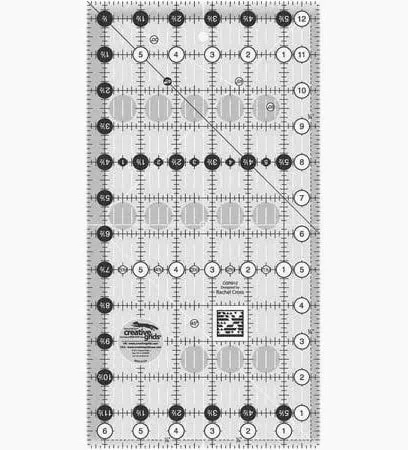
Creative Grids Quilt Ruler 6-1/2in x 12-1/2in Rectangle – CGR612
-
Creative Grids 60 Degree Diamond Ruler – CGR60DIA: Cuts accurate 60-degree diamond shapes for classic quilt patterns If you love Lone Star or tumbling block quilts, this ruler is essential—you cannot cut those shapes accurately with a standard rectangle.
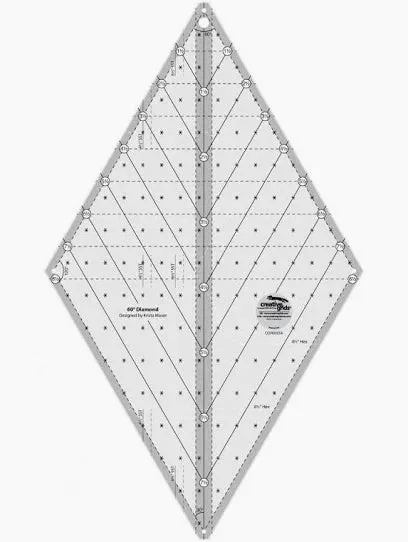
Creative Grids 60 Degree Diamond Ruler – CGR60DIA
Who this guide is for
Best for
- Beginners who need a versatile first ruler
- Quilters who mostly cut strips and square up blocks
- Anyone considering a specialty ruler for a specific pattern
Not for
- Quilters who already own a full set of rulers and know their needs
- Projects requiring only a long ruler for border cutting (consider a 24-inch ruler instead)