Quick answer
Choose a wireless audio receiver that matches your microphone system's frequency and connector type, mounts securely on your camera, and offers reliable range for your typical shooting distance.
Compatibility is the first filter
Not all wireless receivers work with every microphone. The receiver must operate on the same frequency band as your transmitter. Most consumer and prosumer systems use 2.4 GHz or UHF bands. Check your microphone system's specifications before buying a receiver. If you already own a RodeLink system, for example, the Rode RodeLink On-Camera Receiver is designed specifically for that ecosystem, ensuring seamless pairing and stable audio.
Mounting and form factor matter on a camera rig
An on-camera receiver should not block your camera's controls or HDMI port. Look for a low-profile design that attaches via the hot shoe or a cold shoe adapter. The Rode RodeLink On-Camera Receiver mounts directly onto your camera's hot shoe, keeping the setup compact and balanced. If your camera has a side-mounted hot shoe, verify that the receiver's antenna or body does not interfere with the flip-out screen.
Range vs. real-world use
Manufacturers often advertise maximum line-of-sight range, but walls, crowds, and radio interference reduce that significantly. For talking-head videos or interviews within 10–15 feet, most receivers work fine. For run-and-gun documentary work, look for a receiver with a rated range of at least 100 feet and a diversity antenna system to maintain signal stability.
Decision rules for choosing a wireless audio receiver
- Match the frequency band: Buy a receiver that operates on the same frequency as your transmitter (e.g., 2.4 GHz, UHF). Mismatched bands will not work at all.
- Check connector type: Most cameras use a 3.5 mm TRS input. Confirm the receiver outputs the correct plug. Some pro cameras use XLR; you may need an adapter or a different receiver model.
- Evaluate mounting options: A hot-shoe mount is standard, but verify your camera has a compatible shoe. If you use a cage, look for a receiver with a cold shoe or a 1/4-20 thread mount. Check your camera's shoe type (standard vs. proprietary) before purchasing.
- Consider range needs: For sit-down interviews, 50 ft of range is plenty. For events or run-and-gun, choose a receiver with at least 100 ft rated range and diversity antennas.
- Look for headphone monitoring: A headphone jack on the receiver lets you monitor audio in real time. This is critical for catching distortion or dropouts during recording.
Product facts
-
Rode RodeLink On-Camera Receiver: The Rode RodeLink On-Camera Receiver is a compact audio receiver designed for use with compatible wireless microphone systems and mounts directly onto your camera's hot shoe. If you own a RodeLink wireless mic system, this receiver ensures drop-in compatibility and a stable physical mount without extra brackets.
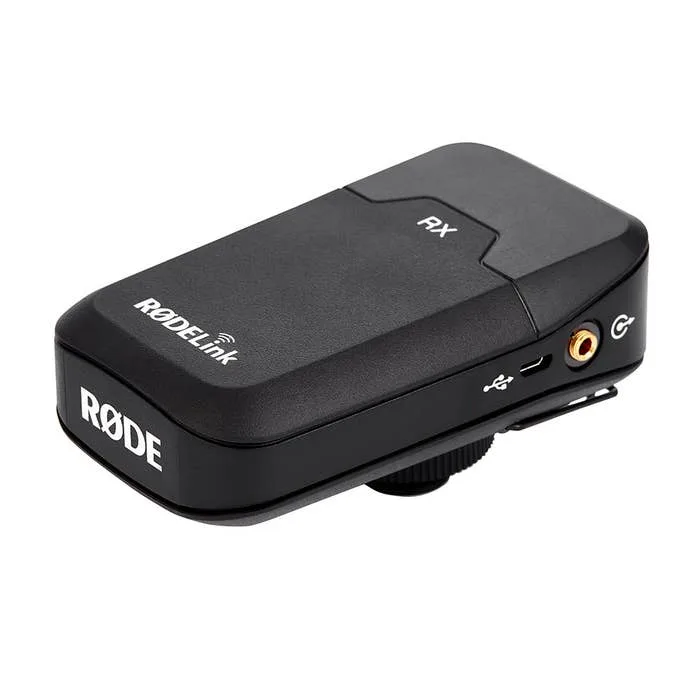
Rode RodeLink On-Camera Receiver
Who this is for
Best for
- Videographers who already own a RodeLink wireless mic system and need a dedicated on-camera receiver
- Solo shooters who want a compact, hot-shoe-mounted receiver for interviews and vlogs
Not for
- Users who need a receiver compatible with multiple mic brands (look for a universal receiver instead)
- Run-and-gun shooters requiring 300+ ft range (consider a UHF system with diversity antennas)