Quick answer
Focus on range, chime variety, volume control, and whether the RGB light works in silent mode. A model like the TECKNET Plug-in Wireless Doorbell offers a good balance of these features for most homes.
Why RGB lighting matters on a doorbell
An RGB light on a doorbell chime isn't just for looks. It can serve as a visual alert when you don't want sound—for example, during a baby's nap or a late-night work session. Some models let you set the light to flash silently, so you never miss a visitor even with the ringer off.
When choosing, check if the RGB light has a dedicated silent mode. Not all doorbells with colored lights offer this feature; some simply light up when the button is pressed, without the option to mute the chime.
Range and placement trade-offs
Wireless doorbells advertise a maximum range, but real-world performance depends on walls, metal objects, and interference. A 1300-foot range is typical for open-air scenarios; inside a house, expect less. If you have a large home or thick walls, look for a model that explicitly states a tested indoor range or has a strong signal.
Also consider whether the receiver plugs into an outlet or runs on batteries. Plug-in models avoid battery changes but limit placement to near an outlet. Battery-powered receivers offer more placement flexibility but need periodic replacement.
Chime selection and volume flexibility
A doorbell with 60 melodies gives you plenty of options to match your preference or avoid confusion with neighbors. Volume control is equally important—some models let you adjust from near-silent (0 dB) to loud (100 dB). A memory function that retains your settings after a power outage is a practical bonus.
If you live in a multi-story home or have hearing difficulties, prioritize models with higher maximum volume and multiple volume levels.
Decision rules for choosing a wireless doorbell with RGB lighting
- Rule 1: Prioritize silent-mode RGB: If you want the RGB light as a quiet alert, confirm the model has a dedicated silent mode where the light flashes but the chime stays off. Not all RGB doorbells include this. Check the product specs for 'silent mode' or 'mute with light' before buying.
- Rule 2: Match range to your home size: For a typical home under 2,000 sq ft, a 1300-foot open-air range is usually sufficient. For larger homes or multiple floors, look for models with a tested indoor range or consider a plug-in receiver for better signal stability. If your home has thick walls or metal framing, expect reduced range and choose accordingly.
- Rule 3: Choose chime variety and volume control: Select a doorbell with at least 10-20 chimes and adjustable volume. 60 chimes offer maximum flexibility. A memory function that saves your settings is a plus. Volume control from near-silent to 100 dB covers both quiet and noisy environments.
- Rule 4: Decide on power source for receiver: Plug-in receivers are maintenance-free but limit placement. Battery-powered receivers can go anywhere but need periodic battery changes. The TECKNET model is plug-in, so plan its location near an outlet. If you need the receiver in a hallway without an outlet, consider a battery-powered option instead.
Product spotlight
-
TECKNET Plug in Wireless Doorbell with RGB Lighting & 1300 Feet Range,IP66 Waterproof Door Bell for Home/Classroom,60 Chimes,5-Level Volume,4.5-Year Battery Life(White),FCC ID:YI6RL-33TX: The TECKNET Plug-in Wireless Doorbell has an RGB light indicator with silent mode—when muted, the light flashes to notify you without sound. This lets you see visitors without disturbing a sleeping baby or during quiet hours, a feature not all RGB doorbells offer.
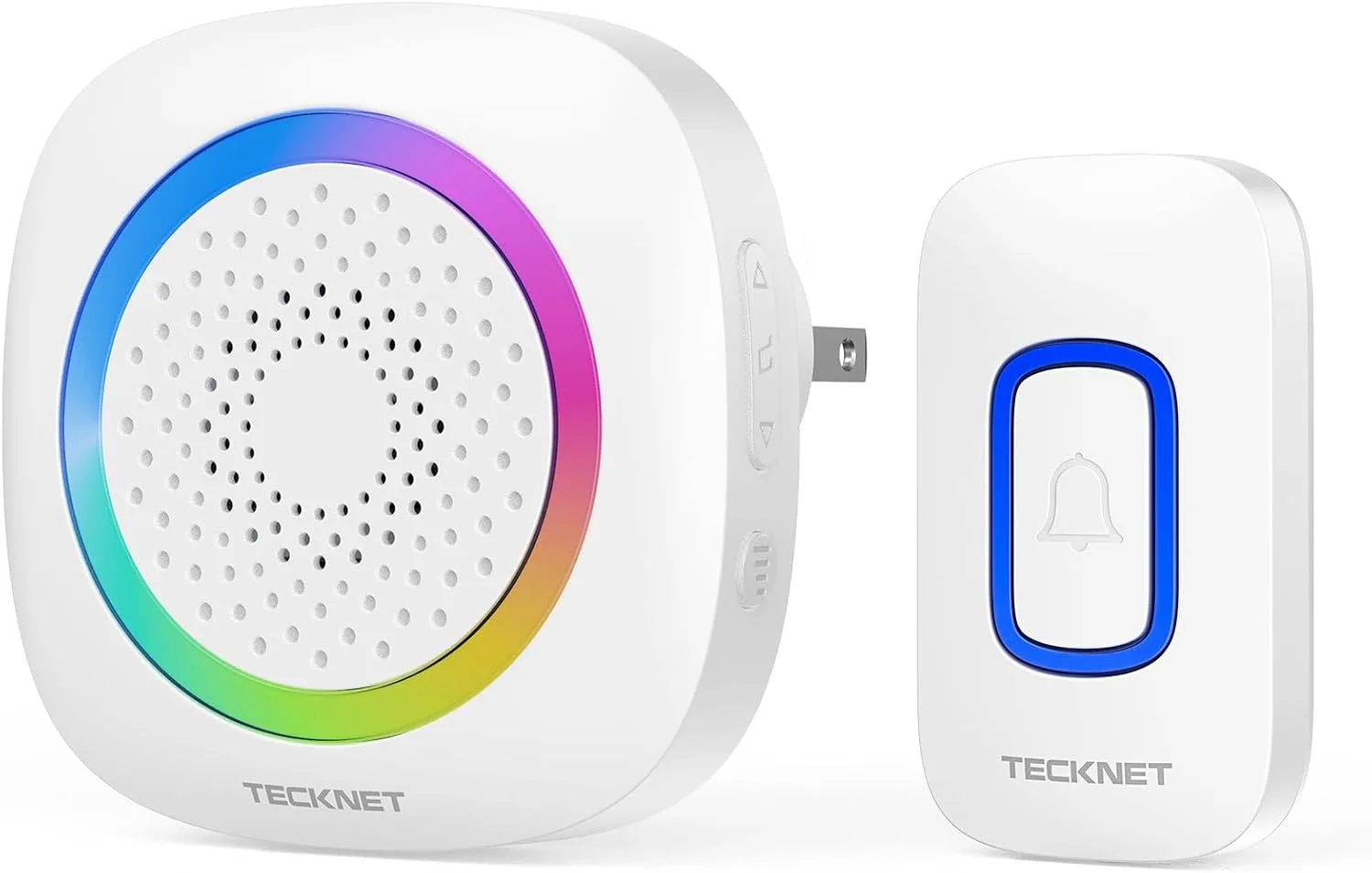
TECKNET Plug in Wireless Doorbell with RGB Lighting & 1300 Feet Range,IP66 Waterproof Door Bell for Home/Classroom,60 Chimes,5-Level Volume,4.5-Year Battery Life(White),FCC ID:YI6RL-33TX
-
TECKNET Plug in Wireless Doorbell with RGB Lighting & 1300 Feet Range,IP66 Waterproof Door Bell for Home/Classroom,60 Chimes,5-Level Volume,4.5-Year Battery Life(White),FCC ID:YI6RL-33TX: It offers 60 selectable melodies and volume from 0 dB to 100 dB with memory function. You can choose a chime that suits your home and adjust volume from silent to very loud, with the memory retaining your preference even after power loss.
-
TECKNET Plug in Wireless Doorbell with RGB Lighting & 1300 Feet Range,IP66 Waterproof Door Bell for Home/Classroom,60 Chimes,5-Level Volume,4.5-Year Battery Life(White),FCC ID:YI6RL-33TX: The receiver is plug-and-play and requires no batteries, while the button has a 4.5-year battery life. You avoid the hassle of changing receiver batteries, and the button's long battery life means less maintenance over time.
Who should buy this type of doorbell?
Best for
- Homeowners who want a visual alert for visitors without disturbing sleep or work
- Anyone looking for a plug-and-play doorbell with minimal maintenance and long button battery life
Not for
- Users who need a battery-powered receiver for flexible placement far from outlets
- Those who require a doorbell with a camera or two-way audio (this is a chime-only model)