Quick answer
Start with a soft, familiar character puppet, model simple movements and sounds, then let your toddler take the lead.
Why hand puppets work for toddlers
Hand puppets are a natural bridge between pretend play and real interaction. For a toddler, a puppet on your hand becomes a safe conversation partner—someone who listens, reacts, and never judges. This makes puppets ideal for building verbal skills, social confidence, and emotional understanding.
The key is to let the puppet be the star. Toddlers respond best when the puppet has a distinct voice or personality, and when play stays short and playful. Avoid over-directing or turning it into a lesson.
Choosing a first hand puppet
Look for a puppet that is soft, washable, and sized to fit both an adult hand and a small toddler hand. Familiar characters—like Mickey Mouse or Minnie Mouse—can instantly capture a toddler's attention because they already recognize the face.
Avoid puppets with small removable parts or hard plastic pieces. A simple open-mouth design allows the puppet to 'speak' and 'eat' during play, which toddlers find hilarious.
Steps to introduce hand puppets
- 1. Start with a warm-up: Sit face-to-face with your toddler and put the puppet on your hand. Let the puppet wave, say hello, and make a simple sound like a squeak or a giggle. Keep your own face visible so your toddler sees it's still you. Common mistake: hiding your face or using a complex voice. Toddlers may get confused or scared. Keep it simple and warm.
- 2. Let the puppet ask for interaction: Have the puppet ask a yes/no question ("Can I sit here?") or request a simple action ("Can you give me a high-five?"). Pause and wait for your toddler's response—even a look or a smile counts. If your toddler is shy, let the puppet offer a toy or give a gentle tickle. Never force a response.
- 3. Hand over control: After a few exchanges, offer the puppet to your toddler. Show them how to slip their hand inside (you may need to help hold the puppet open). Let them explore moving the mouth or waving. Don't correct how they hold or move it. Exploration is the goal. If they drop it or use it as a rag doll, that's fine.
- 4. Introduce simple puppet play scenarios: Use the puppet to act out a familiar routine: eating breakfast, going to sleep, or meeting a stuffed animal. Keep scenes under two minutes and end with the puppet saying goodbye or taking a nap. Common mistake: making the scene too long or complex. Toddlers lose focus quickly. Short, repeatable scenes work best.
- 5. Follow your toddler's lead: If your toddler starts using the puppet to talk to you, respond as the puppet instead of as yourself. If they want to put the puppet on your hand again, let them. The goal is shared enjoyment, not a performance. Resist the urge to quiz or teach. Puppet play builds language naturally through back-and-forth conversation.
Puppet to consider
-
Disney Mickey Mouse & Friends Soft & Cuddly Hand Puppets: The Disney Mickey Mouse & Friends Soft & Cuddly Hand Puppets set includes four 10-inch puppets (Mickey, Minnie, Donald, Goofy) made from super-soft, washable fabric that fits both kids and adults. Having multiple characters lets your toddler choose a favorite and gives you options for simple dialogues, keeping play fresh without buying more puppets.
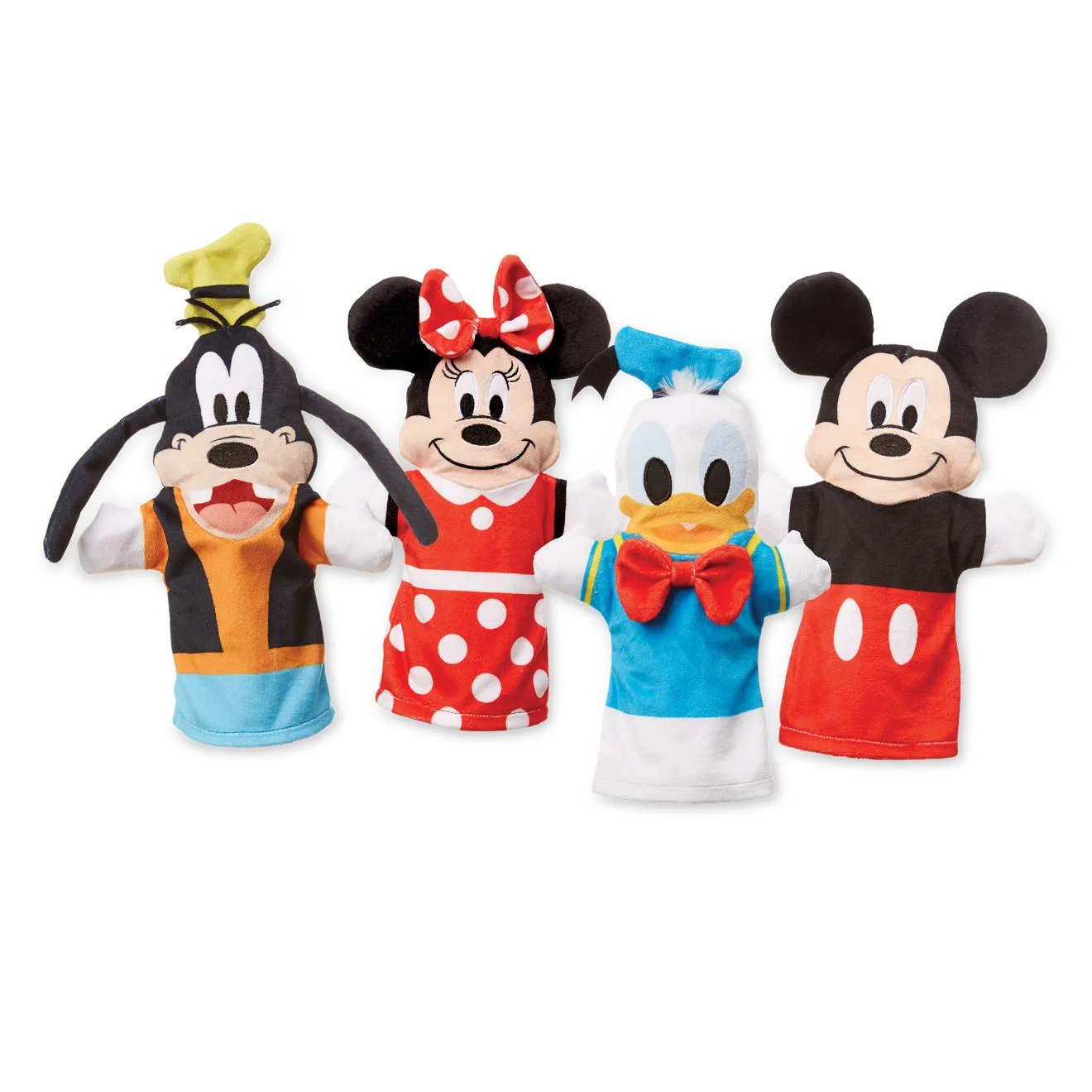
Disney Mickey Mouse & Friends Soft & Cuddly Hand Puppets