Quick Answer
Anti-Monopoly pits competitors against monopolists with different rule sets. Set up the board, assign roles, then follow the turn sequence to buy properties and force opponents into bankruptcy.
Why the Travel Tin Version Is Different
The Anti-Monopoly Game Travel Tin packs the full board game into a compact case, making it ideal for trips and family vacations. Despite the smaller size, all the core mechanics remain intact, including the asymmetric rules for competitors and monopolists.
One trade-off: the travel tin uses smaller tokens and a folded board, which can be less comfortable for players with limited dexterity. However, the portability outweighs this for most travel scenarios.
Understanding the Two Roles
Before you start, players are divided into two groups: competitors and monopolists. This division is crucial because each group follows different rules during the game.
Competitors aim to operate in a free market, while monopolists seek to dominate through aggressive tactics. The rule differences create an engaging dynamic that mirrors real-world economic debates.
Step-by-Step Gameplay
- Setup and Role Assignment: Open the travel tin and unfold the board. Shuffle the Chance and Community Chest cards and place them on their designated spaces. Each player chooses a token and places it on GO. Divide players into competitors and monopolists as instructed by the rulebook, ensuring each player knows their role-specific rules. Common mistake: forgetting to review the role-specific rules before starting, which leads to confusion mid-game.
- Determine the Starting Player: Each player rolls the dice; the highest roll goes first. Play proceeds clockwise. The starting player rolls again to begin their turn. Ensure all players have a clear view of the board to avoid disputes over dice results.
- Take Your Turn: On your turn, roll the dice and move your token clockwise by the sum. Follow the instructions on the space you land on: buy unowned properties, pay rent on owned properties, draw cards, or follow role-specific actions. If you roll doubles, take another turn; three doubles in a row sends you to Jail. Checkpoint: Always verify rent amounts and role-specific advantages before paying or collecting to avoid errors.
- Buy Properties and Build: When you land on an unowned property, you may purchase it at the listed price. If you own all properties in a color group, you can build houses and hotels to increase rent. Monopolists may have different building rules, so consult the role-specific section of the rulebook. Common mistake: building too early without securing a full color group, which wastes resources.
- Handle Jail and Special Spaces: If you land on 'Go to Jail', move directly to Jail and do not collect your salary. While in Jail, you can pay a fine or roll doubles to get out. Follow the standard rules for Free Parking, Chance, and Community Chest. Checkpoint: Keep track of turns spent in Jail; after three failed attempts to roll doubles, you must pay the fine.
- Win the Game: The game ends when all but one player has gone bankrupt. The last player with money and assets wins. If you're playing with a time limit, the player with the highest net worth at the deadline wins. Common mistake: forgetting to count assets (properties, houses, and cash) when determining the winner under time constraints.
Product Spotlight
-
Anti-Monopoly Game Travel Tin: Anti-Monopoly is an update of the monopoly folk game invented by Elizabeth Magie 100 years ago, offering a twist straight from today's headlines: free market competitors clash with ruthless monopolists. This historical and thematic background explains why the game includes two distinct rule sets, adding depth and replay value beyond a standard property-trading game.
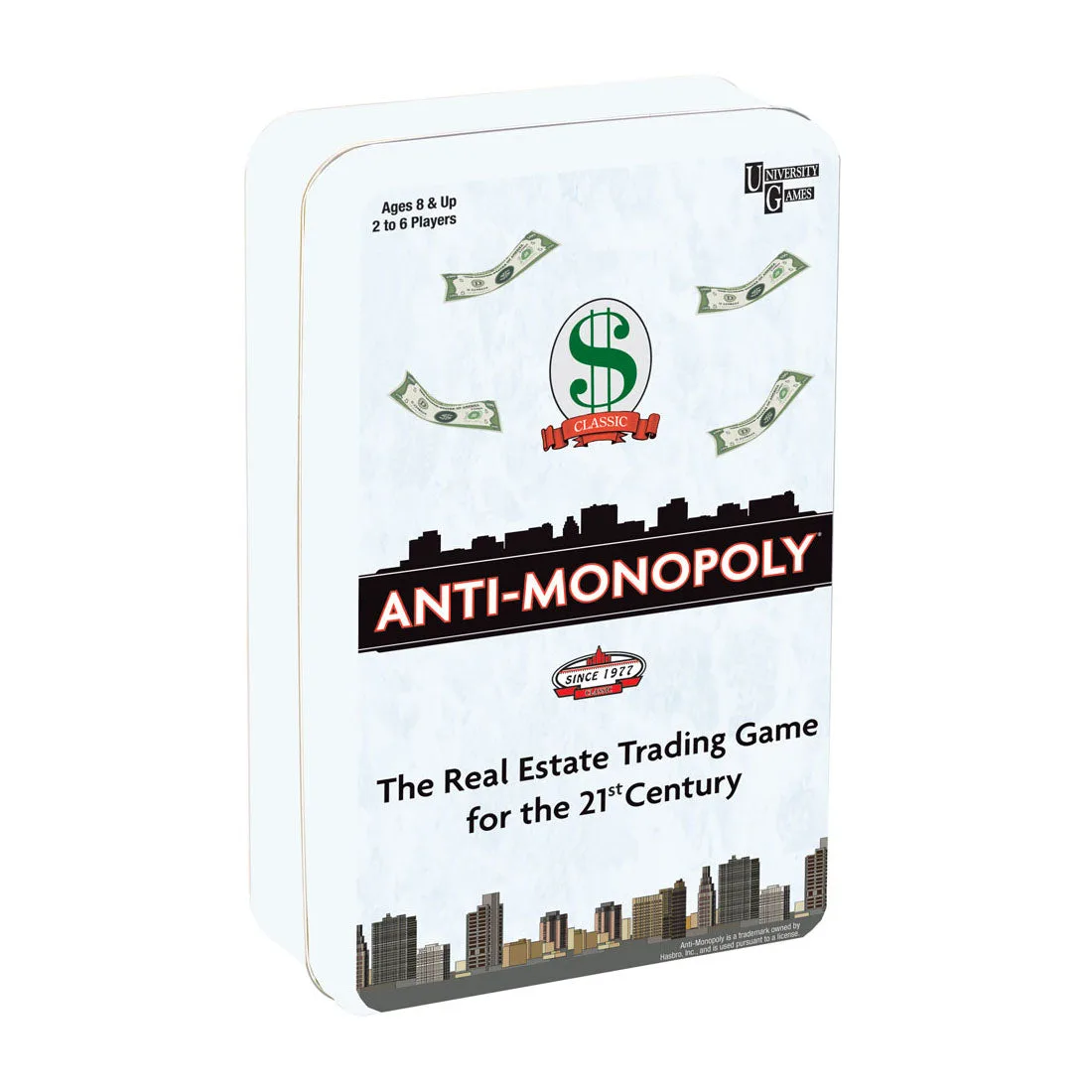
Anti-Monopoly Game Travel Tin