Quick answer
Azul is a tile-drafting game for 2–4 players. On each turn you take all tiles of one color from a factory display or from the center, then place them on one row of your player board. The round ends when all tiles are gone, and you score points for tiles that reach your wall. After five or six rounds, the player with the most points wins. The core skill is refusing tiles you cannot place well, so plan your rows before you draft.
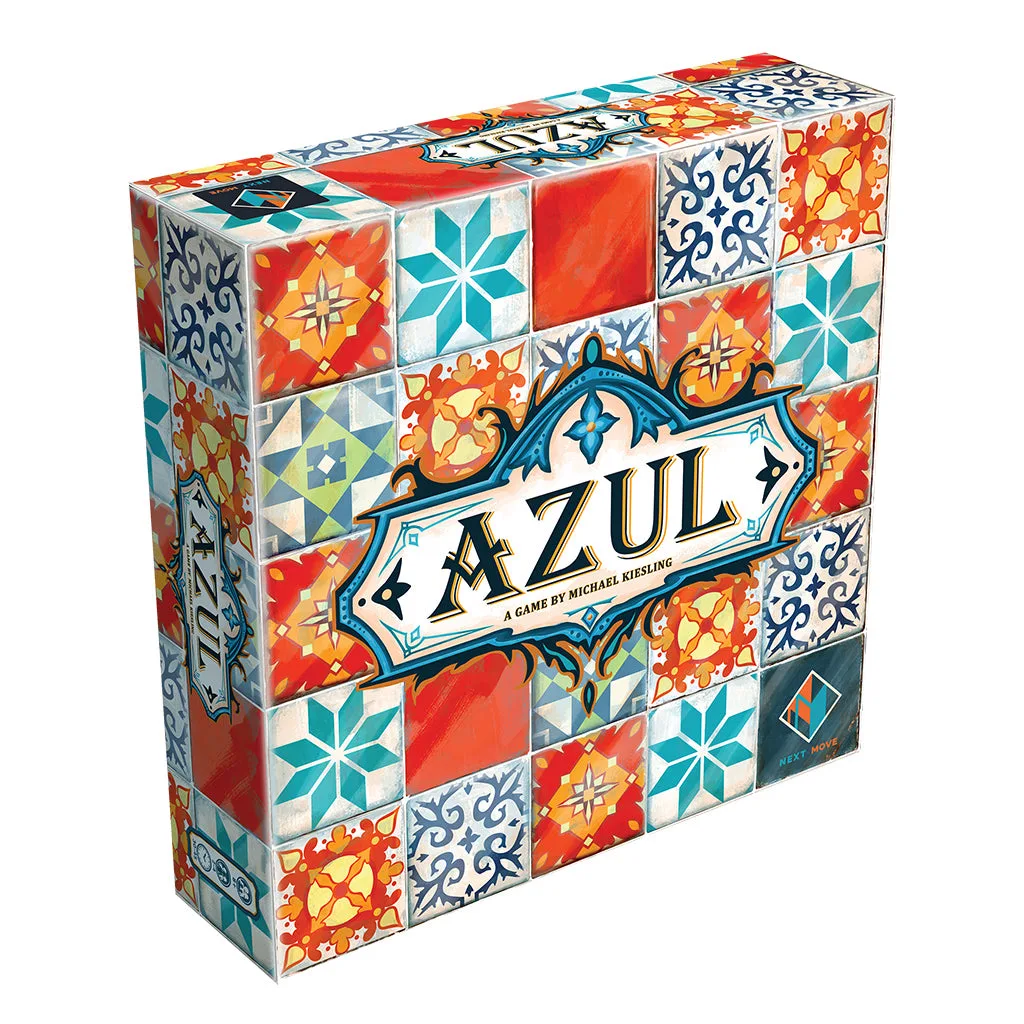
Azul
What you need before you start
Set the four factory displays in a circle and put the cloth bag in the middle. Each player takes a player board and places it in front of them. Draw tiles from the bag to fill each factory display with four tiles. The first player to take tiles from the center in a round will also take the first-player marker and place it on their floor line, which costs points at the end of the round. Leave the score track and the lid of the box nearby for discarded tiles.
The turn sequence, step by step
On your turn, choose one factory display or the center area and take all tiles of a single color from it. If you take from a factory display, move the remaining tiles to the center. If you take from the center, you take all tiles of that color and also take the first-player marker if it is still there. Then place the chosen tiles on one row of your player board. You must place all of them on the same row, and that row must be empty or already contain tiles of the same color. Any tiles you cannot place go to your floor line, one per space, and each floor-line space costs points at the end of the round.
How scoring works at the end of each round
After all tiles are taken, each player checks their wall. For each tile you placed on the wall this round, score one point for the tile itself. If it is adjacent horizontally or vertically to other tiles, score one additional point for each tile in that connected group. A tile with no neighbors scores one point. Then subtract points for your floor line: the first space costs one point, the second costs two, the third costs three, and so on, up to a maximum of 14 points. The first-player marker on the floor line costs one point. After scoring, clear the floor line and move any tiles from your pattern rows to the wall, then refill the factory displays for the next round.
End-game scoring and winning
The game ends after the round in which at least one player completes a horizontal row of five tiles on their wall. At that point, score bonus points: two points for each complete horizontal row, seven points for each complete vertical column, and ten points for each color of which you have placed all five tiles on your wall. The player with the most points wins. If there is a tie, the player with the most complete horizontal rows wins.
The game
Your first game: 5 steps to play well
- Plan your rows before you draft: Look at your pattern rows and decide which colors you can actually place this round. A row needs five tiles of the same color to reach the wall, so start filling rows that are already partly complete. Checkpoint: if a row is empty and you cannot fill it soon, ignore that color for now.
- Take from the center only when it helps you: The center often holds many tiles, but taking from it gives you the first-player marker and its floor-line penalty. Take from a factory display first if it offers the color you need. Common mistake: grabbing a big pile from the center just because it is there, then losing points to the floor line.
- Count the floor line before you commit: Each floor-line space costs 1, 2, 3, 4, 5, 6, or 7 points. If you must take extra tiles, place them on the floor line only if the points you gain this round outweigh the penalty. Checkpoint: never fill more than two floor-line spaces in a round unless you are forced to.
- Build toward columns and colors for bonuses: End-game bonuses reward complete columns (7 points) and full colors (10 points). While you play, favor moves that fill a column or finish a color set, even if they score fewer points this round. Common mistake: chasing immediate points and leaving columns half-finished.
- Watch what your opponents need: If an opponent is clearly collecting a color, you can take that color from a factory display to deny them, even if you only place one tile. This is especially strong in two-player games. Checkpoint: after your first few turns, name the color each opponent is collecting and adjust your picks.
Gear that helps you play and protect Azul
- PRIME Sleeves: Scythe and-or Lost Cities (72 x 112 mm): These PRIME Sleeves fit cards sized 72 x 112 mm and use 100-micron polypropylene for premium protection and a great shuffle feel. Azul's tiles are handled constantly, and if you also own card-based games with this card size, these sleeves keep them clean and shuffle-ready without hiding the artwork.
- Magic: The Gathering | Lorwyn Eclipsed Shiny Playmat - Moonshadow: This officially licensed Magic: The Gathering playmat has 2mm soft cushioning and an ultrafine surface for smooth card play. If you play Azul on a hard or dusty table, a playmat gives you a clean, cushioned surface that protects tiles and cards from scratches and keeps them from sliding.