Quick answer
Start with shape matching, then add counting and stacking challenges to build your toddler's recognition, coordination, and problem-solving skills.
Why a geometric sorting board works for toddlers
A geometric sorting board combines shape matching with counting practice, giving toddlers a hands-on way to learn colors, shapes, and numbers. The simple act of picking up a shape and placing it in the correct slot strengthens fine motor control and hand-eye coordination.
Unlike electronic toys, a wooden sorting board offers open-ended play. Children can stack shapes, sort by color, or count the holes—adapting the activity to their current skill level without flashing lights or sounds.
Step-by-step play guide
- Introduce each shape by name and color: Hold up one shape at a time, say its name and color, then let your child hold it. Run your finger along the edges to emphasize the shape's outline. Repeat for all four pieces. Common mistake: rushing through all shapes at once. Let your child handle each piece before moving on.
- Match shapes to their slots: Place the board in front of your child and point to the slot that matches the shape in their hand. Guide their hand gently toward the correct opening if needed. Let them try on their own once they understand the idea. Checkpoint: if your child gets frustrated, switch to just two shapes (circle and square) to reduce choices.
- Count the holes together: After a shape is placed, flip the board or point to the holes inside the shape. Count aloud: 'One, two, three…' Let your child touch each hole as you count. This builds one-to-one correspondence. Common mistake: expecting perfect counting. Toddlers often skip numbers or count the same hole twice—that's normal at this age.
- Stack shapes by size or color: Remove all shapes and show your child how to stack them on a flat surface. Ask 'Can you put the red one on top?' or 'Which shape is biggest?' This encourages comparison and vocabulary. Checkpoint: stacking requires more coordination than sorting. If shapes keep falling, hold the bottom piece steady for your child.
- Play a hide-and-find game: Hide one shape behind your back or under a cloth. Ask 'Which shape is missing?' Let your child find it and place it in the board. This builds memory and attention. Common mistake: hiding too many shapes at once. Start with one missing shape so the game stays fun and not overwhelming.
Product spotlight
-
Geometric Sorting Board: Includes 4 shapes (circle, rectangle, square, triangle) in 4 colors (yellow, blue, green, red) with different numbers of holes. Children naturally learn shape names, color words, and early counting (1–4 holes) during play, without needing a separate lesson.
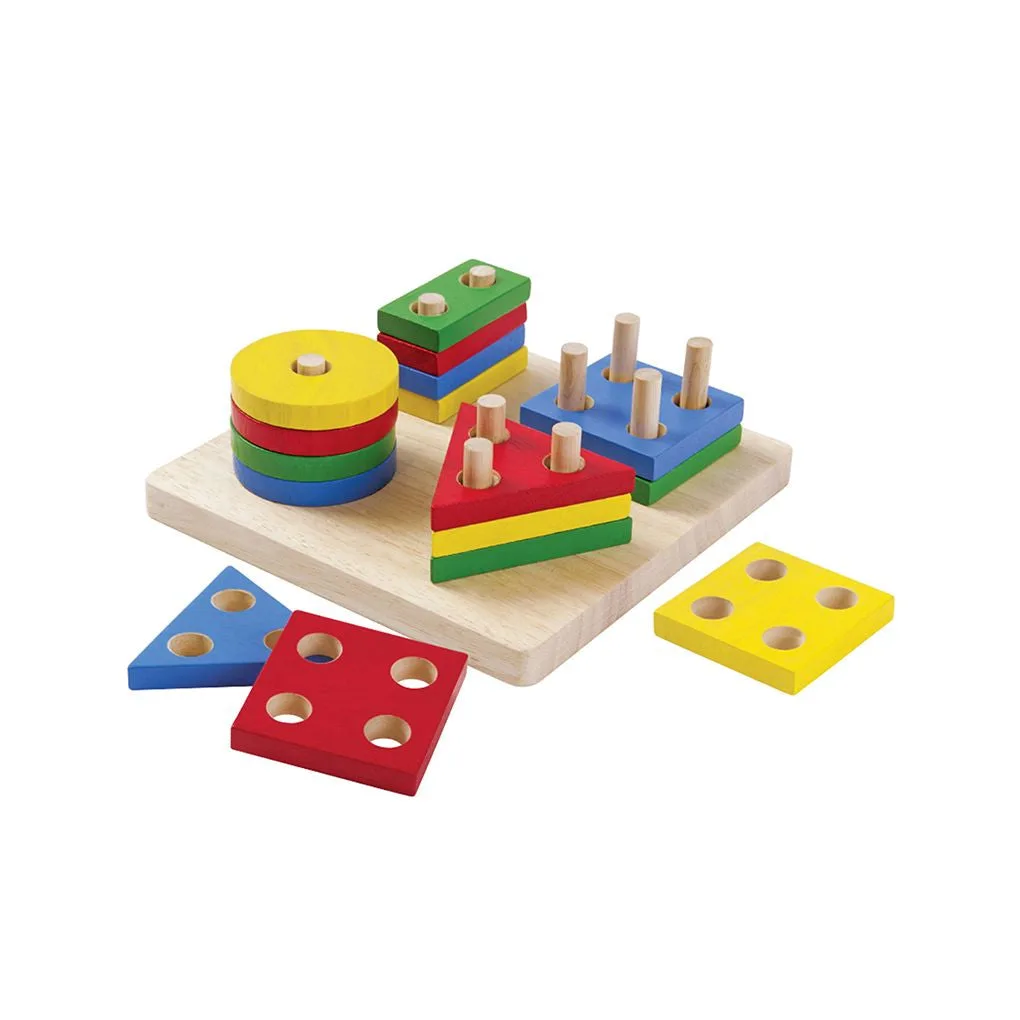
Geometric Sorting Board