Quick answer
Check your contact lens prescription for the sphere (power) number, then match it to a product whose stated range covers that number. For example, New York N Brown is listed in the Designer Lens -0.50 ~ -8.00 category and comes in Prescription, while Breeze Hazel sits in All Color Lens and also offers Prescription. If your power falls outside the listed range, or you need astigmatism or multifocal correction, choose a different product or ask your eye care professional.
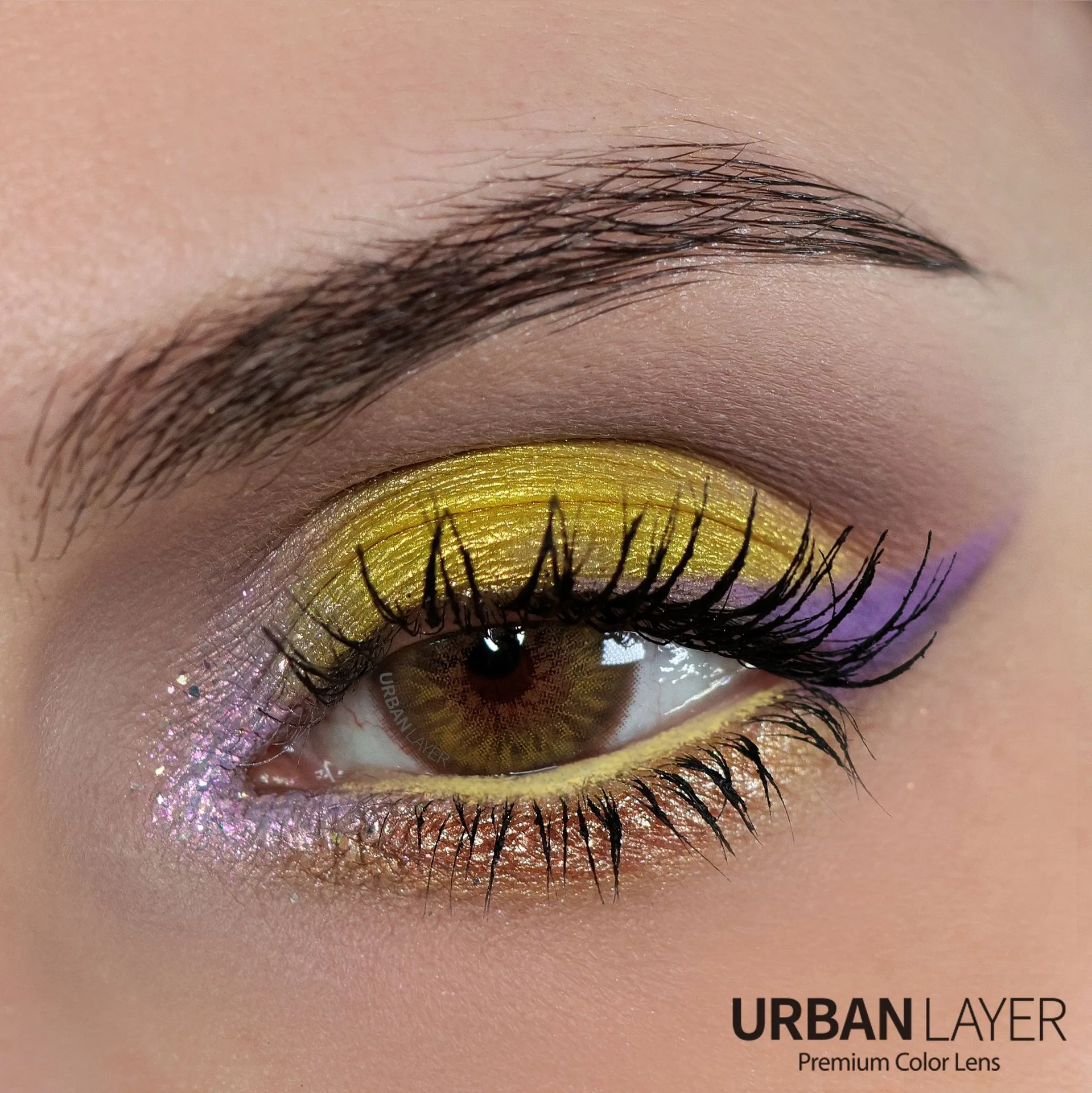
Breeze Hazel
Buying prescription colored contacts gets confusing fast because the same product page mixes style details with vision details. The number that matters most for seeing clearly is the sphere power, usually written as a minus number such as -2.50. The range -0.50 to -8.00 tells you the weakest and strongest nearsighted correction a product line is built to cover.
This guide walks through how to read contact lens prescription details on color lens -0.50 to -8.00 products, what the base curve and diameter mean for fit, and when a designer lens prescription range is the better choice. It uses real catalog examples so you can compare before you buy.
The three numbers on a colored contact lens prescription
A contact lens prescription is not the same as your glasses prescription. The key number is sphere, or power, shown as a minus value for myopia. That is the number a range like -0.50 to -8.00 refers to. The second number is base curve (B.C), which describes the curve of the lens back surface and affects how it sits on your eye. The third is diameter (DIA), the overall lens size.
For colored lenses, diameter often runs larger than clear lenses because the color design needs space. Havana Brown lists a 14.0mm diameter and 8.6mm base curve, while Breeze Hazel and Nile Hazel list 14.2mm diameter and 8.7mm base curve. Those small differences change how the lens feels and how much color shows.
- Write your sphere, base curve, and diameter down before browsing so you can compare quickly.
- If your prescription includes cylinder or axis, you need toric lenses, not a standard sphere range.
What -0.50 to -8.00 actually covers
The -0.50 to -8.00 label is a range, not a guarantee that every step in between is stocked. It starts at mild myopia and extends to stronger myopia. If your sphere is -0.50, you are at the light end. If it is -8.00, you are at the strong end. Anything beyond that, such as -8.50 or -9.00, falls outside this range.
This matters because a product can look perfect in photos but simply not be made in your power. New York N Brown is listed in the Designer Lens -0.50 ~ -8.00 category and offers Prescription as an option type. Breeze Hazel is listed in All Color Lens and also offers Prescription. Always confirm the exact power is selectable before you commit.
- Compare your sphere number against the product's stated range, not against the category name alone.
- If you are between steps, ask your eye care professional which step to order rather than guessing.
Base curve and diameter: the fit numbers people skip
Sphere gets all the attention, but base curve and diameter decide comfort. A base curve that is too flat or too steep can cause movement, irritation, or blurred vision even when the power is correct. The catalog lists 8.6mm for Havana Brown and 8.7mm for Breeze Hazel, Nile Hazel, and New York N Brown, so these sit in a similar fit zone.
Diameter affects both coverage and how the color reads on your eye. A 14.0mm lens like Havana Brown gives a more subtle enlargement, while 14.2mm options such as Breeze Hazel and Nile Hazel add slightly more presence. Neither is better; they suit different looks and different eye sizes.
- Stay close to the base curve your eye care professional measured for you.
- If you have never worn 14.2mm lenses, try one pair before buying several boxes.
Pupil hole size and why it can affect vision
Some hand-painted designs use a smaller pupil hole than standard color lenses. The catalog notes this for several products, including Breeze Hazel, Nile Hazel, and New York N Brown, warning that a smaller pupil hole can obstruct vision when wearing the lens. This is a design trade-off, not a defect, but it is worth knowing before you buy.
If you plan to wear the lenses while driving, cycling, or in low light, a design with a smaller pupil hole may not be the right pick. For photos, cosplay, or short indoor wear, the visual effect is often worth it. Read the product notes carefully and match them to where you will actually wear the lenses.
- Avoid smaller pupil hole designs for night driving or dim environments.
- If you notice shadows or ghosting, remove the lens and reassess.
How to verify a prescription before checkout
Start with your most recent contact lens prescription from your eye care professional, not an old glasses prescription. Confirm the sphere power, base curve, and diameter. Then open the product page and check that the exact power is available and that the base curve is close to your measurement.
If the product offers Prescription as an option type, like Breeze Hazel and New York N Brown, you can enter your power during ordering. If a product does not list prescription options, treat it as a plano or cosmetic lens only. Never assume a colored lens can replace your corrective lenses unless the power is explicitly offered.
- Keep a photo of your prescription on your phone for quick reference.
- Replace lenses on the schedule your eye care professional recommends, even if they still feel fine.
Decision rules for buying prescription colored contacts
- Rule 1: Match sphere first: Find your sphere power on your prescription and confirm the product's stated range includes it. A -0.50 to -8.00 range will not cover -8.50 or stronger. If your power is outside the range, stop and choose another product.
- Rule 2: Stay near your base curve: Compare the product's B.C to the base curve your eye care professional measured. Havana Brown lists 8.6mm; Breeze Hazel, Nile Hazel, and New York N Brown list 8.7mm. A base curve far from your measurement is a comfort risk, not a style choice.
- Rule 3: Read the pupil hole note: If the catalog warns that the pupil hole is smaller than normal, plan for bright, stationary settings rather than driving or dim rooms. Choose a different design if you need all-day, low-light wear.
- Rule 4: Confirm the prescription option: Only buy if the product page lists Prescription as an available option. Havana Brown does not list it; Breeze Hazel and New York N Brown do. No prescription option means cosmetic wear only.
Catalog examples that show the difference
- New York N Brown: Listed in Designer Lens -0.50 ~ -8.00, DIA 14.2mm, B.C 8.7mm, hydrogel, 40% water content, made in Korea, Prescription option available. The catalog notes its pupil hole is smaller than normal color lenses and can obstruct vision when wearing it. It shows how a designer lens prescription range maps to a real product, and the smaller pupil hole warning tells you to avoid it for low-light or driving use.
- Breeze Hazel: Listed in All Color Lens, DIA 14.2mm, B.C 8.7mm, silicone hydrogel or MPC, 40% water content, made in Korea, Prescription option available. The catalog notes its pupil hole is smaller than normal color lenses and can obstruct vision when wearing it. A color lens with a prescription option, so you can compare it against designer lines when your power falls inside the offered range.
- Havana Brown: Listed in All Color Lens, DIA 14.0mm, B.C 8.6mm, silicone hydrogel or MPC, 40% water content, made in Korea. No prescription option is listed. A reminder that not every color lens comes in prescription; if you need correction, this one is not the right fit.
- Nile Hazel: Listed in All Color Lens, DIA 14.2mm, B.C 8.7mm, silicone hydrogel or MPC, 40% water content, made in Korea. The catalog notes its pupil hole is smaller than normal color lenses and can obstruct vision when wearing it. Shows that pupil hole size varies by design, so read the notes even when the diameter and base curve look standard.
Who should buy which
Best for
- Shoppers whose sphere power falls between -0.50 and -8.00 and who want a colored or designer lens with a prescription option
- Buyers who have a current contact lens prescription and can match base curve and diameter before ordering
- People who mainly wear lenses for photos, events, or short indoor sessions and can accept a smaller pupil hole design
Not for
- Anyone whose sphere power is stronger than -8.00 or who needs toric or multifocal correction
- Shoppers who plan to drive or wear lenses in low light and need a wide pupil hole
- Buyers without a current contact lens prescription who are guessing their power
Reading the prescription details on color lens -0.50 to -8.00 products comes down to four checks: sphere, base curve, diameter, and whether a prescription option exists. Use the catalog notes on pupil hole size to judge where you can safely wear the lenses. When in doubt, confirm with your eye care professional before you buy.