Quick answer
Keep 6 to 8 toys visible on a low shelf, store the rest out of sight, and swap the selection every 2 to 3 weeks. Rotate by skill rather than by novelty: one building toy, one language or matching toy, one practical-life item, plus a comfort object. If your child ignores a toy for three days, it is ready for storage, not the donation bin.
A toy rotation works because fewer choices create deeper play. Instead of a bin of 40 pieces, your child sees a short, deliberate shelf where everything is reachable and nothing is background noise. The swap does not need to be elaborate: a basket in a closet is enough storage.
This guide walks through the setup in order, from choosing a shelf spot to timing the swaps. It also covers the mistakes that make rotation feel like extra work, and how to pick toys that survive repeated cycles. If you already own a Montessori shelf setup, you can start with step 3 today.
Montessori
Why a toy rotation system works
Children under six are still building the ability to filter distractions. When every toy is available at once, play gets shallow: a piece gets picked up, put down, and abandoned. Reducing the visible set makes the remaining toys more interesting and lets your child finish what they start.
Rotation also protects your budget. A toy that disappears for two weeks feels new when it returns, so you buy less. The goal is not minimalism for its own sake; it is a play space where each item has a job and your child can reach it without asking an adult.
- Aim for a shelf your child can reach while standing or kneeling.
- Keep one comfort item out permanently; it is not part of the rotation.
How many toys stay out at once
For toddlers, 6 to 8 items on the shelf is a practical ceiling, counting a small tray or basket as one item. For children around 4 to 6, you can stretch to 8 to 10 if the toys are single-purpose and tidy up easily. More than that and the shelf turns back into a toy bin.
Count pieces, not categories. A 60-piece construction set is one shelf item because it lives in one container, but a puzzle with 40 loose pieces is a poor fit for open shelving unless it has a tray. If a toy needs adult help to reset, it belongs in a cabinet, not on the shelf.
- Use one shallow basket per category so cleanup stays obvious.
- Leave one empty shelf space; it signals that the shelf is managed, not stuffed.
Pick a rotation interval you can keep
Two to three weeks is the sweet spot for most families. Shorter intervals interrupt deep play; longer ones let interest fade to zero. Watch your child rather than the calendar: when a toy sits untouched for three consecutive days, that is your cue to swap it out.
Keep a simple storage system so swaps take minutes. Clear bins labeled by skill, not by toy name, let you grab a replacement without digging. If you have seasonal items, store them separately so holiday toys do not crowd the everyday rotation.
- Set a recurring reminder for the swap day; it takes about 10 minutes.
- Photograph the current shelf so you can rebuild a favorite combination later.
Match toys to the shelf, not the other way around
Open shelving favors toys that are self-contained and self-correcting. A matching game with a fixed number of pieces, a lacing set, or a small practical-life tool all reset in seconds. Sets with dozens of loose parts work better in a lidded box that lives on a lower shelf or in a closet.
Check the size and weight against your shelf before you commit. A large floor toy will not fit a standard cubby, and a heavy item on a high shelf is a hazard. The catalog dimensions on the product page are the fastest way to avoid a swap-day surprise.
- Measure your shelf depth before buying a new rotation item.
- Keep water-based or liquid-contact toys off the shelf if they need spot cleaning.
Set up the shelf so cleanup is part of play
Place the heaviest items on the bottom, the most-used tray at child height, and a small basket for loose parts beside it. Everything should have one obvious home. When the shelf is arranged this way, a toddler can reset it without instructions, which is the point of a Montessori play space.
Resist the urge to decorate the shelf. A plant, a stack of books, and a single framed picture compete with the toys for attention. If you want a display area, keep it above your child's reach so it does not become part of the rotation.
- Rotate the shelf position occasionally to refresh the room without new toys.
- Store the outgoing toys where your child cannot see them; visible storage defeats the system.
Your rotation setup, step by step
- Choose and clear the shelf: Pick a low, reachable spot with no screen nearby. Empty it completely, then wipe it down. Common mistake: leaving a few 'always out' toys on top, which quietly pushes the count past the limit. Checkpoint: your child can reach every shelf level without climbing.
- Sort the current toys into three piles: Make a keep-out pile, a store pile, and a repair-or-retire pile. Anything missing pieces or needing batteries you do not have goes in the third pile. Common mistake: keeping a broken set 'for later' and re-shelving it by accident. Checkpoint: the store pile is larger than the keep-out pile.
- Choose 6 to 8 items across skills: Pick one construction toy, one language or matching toy, one practical-life item, one movement or stacking toy, and a comfort object. For a toddler, use the lower end of the range. Common mistake: choosing three toys from the same category because they are the current favorites. Checkpoint: no more than two items share the same skill.
- Arrange the shelf by weight and use: Heavy items on the bottom, the most-used tray at child height, loose parts in one shallow basket. Leave one space empty. Common mistake: stacking trays so the bottom one is unreachable. Checkpoint: a toddler can reset the shelf alone in under two minutes.
- Store the rest out of sight: Use clear bins labeled by skill and place them where your child does not play. Keep a short list of what is stored so you do not rebuy it. Common mistake: storing toys in the same room in open bins, which turns the rotation back into a pile. Checkpoint: the stored toys are not visible from the play area.
- Set the swap date and watch for cues: Mark a swap 2 to 3 weeks out, but pull a toy early if it sits untouched for three days. Swap one or two items at a time rather than the whole shelf. Common mistake: changing everything at once, which resets your child's orientation instead of refreshing it. Checkpoint: at least one familiar toy stays out through every swap.
Toys that rotate well
- Montessori Crane & Train Magnetic Playset: Contains 60 construction parts and 2 train cars, sized 15.7" x 4.1" x 13.4", for ages 3+, and is compatible with most other wooden tracks. It works as a single shelf item because the parts live in one container, and the track compatibility means it can return to the rotation alongside other wooden sets instead of replacing them.
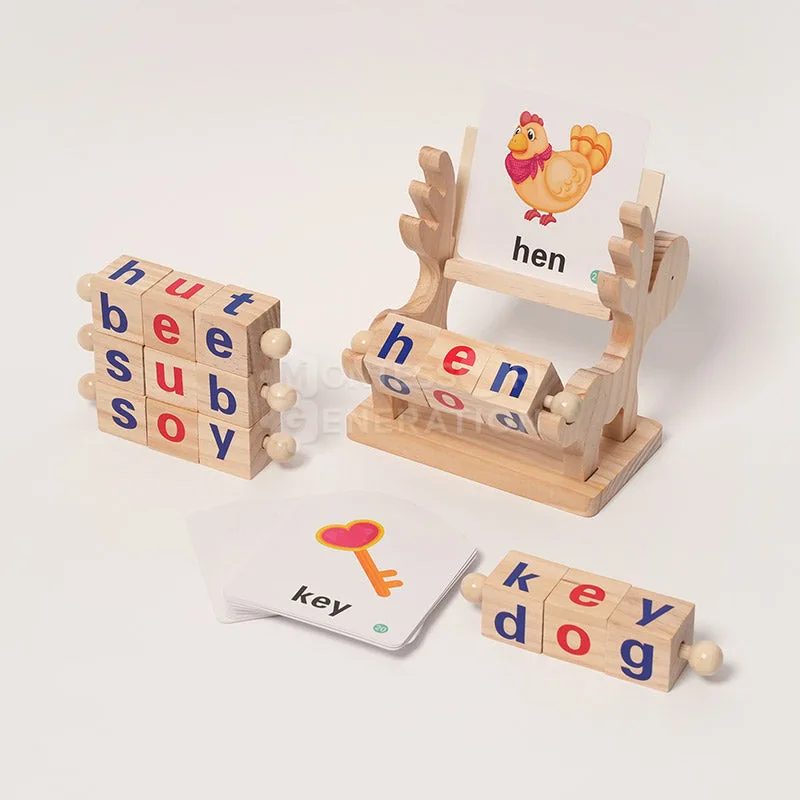
- Montessori Spin and Spell Set: Includes 4 board parts, 5 letter block sets, and 40 word-and-image cards, for ages 3+, with spot-clean-only care. It covers the language slot on the shelf, and the card-based format resets quickly, so it survives repeated rotation cycles without losing pieces.
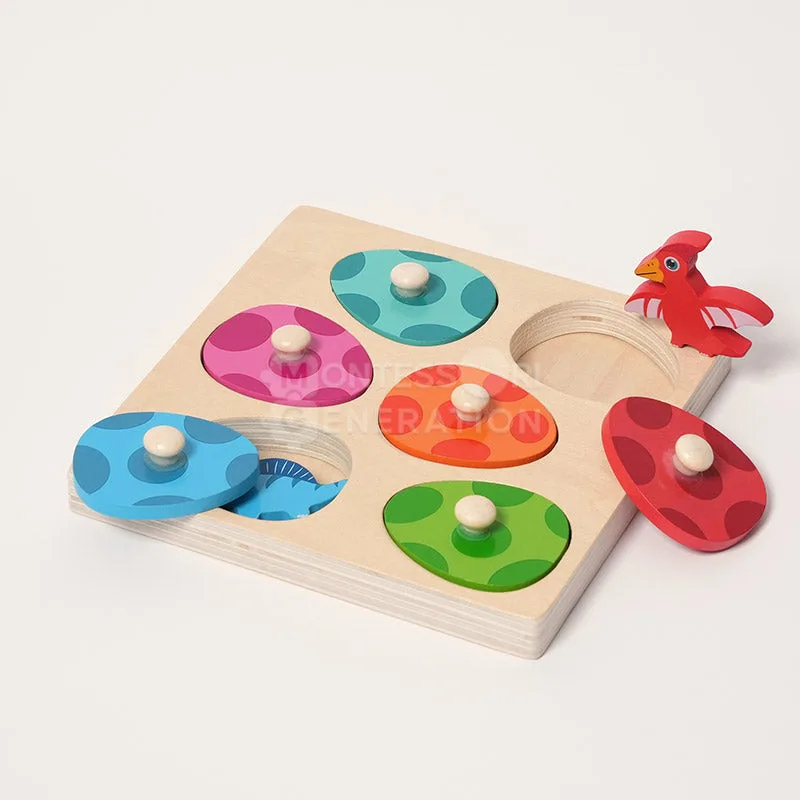
- Montessori Dino Hatch and Match: A wooden board with 6 eggshells and 6 dinos, 6.9" x 6.9" x 1.0", for ages 2+, spot clean only. Its small footprint fits a shallow shelf, and the fixed piece count makes it easy to check that everything is back before it goes into storage.
Start with one shelf and one storage bin, not a whole playroom overhaul. Rotate on a two-to-three-week rhythm, keep the count low, and let your child's attention tell you when to swap. Done this way, a toy rotation system costs you ten minutes a month and gives your child a calmer, deeper way to play.