Quick answer
Stop concealer creasing by applying it in thin layers over eye cream that has fully absorbed, blending only the edges, and setting just the inner corner with a whisper of powder. If creasing still appears within an hour, your concealer is likely too thick or too emollient for the area, and a lighter formula will do more than any technique tweak.
Why creasing happens in the first place
The under-eye area moves every time you blink, smile, or glance sideways, and it has very few oil glands compared with the rest of your face. Concealer sits on top of that thin, mobile skin, so any product that stays flexible will fold into the same lines your skin already has. Creasing is not a sign that you applied it badly; it is a sign that the product and the layering are fighting the anatomy.
Two forces are usually at work. First, moisture: if your eye cream or serum has not fully absorbed, the concealer slides into lines instead of gripping. Second, volume: a heavy layer cannot bend with the skin, so it cracks along the finest creases. Fixing one without the other rarely holds for a full day.
The layering order that actually holds
Wait two to three minutes after eye cream before applying anything else. Then use a colour corrector under eyes only if you have visible blue or purple tones; skip it if your concern is purely texture, because an extra layer adds another chance to crease. Tap concealer on with a fingertip or a small brush, starting at the inner corner where darkness is usually deepest, and stop before you reach the lash line.
Blend only the outer edges with a clean, dry brush or a damp sponge. Do not sweep back and forth across the whole area, which pushes product into lines. If you need more coverage, wait thirty seconds and add a second thin layer rather than one thick one. This is the best way to apply under eye concealer for mature skin, where the skin is thinner and less forgiving of heavy layers.
How to set concealer without caking
Powder is the step most people either skip or overdo. Press, do not sweep: dip a small fluffy brush into a finely milled powder, tap off the excess, and press it only into the inner corner and any spot that has already creased. Leave the outer half of the under-eye bare or nearly bare, because that is where dryness and fine lines show first.
If your skin is dry or mature, consider skipping powder entirely and instead pressing the concealer in with a warm fingertip, then letting it set for a minute. A setting spray misted from a distance can add hold without the texture of powder. The goal is a concealer creasing fix that lasts, not a matte finish that emphasizes every line.
When the problem is the formula, not the technique
If you have tried thin layers, waited for skincare to absorb, and set sparingly, and creasing still appears within an hour, the concealer itself is the issue. Very emollient or very full-coverage formulas are the usual culprits under the eyes, especially for mature skin. In that case, switch to a lighter, more flexible texture rather than adding more powder, which only creates a dry, cracked look.
The same logic applies to tools. A dense brush can deposit too much product in one pass, so a smaller, softer brush or a clean fingertip gives you more control. If your eye area is also puffy or dry, address that with skincare first; concealer cannot smooth texture it is sitting on top of.
Diagnose your creasing
- Creases appear within minutes of applying: Your skincare has not absorbed, or you applied concealer in one thick layer. Wait two to three minutes after eye cream, then tap on two thin layers instead of one. If this fixes it, keep the thin-layer method and stop here.
- Creases appear after an hour, mostly at the inner corner: This is normal movement combined with too much product in one spot. Press a tiny amount of powder into the inner corner only, and leave the rest of the under-eye bare. If creasing returns by midday, move to the next diagnosis.
- Creasing persists even with thin layers and minimal powder: The formula is likely too emollient or too full-coverage for your under-eye skin. Switch to a lighter, more flexible concealer rather than adding more powder. Stop adjusting technique and change the product; more powder will only look dry and cracked.
Products that support this routine
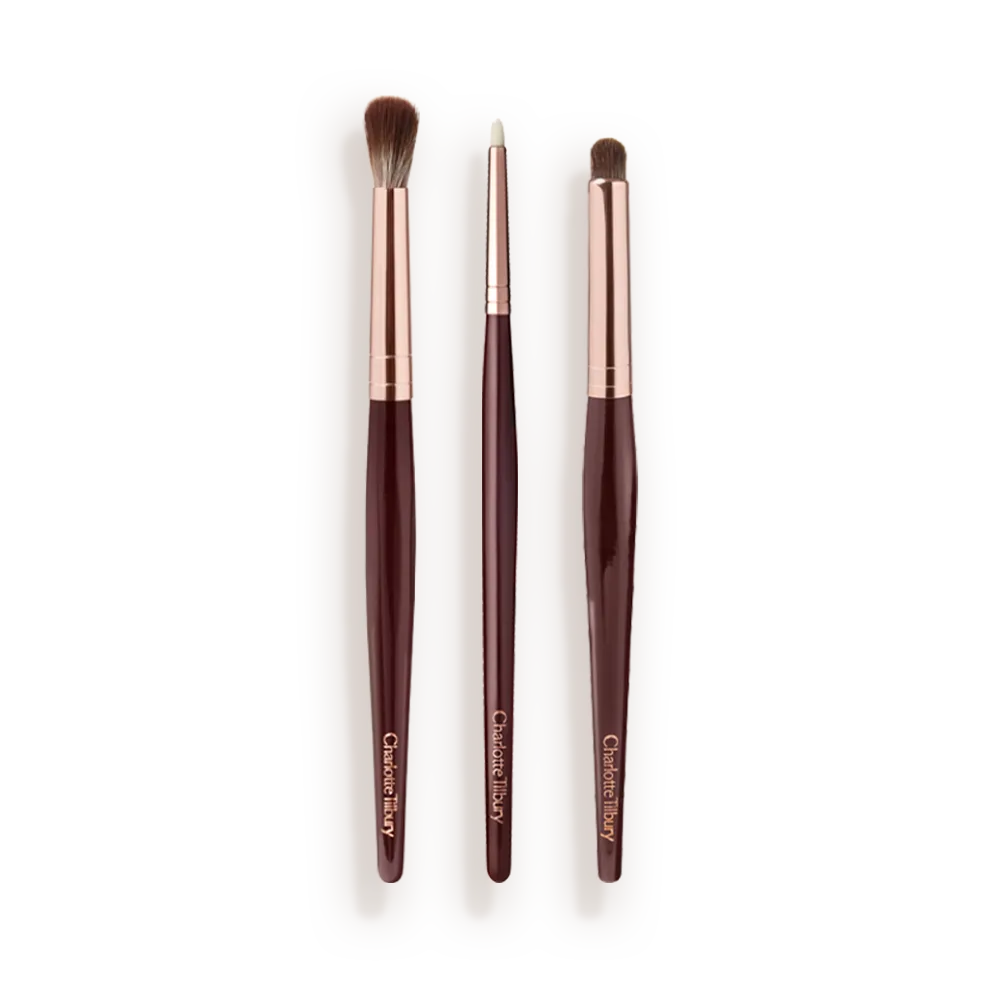
- THE ESSENTIAL EYE TOOLS - MAKEUP BRUSHES: The Essential Eye Tools makeup brushes include a curated trio for blending, shading, and defining the eyes. A small blending brush lets you tap concealer into the inner corner and blend only the edges, which is exactly the controlled application that reduces creasing.
- SCIENCE-POWERED SERUM & MAGIC CREAM KIT - SKINCARE KIT: The Science-Powered Serum & Magic Cream Kit pairs a hydrating face serum with an award-winning moisturiser, saving 5% versus buying the products separately. Well-hydrated under-eye skin holds concealer more smoothly, so getting your serum and moisturiser layer right before makeup is the first step in this routine.
- SPF50 AIRBRUSH COMPLEXION DUO - MAKEUP KIT: The SPF50 Airbrush Complexion Duo pairs an SPF primer with a full-coverage foundation, saving 5% versus buying them separately. If you wear foundation near the under-eye, priming and protecting that area first helps your concealer sit on a stable base instead of sliding into lines.