Quick answer
Use a precision knife for quilting details when you need to cut small, intricate shapes or tight curves that a rotary cutter cannot handle. Work on a self-healing mat, use a sharp blade, and cut away from your body for safety.
Why choose a precision knife over a rotary cutter
A rotary cutter excels at long straight cuts and wide curves, but it struggles with tiny angles, inner corners, and delicate appliqué shapes. A precision knife, with its pointed tip and narrow blade, gives you the control needed for details like window cuts, small curves, and precise notches.
The trade-off is speed: a precision knife cuts one line at a time, so it is best reserved for small sections rather than full quilt pieces.
Step-by-step guide to using a precision knife for quilting details
- Prepare your workspace: Place a self-healing cutting mat on a flat, stable surface. Ensure good lighting so you can see the cutting line clearly. Have your precision knife with a fresh blade installed. A dull blade can tear fabric instead of cutting it—change blades often.
- Secure the fabric: Lay the fabric flat on the mat. Use pattern weights or low-tack painter's tape to hold it in place. Do not use pins, as they can shift the fabric or interfere with the knife path. Tape can leave residue on delicate fabrics; test on a scrap first.
- Mark your cutting line: Use a fabric pen or chalk to draw the exact shape you want to cut. For intricate details, trace a template or stencil. Let the line be your guide. Washable markers may bleed on some fabrics—use a fine-tip chalk pencil for dark fabrics.
- Hold the knife correctly: Grip the knife like a pencil, with the blade angled slightly away from your body. Rest your cutting hand on the mat for stability. Keep your other hand clear of the cutting path. Never cut toward your fingers or body—always cut away.
- Cut with light, even pressure: Apply gentle, consistent pressure as you follow the marked line. For tight curves, rotate the fabric rather than the knife. Make multiple passes if needed—do not force the blade. Forcing the blade can cause the tip to snap or the fabric to shift.
- Finish and store safely: Once the cut is complete, immediately replace the blade cap or retract the blade. Store the knife in its case or a dedicated holder. Clean the mat and discard fabric scraps. Always store the knife with the blade covered or retracted to prevent accidental cuts.
Recommended tool for detail cutting
-
Precision Knife With Case and Extra Blades: The Precision Knife With Case and Extra Blades is designed for intricate cutting, carving, and modeling on materials like paper, cardboard, vinyl, and thin plastic sheets. For quilting, this means you can cut fabric templates, stencils, and small appliqué shapes with the same precision you would use for paper crafts, and the included case protects the blade when not in use.
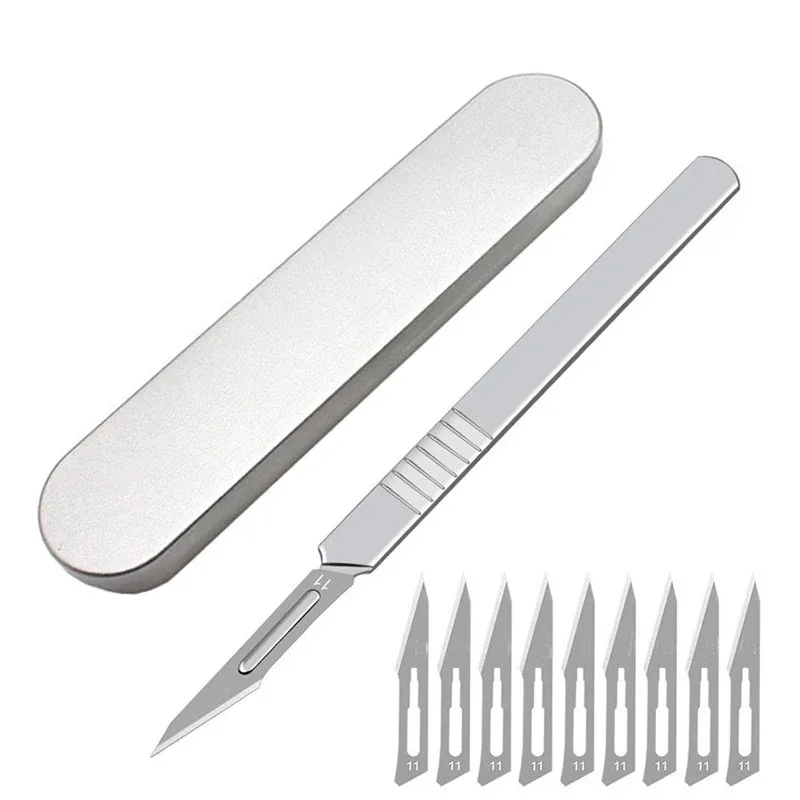
Precision Knife With Case and Extra Blades