Quick answer
Use Melissa & Doug Alphabet Lacing Cards to strengthen fine motor skills by having children lace, match, and sequence the cards while practicing letter recognition.
Why lacing builds fine motor skills
Threading a lace through a hole requires precise pincer grip, bilateral coordination, and hand-eye coordination. These are the same skills needed later for writing, buttoning, and using utensils.
Letter recognition bonus
Each card has an uppercase and lowercase letter on one side and a colorful illustration on the other. This dual design lets you combine motor practice with phonics or alphabet games without needing separate materials.
How to use Alphabet Lacing Cards step by step
- 1. Set up the workspace: Place one card flat on a tray or table. Show the child how to hold the lace with one hand and the card with the other. Common mistake: letting the child hold the card in the air makes threading harder. Keep it on a flat surface. A stable surface prevents frustration and builds confidence.
- 2. Demonstrate the threading motion: Insert the lace tip through the first hole from front to back, then pull it through. Say 'in and out' as you go. Common mistake: pulling the lace too fast can yank the card. Guide the child to pull slowly. Slow, deliberate movements train the pincer grip better than speed.
- 3. Start with a single card: Let the child lace one card completely before moving to the next. Common mistake: offering too many cards at once overwhelms young children. One card keeps focus on the motor task. Mastering one card builds the muscle memory needed for longer sequences.
- 4. Add letter identification: Before lacing, ask the child to point to the letter on the card. Say the letter name and sound. Common mistake: skipping this step turns it into a pure motor activity. The letter side is designed for dual learning. Pairing motor practice with letter sounds reinforces both skills.
- 5. Try lacing in alphabetical order: Once the child is comfortable, line up cards A to Z and lace them in sequence. Common mistake: expecting the child to remember the order. Keep the alphabet chart nearby as a reference. Sequencing the alphabet adds a cognitive challenge to the motor workout.
- 6. Use the cards as flashcards: After lacing, flip the card to the illustration side and ask the child to name the picture and its starting letter. Common mistake: discarding the cards after lacing. They double as teaching tools. Extending play beyond lacing increases the set's value and learning time.
Product facts
-
Alphabet Lacing Cards: Each of the 26 shaped lacing boards features a colorful illustration on one side and a label on the back with oversize uppercase and lowercase letters. Children can practice letter identification and matching while threading, turning a motor activity into a literacy lesson.
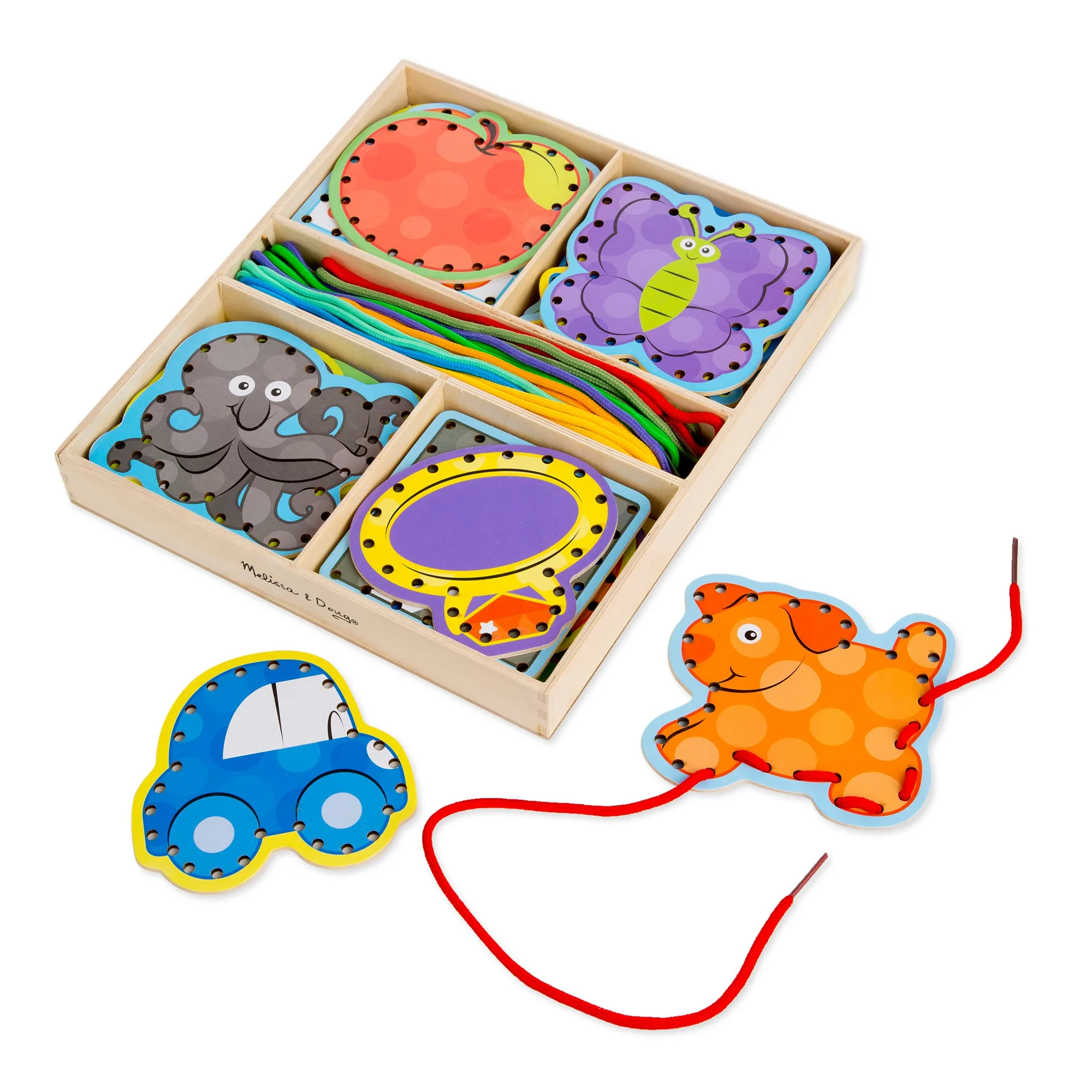
Alphabet Lacing Cards