Quick Answer
To support newborn visual development, hold contrast cards about 8–12 inches from your baby's face, introduce them in short sessions, and follow their gaze to adjust pace and position.
Why contrast matters in the first months
Newborns see the world in soft focus and are most drawn to bold black-and-white patterns because their retinas and optic nerves are still maturing. High contrast images give their eyes something clear to track, which helps build the neural pathways needed for focusing, following objects, and eventually recognizing shapes and faces.
During the first three months, a baby's vision is limited to about 8–12 inches. Holding cards at that distance and moving them slowly gives your baby something meaningful to look at during wakeful moments. This is not about teaching content yet; it is about giving the visual system gentle practice.
Why black-and-white beats bright colors at first
Newborns see high-contrast patterns most clearly because their retinas and optic nerves are still maturing. Black-and-white images create strong edges that are easier for young eyes to focus on. Around 3 months, babies begin to notice primary colors, which is why a set that progresses from black-and-white to red-and-blue cards matches the natural timeline of visual development.
When to move on to the next card stage
The 60 Contrast Baby Flash Cards are split into three age bands: 0-3 months, 3-6 months, and 6-12 months. Move to the next stage when your baby tracks the current cards smoothly with both eyes and shows less interest. This usually happens around the labeled month range, but every baby develops at their own pace. Watch for steady eye contact and following movement rather than a strict calendar date.
Step-by-Step Guide to Using Contrast Cards
- Start with black-and-white cards for newborns (0–3 months): Hold one card about 8–12 inches from your baby's face, where their vision is clearest. Keep it still for a few seconds, then slowly move it across their line of sight. Use the 20 black-and-white cards from the set during this stage. If your baby looks away, that's a sign they need a break—don't keep going.
- Introduce red and blue accents at 3–6 months: Switch to the cards with splashes of red and blue once your baby starts tracking objects more steadily. These colors add new contrast without overwhelming their maturing vision. Watch for longer focus; if your baby loses interest quickly, alternate between black-and-white and color cards.
- Use high contrast cards during tummy time: Place one card at eye level about 8–12 inches away during tummy time. Move it slowly side to side to encourage head lifting and visual tracking. Keep sessions short — 1 to 2 minutes is plenty for a newborn. Stop before your baby fusses so tummy time stays positive.
Why these cards work for newborn vision
-
60 Contrast Baby Flash Cards | Animals, Shapes & Household Items: The set includes 20 black-and-white cards for babies 0-3 months, 20 cards with red and blue splashes for 3-6 months, and 20 high-contrast cards for 6-12 months. You can keep using the same set as your baby grows, so you don't need to buy new cards every few months.
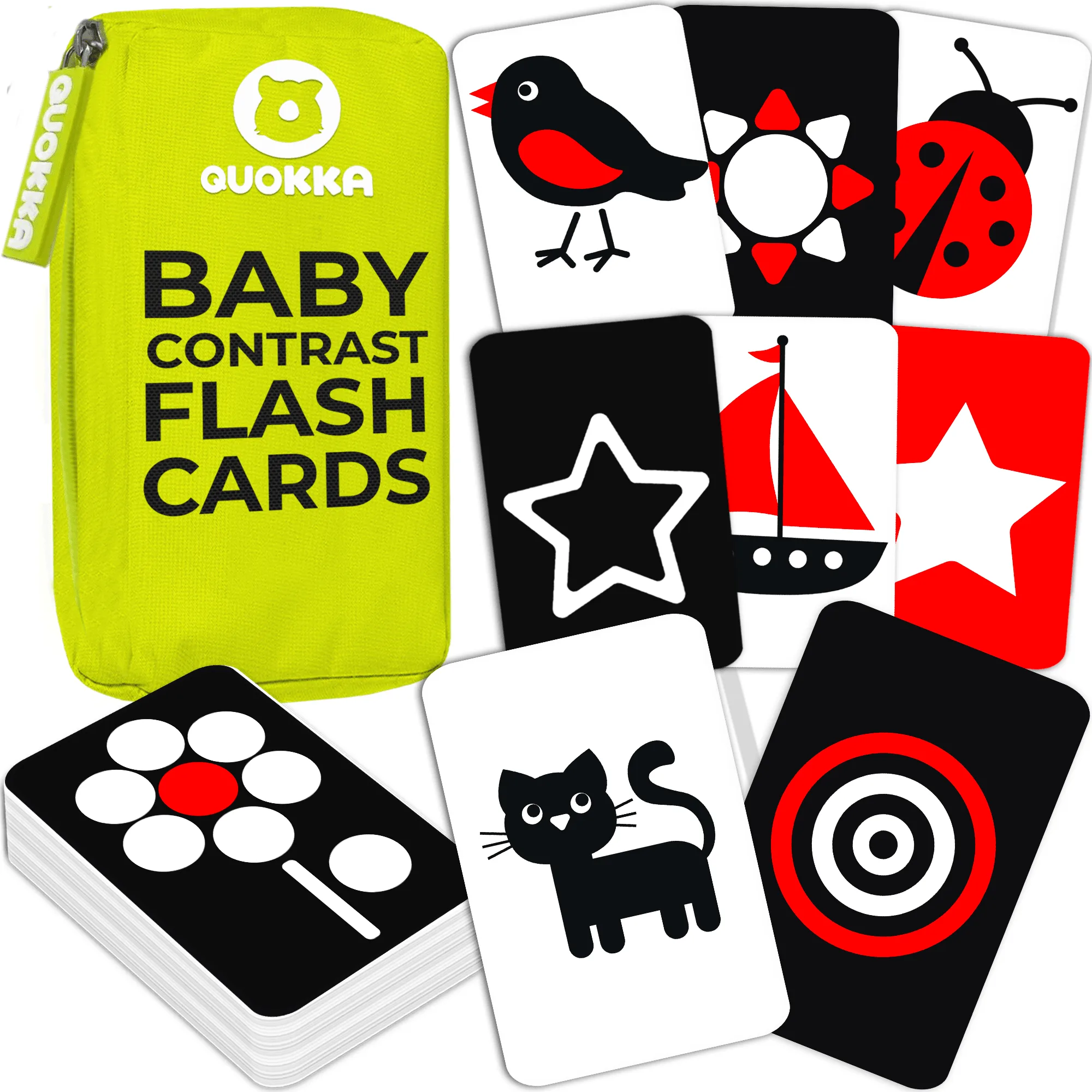
60 Contrast Baby Flash Cards | Animals, Shapes & Household Items