Quick answer
The Greater Game offers a 25-year strategic roadmap that you can break down into actionable decision-making frameworks. Use the steps below to apply its principles to your own business challenges.
Why a long-term framework matters for decision making
Most business decisions focus on short-term gains, but The Greater Game emphasizes a 25-year horizon. This shift in perspective helps you prioritize actions that compound over time rather than chase immediate wins.
The book is grounded in real-time research and over 40 years of coaching industry-defining leaders. That depth means the frameworks aren't theoretical—they've been tested in high-stakes environments.
How to apply The Greater Game decision framework
- Define your 25-year legacy goal: Start by writing down what you want to have built or become in 25 years. This becomes your north star for every major decision. Common mistake: setting a goal that is too vague or too short-term, like a 5-year revenue target. Make your legacy goal specific, measurable, and emotionally compelling enough to guide tough trade-offs.
- Map decisions to your exponential growth path: For each key decision, ask: Does this move me closer to 100x growth or does it optimize for incremental gain? The Greater Game prioritizes moves that create compound effects. Common checkpoint: avoid the trap of choosing the safe, familiar option just because it feels less risky. If a decision doesn't accelerate your growth trajectory, it may be a distraction.
- Use the 40-year coaching lens: The book's frameworks are built on decades of real-world leadership coaching. When you face a dilemma, imagine you have access to that collective experience. Ask: What would a leader who has already built a legacy do here? Common mistake: relying only on your own limited experience instead of leveraging proven patterns. Externalize the decision by comparing it to patterns from other successful entrepreneurs.
- Break the 25-year plan into actionable cycles: Divide the roadmap into 5-year sprints. For each sprint, identify 2-3 strategic bets that align with your long-term vision. Common checkpoint: don't try to plan every detail—leave room for adaptation as new information emerges. Each 5-year cycle should have clear milestones that you can review and adjust.
- Review decisions against the freedom and legacy criteria: The Greater Game emphasizes that true success includes freedom and legacy, not just financial growth. Before finalizing a decision, check: Does this preserve my autonomy? Does it build something that outlasts me? Common mistake: optimizing for money at the expense of time or impact. If a decision compromises your freedom or doesn't contribute to legacy, reconsider its priority.
About the book
-
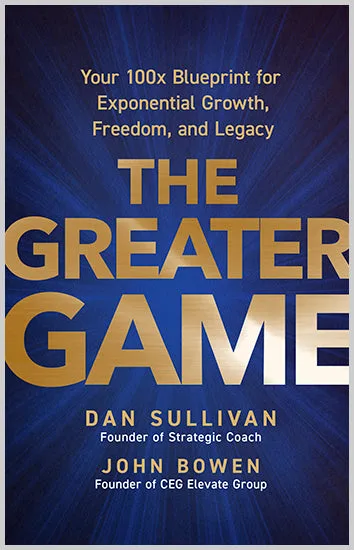
The Greater Game: A strategic blueprint for elite and rising entrepreneurs to achieve 100x growth, build legacy, and engineer 25 years of exponential success. It gives you a proven structure to evaluate decisions not just for next quarter, but for the next quarter-century.
The Greater Game