Quick Answer
Use a hopscotch rug to turn counting into an active game: have your child toss a beanbag, hop to the number, and say it aloud. This builds number recognition and gross motor skills at the same time.
Why a Hopscotch Rug Works for Counting Practice
Hopscotch naturally combines movement with numbers, making it a perfect tool for active learning. When kids hop and count, they engage both their bodies and brains, which helps reinforce number sequences and one-to-one correspondence.
Unlike flashcards or worksheets, a hopscotch rug invites kids to move, which can improve focus and retention. The physical act of hopping to a number makes the learning stick.
This approach works especially well for kids who struggle to sit still or who learn best through movement. It also turns practice into a game, so kids are more likely to want to play again and again.
Step-by-Step Counting Games
- Set Up the Rug in a Safe Space: Lay the rug on a flat, open area with enough room around it for jumping and landing. Check that the rug is fully flat and the skid-proof backing is gripping the floor. A common mistake is placing the rug near furniture or walls; give at least a few feet of clearance on all sides.
- Start with Simple Number Recognition: Have your child point to each number in order while saying it aloud. Then call out a number and ask them to hop to it. This builds number recognition without the pressure of counting sequence. Checkpoint: If your child hesitates, slow down and practice one number at a time before mixing them up.
- Introduce Beanbag Toss and Count: Use the included beanbags. Have your child toss a beanbag onto a number, then hop to that number and count aloud from 1 to that number. For example, if the beanbag lands on 4, they hop to 4 while counting '1, 2, 3, 4.' Common mistake: Kids may count only the landing number. Encourage them to count each hop along the way to reinforce one-to-one correspondence.
- Practice Counting Forward and Backward: Ask your child to hop from 1 to 10 counting forward, then from 10 back to 1 counting backward. This strengthens number sequence and prepares them for addition and subtraction concepts. Checkpoint: If counting backward is too hard, start with just 5 to 1 and gradually increase the range.
- Create Simple Addition and Subtraction Challenges: For older kids, call out a simple problem like '3 + 2.' Have them hop to the starting number (3) and then take two more hops to land on 5. This turns the rug into a hands-on math tool. A common mistake is making problems too hard too fast; keep sums within 10 until your child is confident.
- Turn It into a Game with Two Players: Take turns calling out numbers or problems. The other player hops to the correct answer. This adds a social element and keeps kids engaged longer. Checkpoint: Keep the game cooperative rather than competitive to avoid frustration; focus on having fun while learning.
Product Spotlight
-
Hop & Count Hopscotch Rug: The Hop & Count Hopscotch Rug is a colorful, high-quality hopscotch game set with reinforced border binding and a skid-proof backing. The skid-proof backing keeps the rug safe on all floor surfaces, so kids can hop and count without the rug slipping, and the durable material is machine washable for easy cleanup.
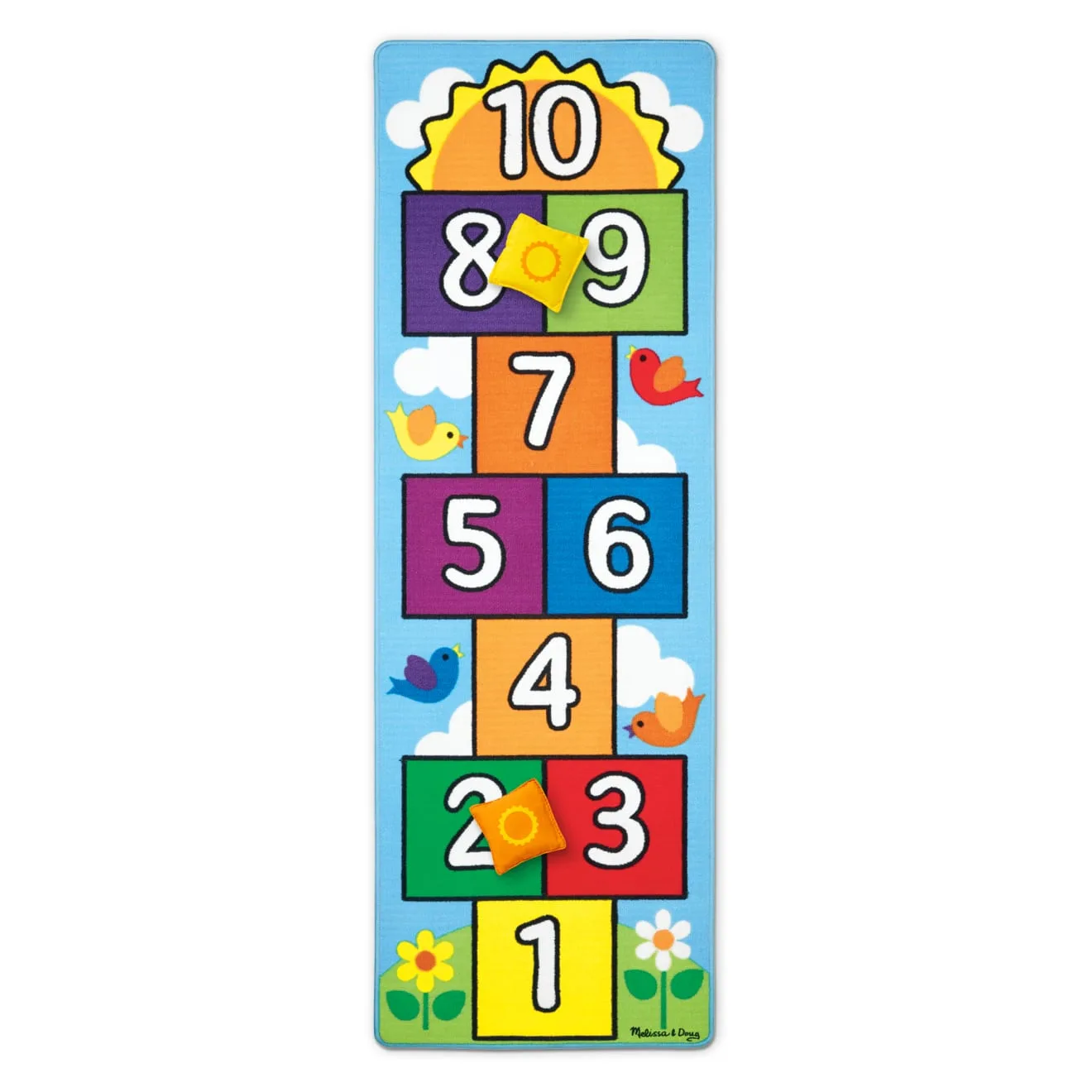
Hop & Count Hopscotch Rug