Quick Answer
For effective hot flash relief, hold a portable cooling fan close to your face and neck, use the cooling plate against pulse points, and adjust the fan speed to your comfort level.
Why Positioning Matters More Than Speed
When a hot flash hits, your body rapidly heats up. Directing airflow to areas with high blood flow—like your face, neck, and wrists—helps dissipate heat faster. Holding the fan closer (within a few inches) provides more targeted cooling than using it at arm's length.
The cooling plate on some fans adds a second layer of relief. Pressing it against your pulse points can quickly lower skin temperature, which is especially helpful during intense flashes. The Kinetik Wellbeing Portable Cooling Fan includes an ice-cold cooling plate for this purpose.
Battery Life and Charging Considerations
Portable fans are rechargeable, but battery life varies with speed settings. Higher speeds drain the battery faster. For all-day use, start on a lower speed and only increase when needed. Charging time can take a couple of hours, so it's wise to charge overnight or keep a power bank handy for longer outings.
If you're traveling, remember that the fan must be fully charged before a flight. Lithium-ion batteries are typically allowed in carry-on luggage, but check with your airline for specific rules.
5 Steps to Use Your Portable Cooling Fan Effectively
- Position the fan close to your face and neck: Hold the fan within 4–6 inches of your face, neck, or chest. Direct airflow to these areas to help cool your core quickly. Avoid holding it too far away, as the airflow loses effectiveness. Check that the airflow feels consistent; if it's too weak, move the fan closer before increasing speed.
- Choose the right speed setting: Start on the lowest speed and gradually increase until you feel relief. Using the lowest effective speed saves battery and prevents over-stimulation. Many users find low or medium sufficient for most hot flashes. If the fan feels too strong or too weak, adjust one speed at a time to find your comfort zone.
- Use the cooling plate on pulse points: If your fan has a cooling plate, press it against your wrists, neck, or temples for 10–15 seconds. This can provide a rapid cooling sensation that complements the airflow. Reapply as needed during a prolonged flash. If the plate no longer feels cool, wait a few minutes for it to re-chill before using again.
- Take breaks and stay hydrated: Use the fan in intervals—on for a few minutes, then off—to avoid over-cooling or exhausting the battery. Sip cool water between uses to support your body's temperature regulation. If you feel chilled or uncomfortable, turn the fan off and let your body adjust.
- Charge the fan regularly: Plug the fan into a USB charger when not in use, especially after a day of heavy use. A full charge ensures it's ready when a hot flash strikes. For travel, charge it the night before and consider carrying a power bank. Set a routine to charge the fan every evening, so it's always ready for the next day.
Product Spotlight
-
Kinetik Wellbeing | Portable Cooling Fan: The Kinetik Wellbeing Portable Cooling Fan features three fan speeds and an ice-cold cooling plate for targeted, fast-acting relief. You can choose a gentle breeze for subtle comfort or a stronger airflow for intense flashes, while the cooling plate adds extra relief on pulse points.
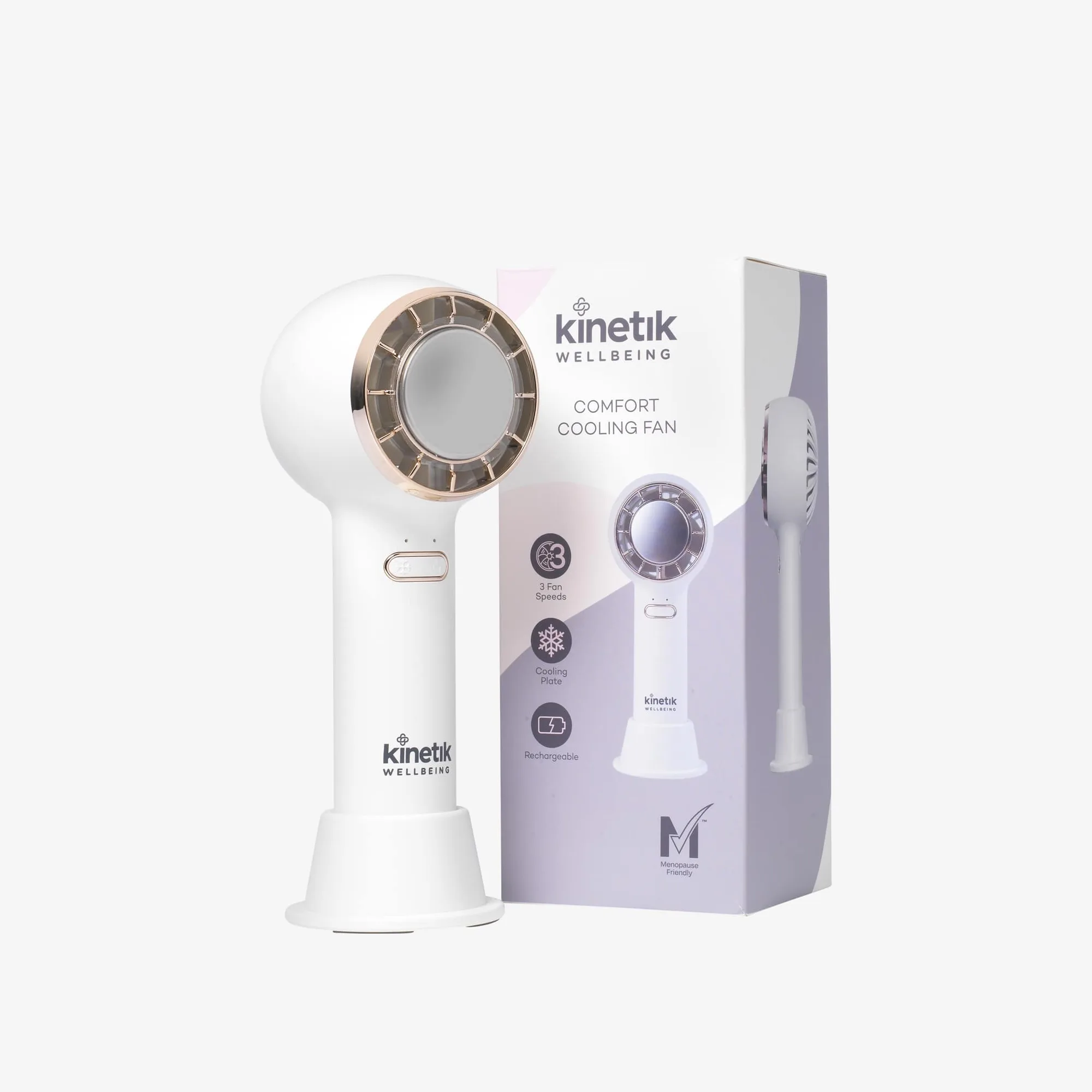
Kinetik Wellbeing | Portable Cooling Fan