Quick answer
Replace the Kreg 20V Ionic Drive Wet/Dry Vac HEPA filter when you notice a drop in suction, visible damage, or a persistent musty odor that cleaning won't fix. For most workshop users, that means every 3–6 months of regular use, or sooner if you're cutting a lot of MDF, drywall, or fine dust. The genuine replacement filter (product 280660) is a direct-fit part that keeps filtration at 99.97% for particles 0.3 microns and larger.
Signs your Kreg HEPA filter needs attention
The filter is doing its job quietly until it isn't. Watch for three concrete clues: the vac's suction feels weaker on the same material you cleaned last week, you see a visible tear or crushed pleats, or a musty smell comes out of the exhaust even after you've emptied the tank. Because the Kreg 20V Wet/Dry Vac uses HEPA-rated filtration to capture 99.97% of particles 0.3 microns and larger, a clogged or damaged filter doesn't just reduce airflow — it can let fine dust bypass the media and back into your shop air.
If you mainly pick up sawdust from a random orbit sander, expect the filter to load up faster than if you're vacuuming up drywall chunks or general debris. The sander's sealed dust containment system sends a lot of fine particles into the vac, so the filter is your last line of defense.
How to replace the filter step by step
- Unplug the vac or remove the 20V battery before you touch the filter. Mistake to avoid: working on a live tool because it's 'just a quick swap.'
- Release the tank latches and lift the motor housing off the tank. Checkpoint: set the housing upside down on a stable surface so the filter doesn't fall out.
- Twist the old HEPA filter counterclockwise and pull it off the filter mount. Mistake to avoid: yanking it straight off, which can crack the mount or tear the media and dump dust everywhere.
- Wipe the mounting area and the inside of the housing with a dry cloth. Checkpoint: if you see caked dust around the seal, that's a sign the old filter wasn't seated fully.
- Align the new filter's tabs with the mount and twist clockwise until it stops. Mistake to avoid: forcing it — if it doesn't turn easily, you're misaligned, not weak.
- Reassemble the motor housing onto the tank, latch it, and run the vac for 10 seconds. Checkpoint: listen for a smooth motor and feel strong suction at the hose end. If suction is still weak, check for a block in the hose before assuming the filter is bad.
Care habits that extend filter life
You can't wash a HEPA filter and expect it to keep its 99.97% rating — the pleats are delicate and water can degrade the media. Instead, tap the filter gently against the inside of a trash can every few tank empties to knock loose dust out of the pleats. Do this outdoors or with a shop vac running nearby if you're sensitive to dust. Avoid compressed air at high pressure; it can tear the pleats and ruin the seal.
Empty the tank before it reaches the max fill line. When debris piles up close to the filter, airflow drops and the motor works harder. If you're doing a big sanding session, check the filter afterward rather than waiting for your usual maintenance day. The 2.6-gallon capacity on the Kreg vac is generous for a compact unit, but fine dust fills it faster than you'd guess.
Filter replacement steps at a glance
- Power down and remove the battery: Unplug the vac or pull the 20V battery before any maintenance. Checkpoint: the motor should be completely off and the switch locked out.
- Open the tank and access the filter: Release the latches and lift the motor housing off the tank. Mistake to avoid: setting the housing on its side where the filter can fall and scatter dust.
- Remove the old filter: Twist counterclockwise and pull the filter off the mount. Checkpoint: inspect the mount for cracks or packed dust before installing the new filter.
- Install the new HEPA filter: Align tabs and twist clockwise until it seats firmly. Mistake to avoid: forcing the filter — it should turn smoothly when aligned.
- Reassemble and test: Latch the housing, then run the vac for a few seconds. Checkpoint: strong suction at the hose confirms a proper seal; weak suction means check the hose for blockages.
Product facts
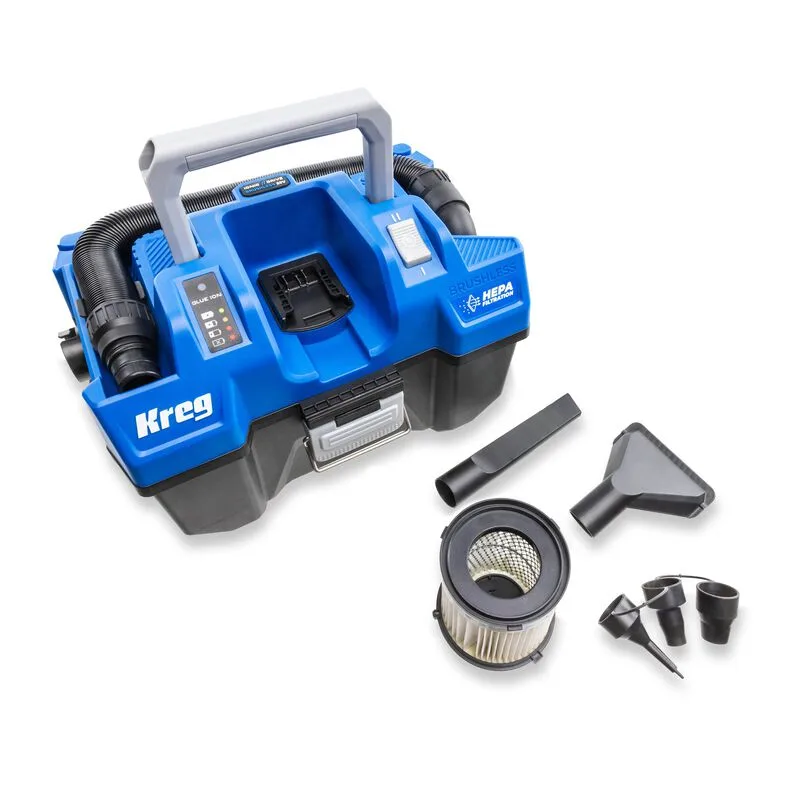
- Kreg 20V Ionic Drive™ Wet/Dry Vac HEPA Replacement Filter: Genuine HEPA replacement filter for the Kreg 20V Ionic Drive Wet/Dry Vac; captures 99.97% of particles 0.3 microns and larger. A correct-fit filter keeps the vac's HEPA rating intact, so fine dust stays out of your shop air instead of recirculating.
- Kreg 20V Ionic Drive™ Wet/Dry Vac with HEPA (Tool Only): Kreg 20V Ionic Drive Wet/Dry Vac with HEPA (Tool Only) has a universal connector that fits 1-1/4" and 36mm tool ports, 50 CFM suction, and a 7-foot hose. If you're replacing the filter because suction feels weak, confirm the hose and port connection are sealed first — a loose fit can mimic a clogged filter.
Keep a spare Kreg HEPA filter on the shelf so a clogged filter never sidelines a project. When suction drops, swap in the new filter, run a quick test, and get back to sanding or cleanup without waiting on a reorder.