Quick answer
To win Letter Tycoon more often, build words that buy high-value letter patents early, then use those patents to earn royalties whenever opponents play your letters. Balance each turn between scoring a word and investing in a patent, because the player who owns the most useful letters usually wins. For family game night, teach the patent-royalty loop first, then let everyone play a practice round before keeping score.
Why Letter Tycoon works for family game night
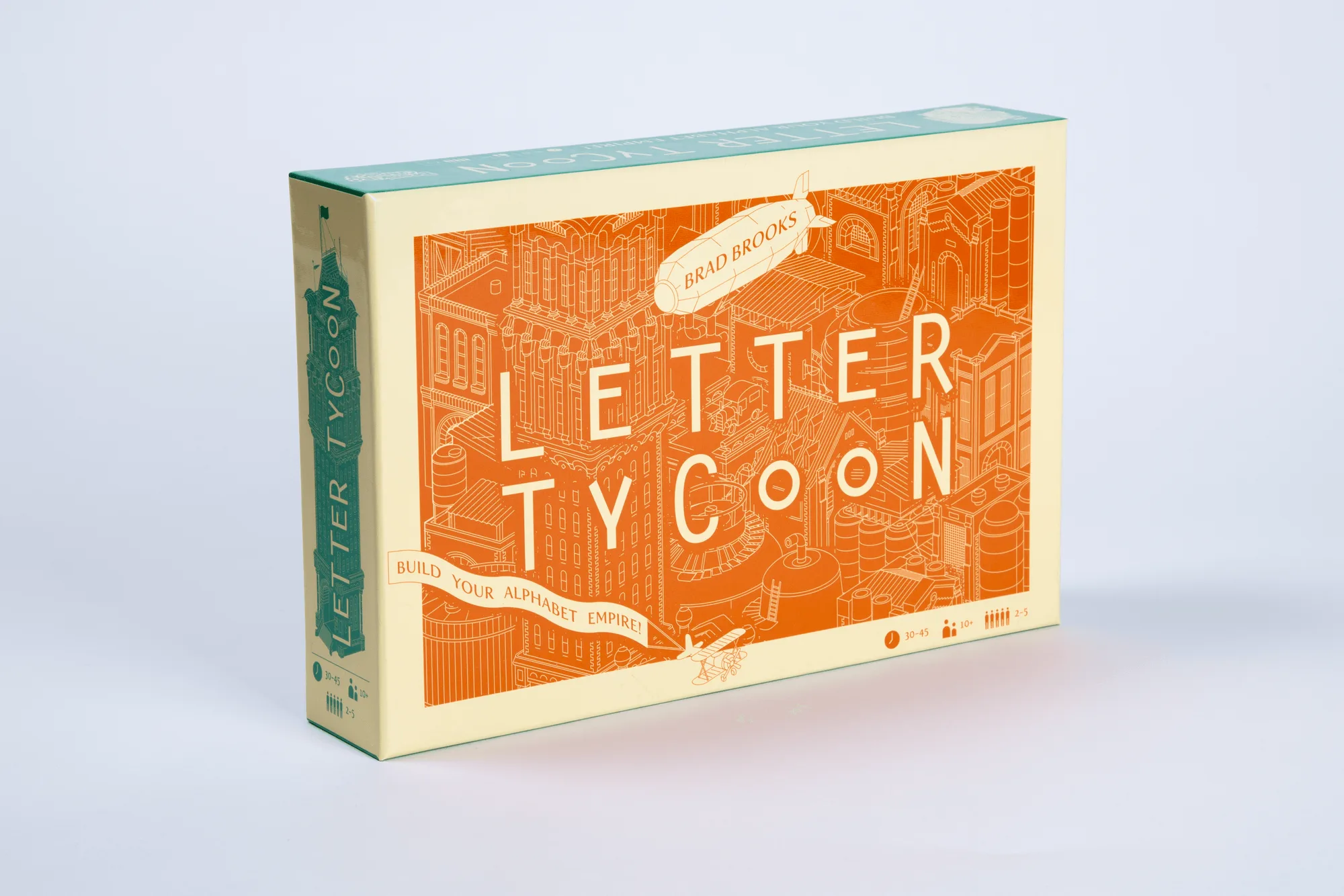
Letter Tycoon is a word-building board game for 2-5 players, ages 10 and up, with a 30-45 minute play time. That range fits a weeknight or a weekend gathering without dragging past bedtime. Each turn you use a hand of 7 cards plus any of the 3 community cards to make a word worth money and stocks. You then spend that money to buy letter patents, and those patents earn you royalties when other players use your letters. The result is a vocabulary game that rewards both word knowledge and light economic strategy, so younger players who know simpler words can still compete by choosing smart patents.
Set up the patent market before anyone draws
Lay out the letter patents in a clear row or grid so everyone can see which letters are still available and what they cost. This matters because the patent market is the main strategic layer of the game. If the patents are scattered, players default to just making words and ignore the investment side. A tidy market keeps the decision visible on every turn. Also separate the money and stock tokens by denomination so payouts move quickly.
Teach the royalty loop with a practice round
Before playing for real, run one open round where everyone makes a word, buys a patent if they can, and then watches what happens when someone else uses a patented letter. The most common mistake for new players is forgetting that patents pay you when opponents use those letters, not when you use them yourself. One practice round fixes that confusion faster than a rules explanation. After that, reset the market and start scoring.
Seven steps to stronger Letter Tycoon play
- 1. Scan the patent market before you look at your hand: Check which letters are still available and their prices first. Then look at your 7 cards and the 3 community cards to see which words you can actually build. Common mistake: building a word first and then discovering you cannot afford the patent you wanted. Checkpoint: you should know your target patent before you place a single card.
- 2. Prioritize high-frequency letters when buying patents: Letters like E, A, R, I, O, T, N, and S appear in many words, so opponents will trigger your royalties more often. A cheap common letter can out-earn an expensive rare one over a full game. Common mistake: buying the most expensive patent just because you can afford it. Checkpoint: ask how many words your family typically plays with that letter.
- 3. Use community cards to stretch a weak hand: The 3 community cards are shared, so they are the fastest way to turn a mediocre hand into a scoring word. Build your word around one or two community cards rather than ignoring them. Common mistake: treating community cards as a last resort instead of a core resource. Checkpoint: every turn, confirm whether a community card unlocks a longer word.
- 4. Balance scoring turns and investing turns: Some turns should maximize money and stocks from a word. Other turns should convert that money into a patent that pays you later. If you only score, you fall behind on royalties. If you only buy, you run out of cash. Common mistake: spending every dollar on patents and leaving no buffer for a strong word next turn. Checkpoint: keep enough cash to make a meaningful word on your next turn.
- 5. Track which letters opponents are collecting: If another player owns E and S, your word choices quietly pay them. You can still use those letters, but weigh whether a slightly lower-scoring word avoids a big royalty payout. Common mistake: ignoring the royalty cost of your own word until the payout happens. Checkpoint: before scoring, note who owns the letters in your word.
- 6. Keep a running score check at the halfway point: Letter Tycoon scores come from words, stocks, and royalties, so the leader is not always obvious. Pause around the 20-minute mark and estimate each player's position. If you are behind, shift toward patents that trigger often. Common mistake: assuming the player with the biggest single word is winning. Checkpoint: royalties often decide close games, so count them.
- 7. Adjust difficulty for younger or newer players: For ages 10 and up, the game already plays well, but you can help younger players by allowing a two-letter word when they are stuck or by letting them ask for one hint per turn. You can also play open-handed for the first game. Common mistake: playing full competitive rules with a first-timer and turning game night into a frustration night. Checkpoint: agree on house rules before the first turn, not mid-game.
Game facts that shape your strategy
- Letter Tycoon: Mensa Select Word-Building Strategy Game for Families and Friends, Ages 10+, 2-5 Players: Letter Tycoon is a Mensa Mind Games Winner for 2015 and plays 2-5 players, ages 10+, in 30-45 minutes. The award signals a well-tested design, and the player count and time fit a family game night slot without a long commitment.