Why monoblocks change your setup plan
A monoblock pair like the M700 gives each loudspeaker its own dedicated amplifier, which simplifies the signal path but adds practical questions about where to put two full-sized chassis, how to run cabling, and how to match them to your speakers. The M700 is a full-sized mono power amplifier, so plan for two identical units—one per channel—rather than a single stereo box.
The supplied catalog describes the M700 as an affordable, high-value monoblock pair that delivers a high level of control and command from your loudspeakers. That description is a manufacturer claim, not a measured promise of audible improvement in your room. Use the steps below to make the most of the pair while keeping expectations grounded in what the product information actually states.
Monoblock placement and cooling: a sensible sequence
The M700 records supplied here do not include specific clearance, temperature, or rack requirements. The steps below are general good practice for full-sized amplifiers; treat them as planning guidance, not manufacturer instructions.
- 1. Choose two stable, ventilated positions: Place each M700 on a solid surface near its speaker. Avoid stacking the two monoblocks directly on top of each other, and leave open space around each chassis so heat can escape. Because the supplied information does not give a minimum clearance, use your own judgment and check that the units do not feel hot to the touch after extended play.
- 2. Keep speaker cables short where practical: Monoblocks are often placed close to the speakers to shorten speaker cable runs. This is a common layout choice, not a requirement stated in the M700 records. If longer runs are unavoidable, route cables neatly and away from walkways.
- 3. Separate low-level and high-level cables: Run interconnect cables and speaker cables on separate paths where you can. This is standard wiring hygiene rather than an M700-specific rule, and it helps keep the installation tidy.
- 4. Confirm the layout before you connect anything: Decide which unit will drive the left speaker and which will drive the right before wiring. Labeling each monoblock now prevents confusion later.
Wiring a monoblock pair: what the records confirm
The supplied M700 records do not include a wiring diagram, terminal layout, or input/output descriptions. That means you should not rely on this article for connector-level instructions. Instead, use the manual that ships with your M700 pair for the exact input, output, and power connections.
What the records do confirm is that the M700 is a mono power amplifier, so each unit handles one channel. Plan one interconnect feed from your preamplifier to each monoblock, and one speaker cable from each monoblock to its corresponding speaker. If your preamplifier has balanced and single-ended outputs, check the M700 documentation for which inputs are supported before buying cables.
The M700 is available in Silver, pair and Black, pair. Color is the only variant listed in the supplied evidence; do not assume other options exist.
M700 facts that affect setup decisions
-
M700 Amplifier Pair: Full-sized mono power amplifier, sold as a pair. You need space for two chassis, not one stereo amplifier, and each unit drives one speaker.
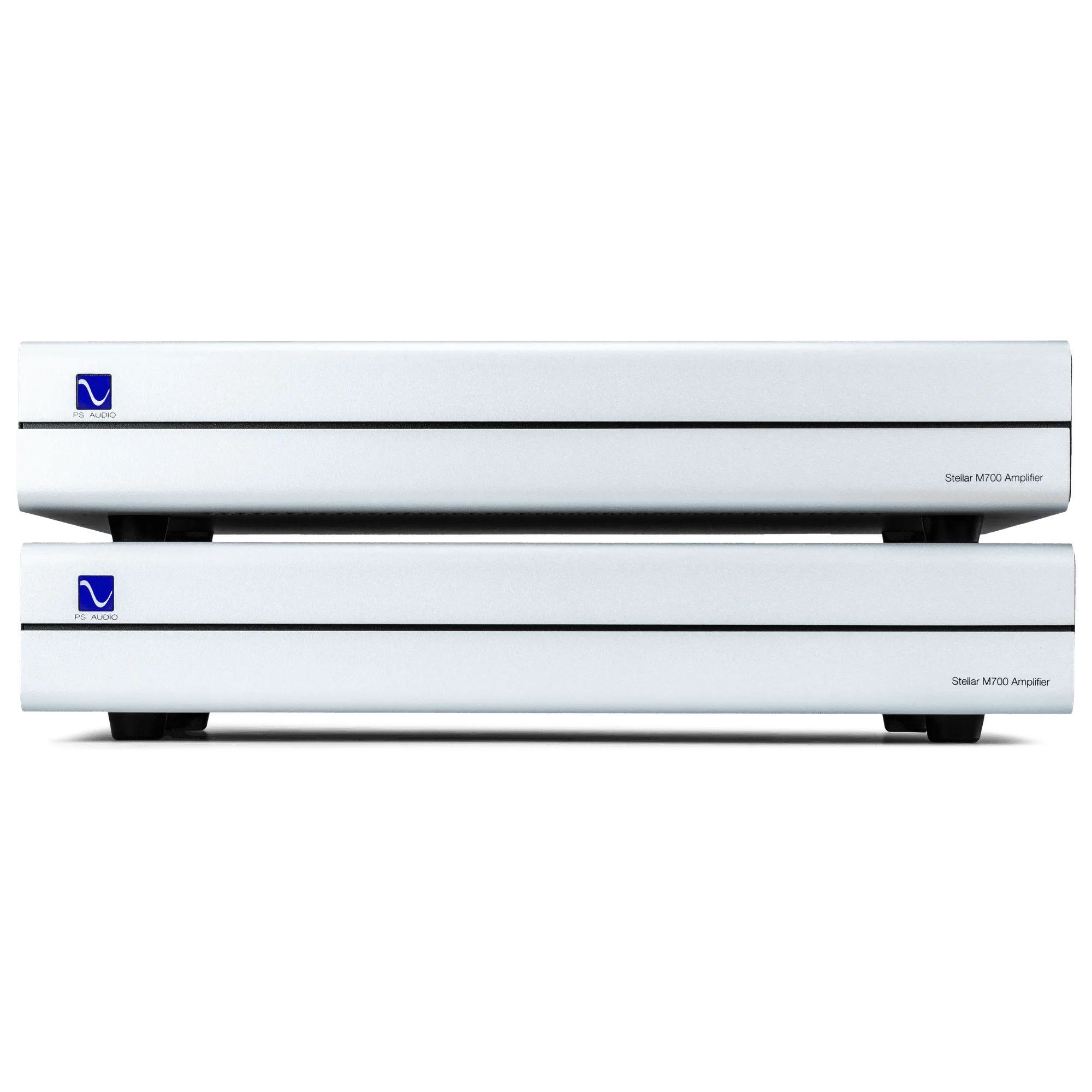
M700 Amplifier Pair
-
M700 Amplifier Pair: Manufacturer describes the M700 as an affordable, high-value monoblock pair that provides a high level of control and command from your loudspeakers. This is the stated design intent; it is not a guarantee of a specific sonic result in your room.
-
M700 Amplifier Pair: Available in Silver, pair and Black, pair. Finish is the only listed variant, so choose based on appearance rather than expecting different technical options.
Gain settings and level matching
The supplied M700 records do not list gain controls, gain ranges, or a gain-matching procedure. If your units have gain adjustments, follow the manufacturer's instructions for setting them. A common approach with monoblocks is to set both channels identically and then use your preamplifier's balance control if needed, but confirm this against your M700 documentation rather than treating it as a rule.
If you hear a level difference between channels, first check that both monoblocks are set the same way and that cables are fully seated. Do not assume a gain mismatch until you have ruled out wiring and settings.
Matching the M700 pair to your speakers
The M700 records supplied here do not include power ratings, impedance figures, or sensitivity recommendations. That limits how precisely anyone can tell you whether the M700 is a technical match for a given speaker. Use the following checks as a framework, and consult the full specifications for both products before you buy.
- Check speaker impedance against the amplifier's rated range: The M700's supported impedance range is not in the supplied evidence. Look it up in the full product documentation and compare it with your speaker's nominal impedance. A mismatch here is a genuine compatibility concern, not a matter of taste.
- Consider speaker sensitivity and your listening distance: Lower-sensitivity speakers or long listening distances typically demand more amplifier output. Without supplied M700 power figures, use the manufacturer's specifications to judge whether the pair has enough output for your room.
- Match the monoblock count to your system: A pair of M700s is intended for two channels: one monoblock per left and right speaker. If you are planning a multi-channel or bi-amplified setup, confirm the required number of units before ordering.
- Audition in your own room if possible: Manufacturer language about control and command is a claim, not a demonstration. Listening with your own speakers and room is the only way to judge whether the M700 pair suits your system.
What the supplied information does not confirm
The M700 records used for this guide do not include care instructions, safety warnings, operating procedures, specifications, or preparation steps. They also do not confirm cooling clearance, gain settings, input types, power output, or impedance compatibility. Treat any statement about those topics as unconfirmed unless it appears in the documentation that comes with your amplifier.
This is a limitation of the supplied evidence, not a statement that the full manufacturer documentation lacks those details. For anything that affects safety or compatibility, rely on the official M700 manual and the specifications published by PS Audio.