Quick Answer
Start with a simple circle game using a set of classic marbles, teach the basic flick and shooting stance, and set clear safety rules before the first roll.
Why Marbles Still Work for Modern Kids
Marbles are one of the oldest playground games because they need almost nothing except a flat surface and a few glass spheres. They teach hand-eye coordination, turn-taking, and a little bit of strategy without screens or batteries.
The physical skills transfer to other sports and games: a good marble flick uses the same pinch-and-release motion as a basketball free throw or a dart throw. Kids who struggle with fine motor control often improve quickly because marbles give instant, visible feedback.
Choosing the Right Marble Set
Not all marbles are equal. A colorful set with smooth, evenly sized glass marbles is easier for small hands to grip and flick than oddly shaped or rough ones. Look for a set with a mix of sizes so kids can practice with different weights.
A standard starter set like Playground Classics Classic Marbles gives you enough marbles for a full game and the bright swirls make it easy to tell whose marble is whose during play.
Safety First: Marbles Are Not for Toddlers
Marbles are a classic choking hazard for children under three, and even older kids need supervision. Set a firm rule: marbles stay on the floor or table, never in the mouth, nose, or ears.
If you have younger siblings at home, play in a room you can close off or use a tray with raised edges to keep marbles contained. After play, count the marbles and store them in a sealed container out of reach of little ones.
How to Play Marbles: Step-by-Step
- Set Up the Playing Area: Find a flat, hard surface like a sidewalk, patio, or indoor floor. Draw a circle about 1 to 3 feet in diameter using chalk or tape. Place 5 to 10 marbles in the center, spaced a little apart. Check that the surface has no cracks or slopes that could send marbles rolling off course.
- Learn the Flick (Knuckling Down): Kneel or crouch with one knuckle on the ground. Hold a shooter marble between your thumb and index finger, then flick your thumb to launch it. This is called 'knuckling down' and is the standard way to shoot. Practice the flick on a flat surface before starting the game; a common mistake is using your whole arm instead of just your thumb.
- Take Turns Shooting: The first player shoots from outside the circle, trying to knock marbles out. If they knock one out, they keep it and get another turn. If they miss or the shooter stays inside the circle, play passes to the next player. A common mistake is moving your shooting hand forward after the flick; keep your hand still to avoid a foul.
- Keep Score and Collect Marbles: Each marble knocked out of the circle is worth one point and is kept by the player. The game ends when all marbles are knocked out or when players agree to stop. The player with the most marbles wins. Count marbles at the end to make sure none are lost; this also helps prevent choking hazards for younger kids.
- Try a Simple Trick: The Bank Shot: Instead of shooting straight, aim at a wall or another marble to bounce your shooter into a target. This is an advanced move that helps you get around obstacles. Start with a straight shot before trying bank shots; a common mistake is using too much force, which makes the marble bounce unpredictably.
Product Spotlight
-
Playground Classics Classic Marbles: Playground Classics Classic Marbles is a colorful set with bright swirls and a smooth glass feel, designed for traditional marble games or starting a collection. The smooth, evenly sized marbles are easier for kids to grip and flick, making it a practical choice for beginners learning the basic techniques.
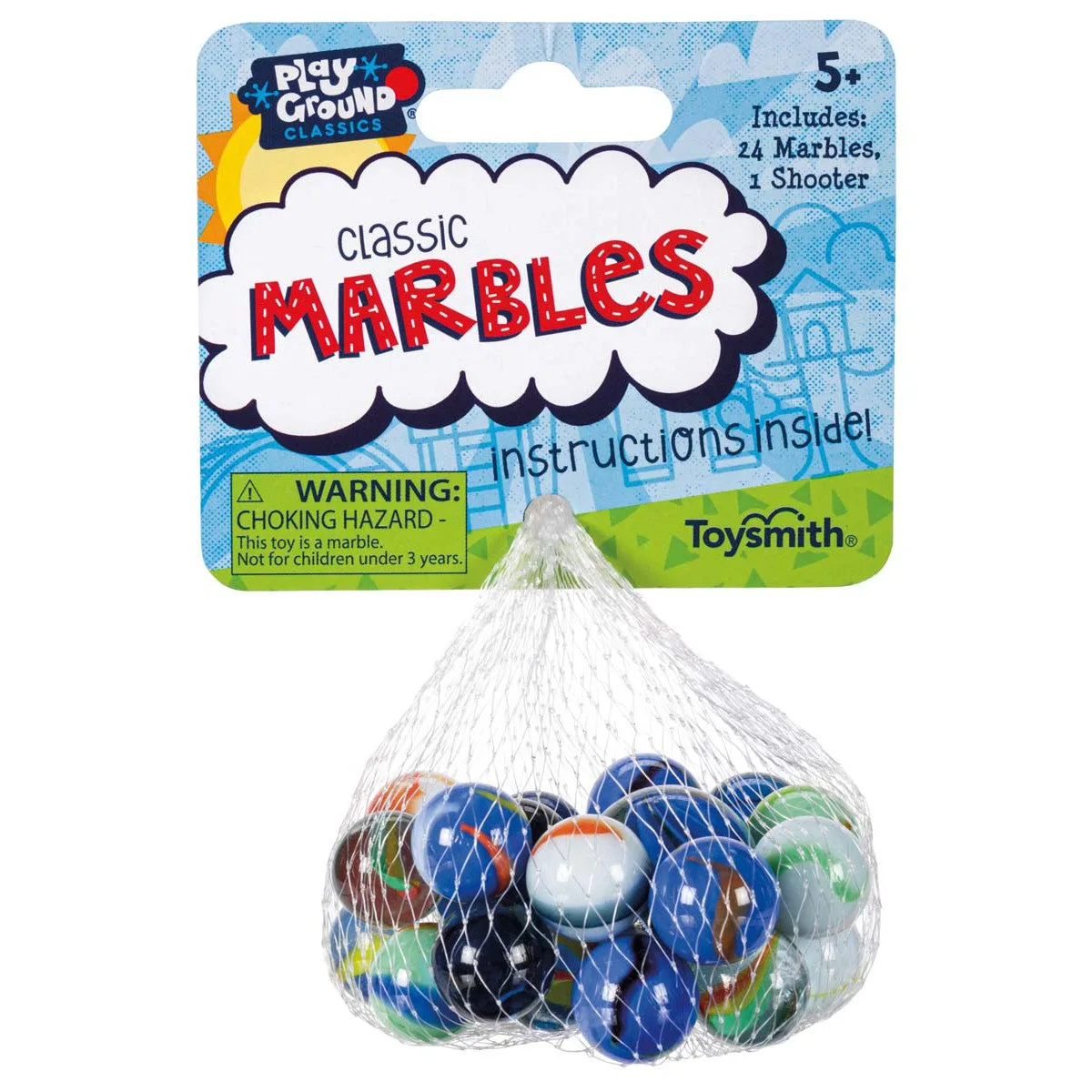
Playground Classics Classic Marbles
Once your kids master the basic circle game, try variations like 'Ringer' (a larger circle with more marbles) or 'Lagging' (a distance shooting contest). The key is to keep it fun and encourage practice. Remember to store your marbles in a secure container after each session.