Quick answer
The Moment Variable ND filter is a strong choice for shooters who need to quickly adapt to changing light without swapping filters, especially for video and bright-light photo work.
Why variable ND for video and photo
Variable ND filters let you dial in the exact amount of light reduction by rotating the filter ring. This is especially useful when you're moving between sunny and shaded areas or need to maintain a specific shutter angle for video.
For photo, a variable ND allows longer exposures or wider apertures in bright conditions without carrying multiple fixed-strength filters. The trade-off is that at maximum density, some variable NDs can introduce a cross-shaped color cast or uneven darkening, though the Moment filter is designed to minimize this.
What to consider before buying
The Moment Variable ND filter is available in different filter sizes and stop ranges. Choosing the right size is straightforward—match your lens thread. The stop range determines how much light you can block, which affects your shutter speed and aperture options.
If you primarily shoot video at 24 or 30 fps with a 180-degree shutter, you'll typically need 2-6 stops of reduction in bright daylight. For long-exposure photos, 6-10 stops may be more useful. The Moment filter covers a practical range, but check the specific stop options for your needs.
Decision rules for choosing a variable ND filter
- Assess your stop needs: For video at 24-30 fps with a 180-degree shutter in bright sun, you typically need 2-6 stops. For long-exposure photos (e.g., waterfalls or clouds), 6-10 stops are more common. The Moment filter offers a variable range—choose the option that covers your primary use.
- Match filter size to your lens: The Moment Variable ND is available in several thread sizes. Check your lens cap or barrel for the diameter (e.g., 67mm, 72mm, 82mm). Using a step-up ring is possible but can add vignetting on wide-angle lenses. If you have multiple lenses with different thread sizes, consider buying the largest size and using step-up rings.
- Consider the trade-off at maximum density: Like most variable NDs, the Moment filter can show uneven darkening or a slight color shift when cranked to its strongest setting. For critical work, test at your intended density before a shoot. If you need consistent color across the frame, a fixed ND may be more reliable. If you often shoot at maximum density, test the filter with your specific lens to confirm image quality.
Product facts
-
Moment Variable ND Filter: Moment Variable ND filters are like sunglasses for camera lenses, adjustable by rotating the filter ring. You can adapt exposure on the fly without swapping filters, saving time and keeping you in the shot.
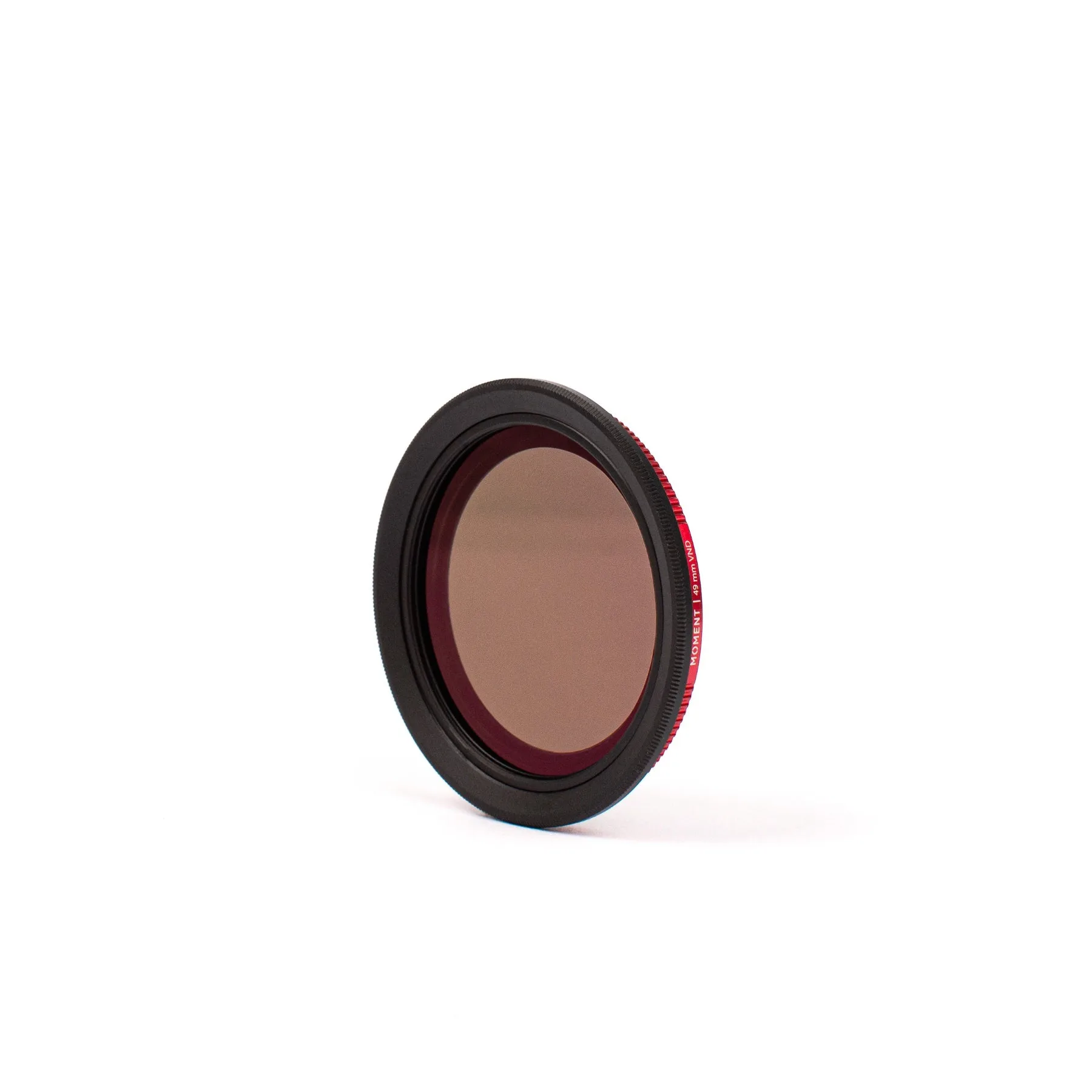
Moment Variable ND Filter
Who should buy this filter
Best for
- Video shooters who need to quickly adjust exposure between scenes without swapping filters
- Photographers who want a single filter for both shallow depth-of-field in bright light and occasional long exposures
Not ideal for
- Shooters who require consistent color and even darkening at maximum density for critical work
- Anyone who prefers fixed ND filters for predictable, repeatable results