Quick answer
Choose a no-pull harness that fits snugly without restricting movement, uses durable materials, and offers easy adjustment. A tactical-style vest with multiple straps gives you better control for small to medium dogs that pull.
Why fit matters more for small and medium dogs
Small and medium dogs have a narrower chest and shorter back than larger breeds, so a one-size-fits-all harness often gaps or slips. A harness with four adjustable straps—two at the shoulders and two at the chest—lets you dial in the fit without pinching or rubbing. This is especially important for dogs that pull because a loose harness can twist, reducing control and causing chafing.
Material and durability trade-offs
Heavier nylon (like 900D) resists abrasion and holds up during active walks or hikes, but it adds weight. For a small dog under 15 lb, a lighter 600D or padded mesh might be more comfortable. For a medium dog that pulls hard, a rugged vest with reinforced stitching is worth the extra ounces because it won't stretch or tear over time.
Quick-release vs. step-in designs
Quick-release buckles make it easy to put on and take off a harness, which is helpful if your dog is impatient or you go on multiple walks per day. Step-in styles are simpler but can be harder to adjust on a wriggly dog. For small and medium dogs that pull, a harness with two quick-release buckles and multiple adjustment points gives you the best balance of convenience and security.
How to choose: decision rules
- Measure your dog's chest and girth first: Use a soft tape measure around the widest part of the chest (just behind the front legs) and around the neck. Compare to the harness size chart, not the breed label. Small and medium dogs vary widely in build.
- Check for at least two adjustment points per side: A harness with only one strap at the chest often shifts on a dog that pulls. Look for separate shoulder and chest straps so you can tighten the chest without choking the neck. If the harness only adjusts at the chest, it may not stay centered on a narrow-chested dog.
- Prioritize material weight vs. durability: For a small dog under 15 lb, a 600D or padded mesh harness is lighter and more comfortable. For a medium dog that pulls hard, 900D nylon with reinforced stitching lasts longer. Trade weight for durability only when the dog's pulling force justifies it. A heavy harness on a small dog can cause fatigue; a flimsy harness on a strong puller will fail quickly.
Product spotlight
-
Tactical Dog Harness for Small Medium Dogs No Pull: This tactical dog harness uses 900D nylon with sturdy stitching and offers four fully adjustable straps (two shoulder, two chest) plus two quick-release buckles. The dense nylon resists wear from pulling, while the multiple adjustment points let you fit it securely on both small and medium body shapes without restricting movement.
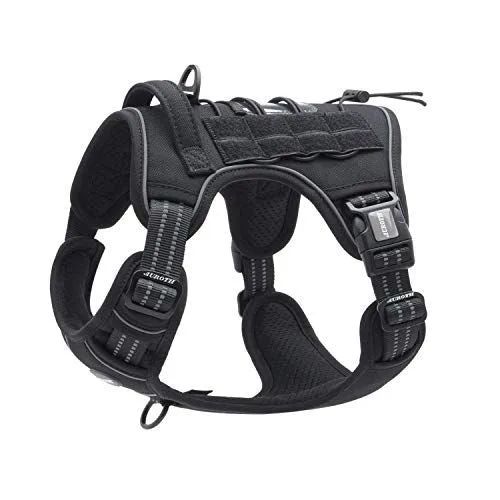
Tactical Dog Harness for Small Medium Dogs No Pull
Who this harness fits best
Best for
- Small to medium dogs (10–40 lb) that pull on walks or hikes
- Owners who want a secure, adjustable fit without constant re-tightening
Not ideal for
- Very small dogs under 10 lb (harness may be too heavy or bulky)
- Dogs that are already trained not to pull (a simpler step-in harness may be lighter and easier)