Quick answer
For a true first educational toy, start with the Play Cube if your baby is sitting and grabbing, because its multiple sides let them choose an activity instead of failing at one. Choose Lacing Animals if your baby already pinches small objects and needs a calm focus task. Save the Number Puzzle for when they can point to and name numbers, usually later. If you want a complete, age-matched set rather than a single piece, the Montessori Educational Box (25-27 Months) bundles six items so you do not have to guess.
Match the toy to the grip, not the age on the box
The most reliable buying signal is what your baby's hands can already do. A palmar grasp that rakes objects toward the palm is not ready for threading. A pincer grasp that pinches a pea-sized item is ready for lacing. Pointing with one finger and waiting for a response is the cue that a number puzzle will hold attention.
Watch for three minutes of free play before you buy. If your baby drops a toy after ten seconds and looks away, a single-activity toy will frustrate both of you. If they turn a toy over, bang it, and try the next side, a multi-activity toy earns its place.
What each toy actually asks your baby to do
The Number Puzzle asks for a single correct answer per piece: one number, one slot. That is excellent for repetition and early math talk, but it offers no second way to succeed. Lacing Animals asks for a sequence: hold the animal, aim the lace, pull through, repeat. That builds patience and hand-eye coordination, and it can be done wrong in a way your baby can see and correct. The Play Cube asks your baby to choose. Shape sorting, bead mazes, and spinning gears sit on different sides, so the toy adapts to the mood instead of demanding one task.
Because these are different jobs, they are not competitors. Many families keep one calm-focus toy and one choice-rich toy on the shelf at the same time, then rotate the third in later. Our guide to rotating toys in your monthly baby box covers a schedule for that.
baby box
Size, storage, and the reality of small homes
Footprint matters more than most buying guides admit. The Play Cube stands 15.5 × 15.5 × 28 cm, so it is a vertical object that needs floor space and a wall-free zone around it. The Number Puzzle is flat at 30 × 22.5 × 1.5 cm and slides into a book shelf. Lacing Animals is small at 6.5 × 27 cm, which makes it the easiest to pack for travel or a restaurant bag, but also the easiest to lose a piece from.
If you have limited floor space, the flat puzzle and the small lacing set will actually get used. If you have a dedicated play corner and want one object that grows with your baby, the cube earns its footprint.
When to buy a box instead of a single toy
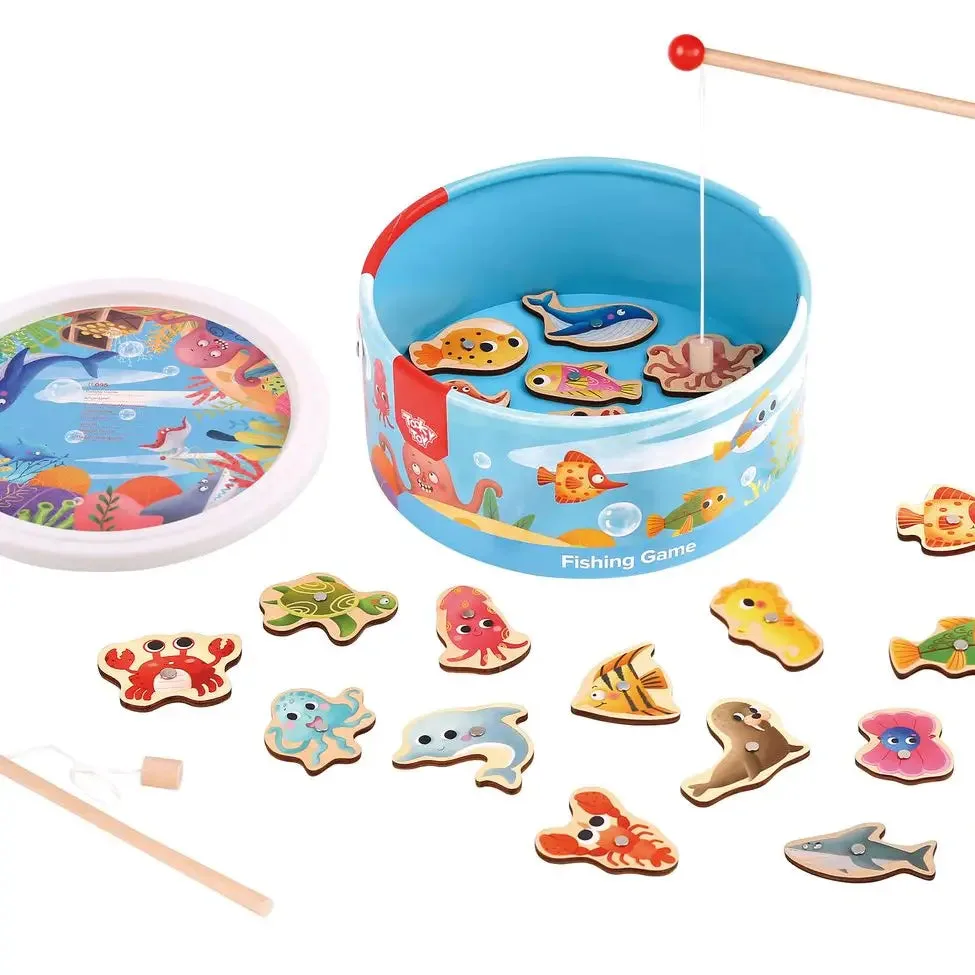
A single toy is the right call when you already know your baby's current skill and want to target it. A box is the right call when you are unsure what comes next, or when you want a set that was already matched to an age range. The Montessori Educational Box (25-27 Months) includes six products, among them a Fishing Game, Counting Shelf, Twisting Cube, and Wooden Push Car, all made from sustainable and safe material. That mix covers several skill levels at once, which reduces the chance that one item sits untouched.
Fishing Game
The trade-off is control. With a box you get a curated range rather than a single perfect match, and you may already own a similar piece. Check what you have before ordering so you are adding variety, not duplicates.
Decision rules for your first toy
- If your baby rakes objects with a whole-hand grasp: Skip lacing and number matching for now. Choose the Play Cube so they can bat, spin, and explore without a wrong answer. Recheck in four to six weeks for a pincer grasp.
- If your baby pinches small items and stays with one task: Choose Lacing Animals. The threading sequence rewards patience and gives a clear result they can repeat. Keep the pieces in a small pouch so nothing goes missing.
- If your baby points, names, or asks what things are: Choose the Number Puzzle. Counting and number recognition land best when your baby already wants to label the world. Do not buy it earlier as a math head start; it will sit unused.
- If you cannot watch your baby closely during play: Pick the largest single piece you can find, or wait. Small lacing parts and puzzle pieces are not for unsupervised floor time. Supervision is the real buying criterion, not age.
- If you are unsure what your baby needs next: Choose the Montessori Educational Box (25-27 Months) and use its six items as a live test of which skill your baby reaches for. Then buy a single toy that matches the winner.
Product facts to compare
- Number Puzzle: Wooden Number Puzzle that introduces counting, number recognition, and problem-solving; measures 30 × 22.5 × 1.5 cm (11.81 × 8.86 × 0.59 in). The flat, slim shape stores on a shelf and the single-slot design makes it a strong repetition tool once your baby can point and match.
- Lacing Animals: Wooden Lacing Animals set that develops fine motor skills, hand-eye coordination, and focus; measures 6.5 × 27 cm (2.56 × 10.63 in). The small size makes it the most portable option, and threading gives a visible cause-and-effect result your baby can repeat without adult help.
- Play Cube: Wooden Play Cube with multiple activities on each side, including shape sorting, bead mazes, and spinning gears; measures 15.5 × 15.5 × 28 cm (6.10 × 6.10 × 11.02 in). Multiple sides mean your baby can switch tasks instead of giving up, which suits short attention spans, but it needs floor space to stand safely.
- Montessori Educational Box (25-27 Months): Montessori Educational Box for ages 25-27 months with 6 products, including a Fishing Game, Counting Shelf, Twisting Cube, and Wooden Push Car, made from sustainable and safe material. A pre-matched set removes the guesswork and covers several skills, which is useful if you are unsure which single toy fits your baby right now.
Who each option fits
Best for
- Babies who are sitting, grabbing, and switching between activities
- Parents who want one object that covers several skills instead of three separate toys
- Families with a dedicated floor play area and room for a standing cube
Not for
- Babies still using a whole-hand rake grasp, who need a simpler grasping toy first
- Homes with no floor space for a 28 cm tall standing toy
- Parents who want a single targeted skill rather than a mixed set