Quick Answer
In Peptide, you draft amino acid cards and link them side-by-side to build peptide chains, using mRNA and tRNA cards to guide your sequences and ATP to fuel your moves. The player who builds the most valuable protein chains wins.
What Makes Peptide Different from Other Science Card Games
Peptide is an open card drafting and resource management game, not a trivia game. You don't just answer questions; you actively build polypeptide chains by matching amino acids in the correct order, which mirrors real RNA-to-protein translation. This means the game rewards planning and resource allocation, not just memory.
The game is designed for 2 to 5 players aged 10 and up, and a typical session lasts 30 to 45 minutes. Because it uses open drafting, all players see the available cards, so the challenge comes from anticipating what others need and deciding which amino acids to grab before they do.
Understanding the Science: Why It Matters for Gameplay
The game teaches the central dogma of molecular biology: DNA is transcribed into mRNA, which is then translated into a protein. In Peptide, you'll use mRNA cards to determine which amino acids you need, and tRNA cards to bring those amino acids to the ribosome. This isn't just flavor text; it directly affects your strategy.
Organelles like the nucleus, mitochondria, and vacuole play roles in the game, often providing bonuses or altering your resource economy. Knowing what each organelle does helps you decide when to focus on building chains versus investing in your cellular machinery.
If you're new to the science, the game includes accurate details that can serve as a learning tool. But don't worry—you don't need a biology degree to play. The rules are intuitive, and the science is integrated so you learn as you play.
How to Play Peptide: Step-by-Step
- Set Up the Game: Shuffle the amino acid cards and place them in a draw pile. Deal a starting hand of amino acids and resource cards (mRNA, tRNA, ATP) to each player. Place the organelle cards face-up in the center if using them. Each player chooses a start player token. Common mistake: Forgetting to set aside the correct number of ATP tokens. Check the rulebook for the starting amount.
- Understand the Turn Structure: On your turn, you may either draft an amino acid card from the open display or draw from the deck. Then you may play cards from your hand to build your peptide chain, following the sequence indicated by your mRNA cards. You can also use ATP to activate organelle abilities. Remember: You can only play one amino acid per turn unless a card says otherwise. Don't try to build your whole chain at once.
- Build Your Peptide Chain: To add an amino acid to your chain, match the amino acid on your mRNA card. Place the amino acid card next to your existing chain, creating a peptide bond. Some amino acids have special abilities that trigger when added. Checkpoint: Ensure the amino acid you play matches the next codon on your mRNA card. If it doesn't, you can't play it.
- Use Resource Cards Wisely: mRNA cards tell you the sequence to build. tRNA cards let you swap or fetch specific amino acids. ATP is used to activate organelle powers or to draw extra cards. Manage these resources to keep your chain growing. Common mistake: Hoarding ATP until the end. Use it early to gain momentum, but save enough for key organelle activations.
- Score and End the Game: The game ends when a player completes a certain number of peptide chains or when the draw pile runs out. Score points for each amino acid in your chains, plus bonuses for completed chains and organelle bonuses. The player with the most points wins. Remember: Unused resources don't score. Spend them to maximize your chain length before the game ends.
Product Facts
-
Peptide: A Protein Building Game | A Strategy Card Game with Accurate Science for Gamers and Teachers | Teaches Amino Acids, mRNA, Organelles: Peptide is an open card drafting and resource management game for 2-5 players, ages 10+, with a play time of 30-45 minutes. This means the game is quick to learn and fits well into a game night, even with younger players, while still offering enough depth for strategy fans.
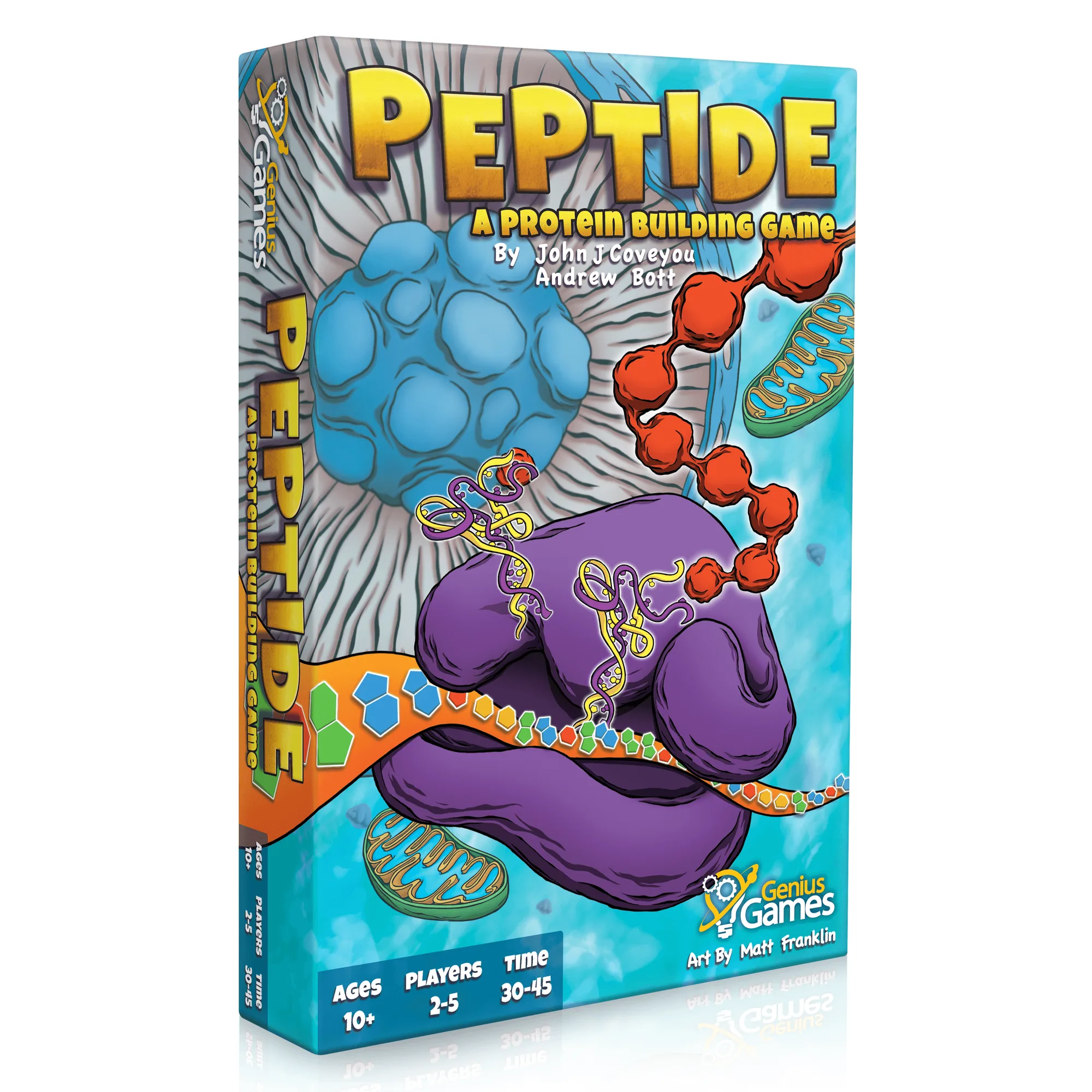
Peptide: A Protein Building Game | A Strategy Card Game with Accurate Science for Gamers and Teachers | Teaches Amino Acids, mRNA, Organelles