Quick answer
Choose single vision lenses if you need one consistent focal distance (e.g., distance-only or reading). Choose progressive lenses if you need clear vision at multiple distances without switching glasses.
The main trade-off: simplicity vs. versatility
Single vision lenses correct one field of vision: distance, intermediate, or near. They are simple, lightweight, and often more affordable. Progressive lenses offer a continuous gradient of power from distance at the top to near at the bottom, so you can see clearly at all distances without a visible line. However, they require a short adaptation period and may not be ideal for dynamic activities like sports.
When single vision makes more sense
If you only need glasses for driving, watching TV, or reading, single vision lenses are a straightforward choice. They also pair well with specialty features like photochromic tints, since the lens design is simpler. For example, a single vision photochromic lens adapts to light changes and is available in multiple tint colors and coatings — ideal for outdoor daily wear.
When progressive lenses are worth the switch
If you already wear bifocals or find yourself swapping between distance and reading glasses, progressives eliminate that hassle. They work well for office work, computer use, and driving. For outdoor use, a progressive polarized sunglass lens can reduce glare while providing clear vision at all distances, though the polarized filter may darken digital screens slightly.
Decision rules for choosing your lens type
- Rule 1: Define your primary visual need: If you need clear vision at one distance (e.g., distance only, or reading only), choose single vision. If you need clear vision at two or more distances (distance, intermediate, near), choose progressive.
- Rule 2: Consider your daily activities: For sports, especially those with quick head movements (cycling, running), single vision lenses are easier to adapt to. For desk work, driving, or general daily wear, progressive lenses offer convenience. If you play sports, single vision with photochromic or polarized tint can be a great fit.
- Rule 3: Evaluate adaptation willingness: Progressive lenses require a short learning period (usually a few days to two weeks) to adjust to the peripheral distortion. Single vision lenses have no adaptation period. If you are not willing to adapt, stick with single vision.
Product facts at a glance
-
Single Vision Photochromic (Light-Responsive) Lenses: Single Vision Photochromic (Light-Responsive) Lenses are available in a 1.57 index and adapt to changing light conditions. Tint colors include Gray, Green, Brown, or Pink, with coating options of No Coating, Anti-Reflective, or others. This makes them a versatile everyday lens for someone who wants one pair of glasses that works indoors and outdoors without switching frames.
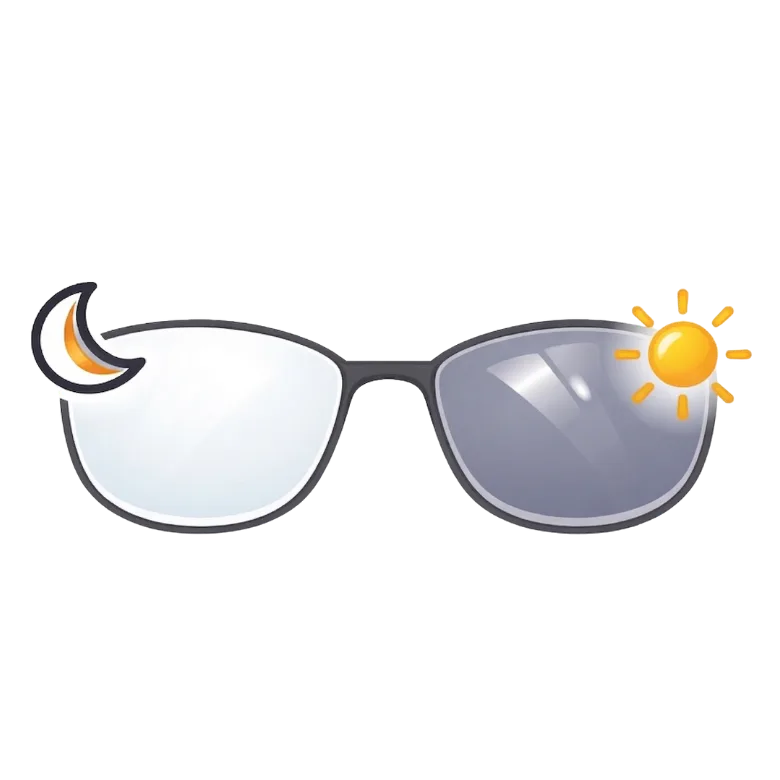
Single Vision Photochromic (Light-Responsive) Lenses
-
Progressive Polarized Sunglasses Lenses: Progressive Polarized Sunglasses Lenses are offered in 1.56, 1.61, and 1.67 indexes, with or without anti-reflective or hydrophobic coatings. The multiple index options let you balance thickness and weight, while the polarized filter reduces glare — ideal for driving or outdoor activities where you need clear vision at all distances.

Progressive Polarized Sunglasses Lenses
Who should choose which
Best for
- People who need one consistent focal distance (e.g., distance-only drivers, readers)
- Active individuals who play sports and want minimal adaptation
Not for
- People who need clear vision at multiple distances without switching glasses
- Those who are willing to adapt to a new lens design for added convenience