Quick answer
For most RMSc footprint red dots, battery life depends on the battery type (CR1620 vs CR2032), the reticle brightness setting, and whether the dot has auto-shutoff or motion activation. A Viridian RMSc with a CR1620 battery typically runs 30,000 hours on low brightness, but high brightness or constant-on use will drain it faster.
Battery type and size matter
RMSc footprint sights often use a CR1620 battery because it fits the slim slide profile. The trade-off is lower capacity (about 70 mAh) compared to a CR2032 (about 220 mAh) used in larger optics. This means you'll need to replace the battery more often, especially if you run the dot at high brightness all day.
If you carry daily, consider whether the sight has an auto-shutoff or motion-activated wake feature to extend battery life. Without it, you might replace the battery every few months instead of every year.
Brightness settings and real-world runtime
Manufacturers often advertise battery life based on the lowest brightness setting. In practice, most users run the dot at medium to high brightness for daylight carry, which can cut battery life by 50-75%. A sight rated for 30,000 hours (3.4 years) at low may only last 8,000-10,000 hours at medium brightness.
For a Viridian RMSc, the CR1620 battery delivers a compact package, but you should plan to change the battery every 6-12 months if you use it daily at medium brightness. Keep a spare battery in your range bag.
Power options: manual vs automatic
Some RMSc sights have manual brightness adjustment only, while others include auto-brightness sensors or motion-activated illumination. Auto-brightness can extend battery life by dimming the dot in low light, but it may not always match your preference (e.g., too dim in a dark room). Motion activation (shake-awake) turns the dot off after a period of inactivity and turns it back on when you move the gun. This is ideal for carry use because it preserves battery while you're not drawing.
The Viridian RMSc uses a manual brightness adjustment with a rotary dial. It does not have auto-brightness or motion activation, so you must remember to turn it off when not in use. This makes it a simpler, more reliable option for range use but less convenient for daily carry.
Decision rules for choosing an RMSc red dot based on battery life
- If you carry daily: Choose a sight with motion activation (shake-awake) to extend battery life. Without it, you may need to replace the battery every 3-6 months. Check the Viridian RMSc lacks motion activation; consider a model with auto-off feature.
- If you shoot mostly at the range: A manual brightness dial is fine. You can turn it off after each session. Battery life is less critical here. The Viridian RMSc is a good fit for range use due to its simple manual control.
- If you want maximum battery runtime: Look for a sight that uses a CR2032 battery (larger capacity) or has a solar panel. These are less common in RMSc footprint but exist in some models. The Viridian RMSc uses CR1620; plan for more frequent battery changes.
- If you need a compact sight for a slim slide: The CR1620 battery is the standard for thin RMSc sights. Accept the shorter battery life as a trade-off for concealability. The Viridian RMSc fits this category perfectly.
Product facts
-
Viridian RMSc: The Apollo Viridian RMSc uses a CR1620 battery and features a 7075 aluminum housing with IPX7 water resistance. The CR1620 battery keeps the sight compact for slim slides, but you'll need to replace it more often than a larger battery sight, especially at higher brightness settings.
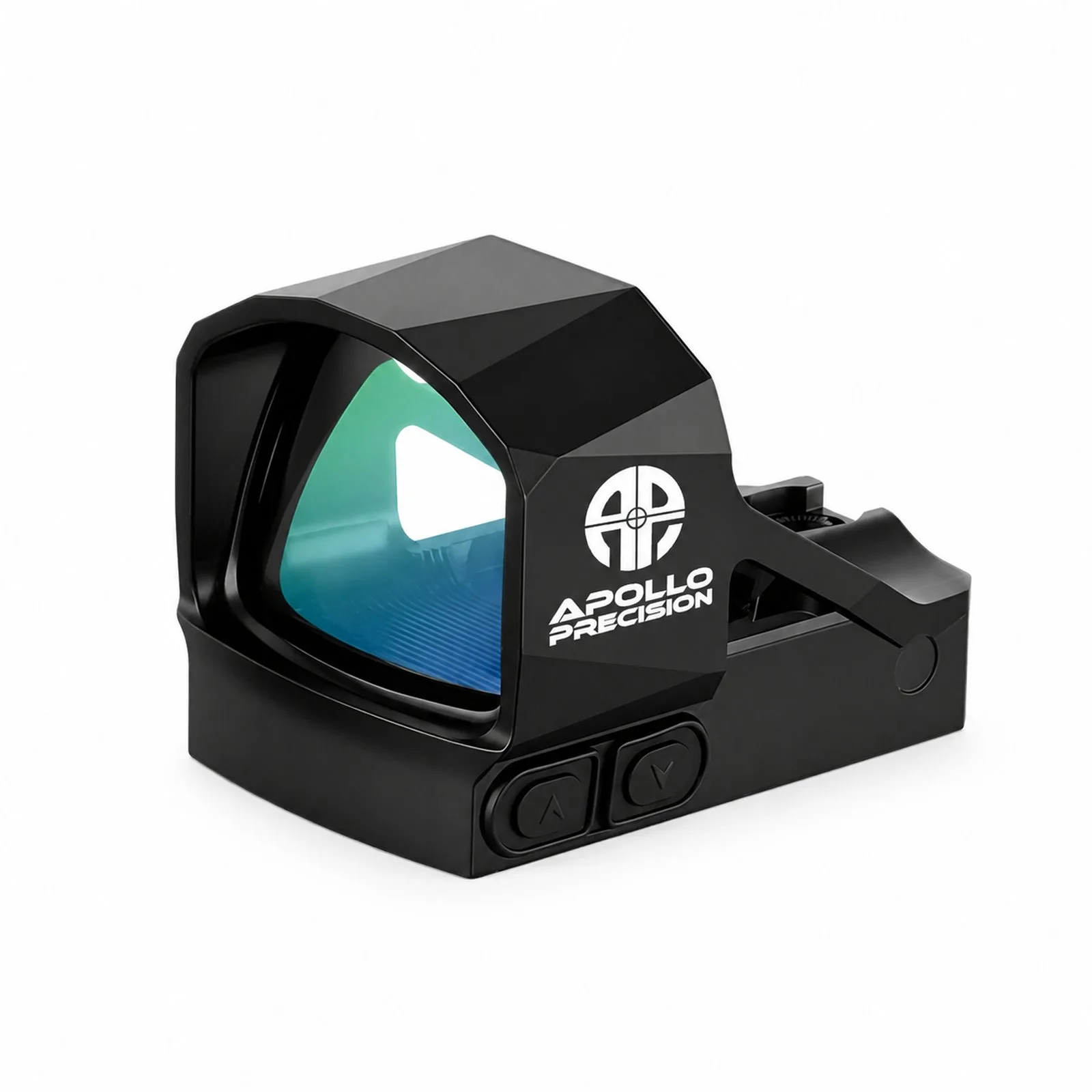
Viridian RMSc
Who should choose the Viridian RMSc
Best for
- Range shooters who prefer a simple manual brightness dial
- Users who need a compact, durable RMSc sight for a slim slide
- Those who don't mind changing the battery every 6-12 months
Not for
- Daily carriers who want motion-activated auto-off to save battery
- Users who want maximum battery life without frequent battery changes