Quick Answer
For street and landscape work on Canon RF APS-C bodies, set the SIGMA 16mm F1.4 DC DN to f/5.6–f/8 for sharpness, use autofocus with face/eye detection for street, and manual focus with focus peaking for landscapes.
Why the Sigma 16mm f/1.4 suits both genres
The SIGMA 16mm F1.4 DC DN Contemporary is a fast wide-angle prime designed for Canon RF mount APS-C cameras. Its 24mm full-frame equivalent field of view is wide enough for immersive street scenes and expansive landscapes, while the f/1.4 aperture helps in low light and adds subject separation when needed.
Native RF mount means no adapter, so autofocus and lens corrections work seamlessly with Canon bodies—a practical advantage when you're switching quickly between street and landscape shots.
Trade-offs to keep in mind
At f/1.4, depth of field is shallow, which can be great for isolating a subject but may cause missed focus on moving street subjects. For landscapes, stopping down to f/8 or f/11 increases depth of field but also increases diffraction slightly—find the sweet spot for your scene.
The lens is compact for its speed, but it's not weather-sealed, so protect it in rain or dusty conditions.
Step-by-Step Setup
- Set aperture for sharpness: For landscapes, use f/8 as a starting point to maximize depth of field and lens sharpness. For street, f/2.8–f/4 balances subject isolation with keeping more of the scene in focus. Check your shutter speed to avoid camera shake when stopping down.
- Choose autofocus mode: For street photography, use AF-C (continuous) with face/eye detection to track moving subjects. For landscapes, switch to AF-S (single) and focus about one-third into the scene for optimal hyperfocal distance. If focus is off, try manual focus with focus peaking for precise control.
- Set ISO and shutter speed: In daylight, keep ISO at 100 and use a shutter speed of 1/250s or faster for street to freeze motion. For landscapes, a tripod allows slower speeds and lower ISO for maximum image quality. When handholding, ensure shutter speed is at least 1/(focal length) to avoid blur.
- Use exposure compensation wisely: For bright skies in landscapes, dial in -0.7 to -1 EV to avoid blown highlights. For street, use +0.3 to +0.7 EV in shadowy scenes to lift details. Review your histogram to confirm you're not clipping highlights or shadows.
- Compose with wide-angle rules: Get close to your subject for street to create dynamic perspective. For landscapes, include a strong foreground element to add depth, and use the rule of thirds for balanced composition. Avoid placing the horizon in the center—choose upper or lower third for more impact.
- Apply lens corrections: Enable in-camera lens corrections for distortion and chromatic aberration to ensure clean edges, especially for architecture and landscape lines. If you shoot raw, corrections are applied in post—use your editing software's profile.
Lens at a glance
-
SIGMA 16mm F1.4 DC DN Contemporary for Canon RF: The SIGMA 16mm F1.4 DC DN Contemporary is a high-performance prime lens made for Canon RF Mount systems, delivering high-quality results in a native mount. You get direct compatibility with Canon RF bodies, so autofocus and image stabilization work without adapters, making it a hassle-free wide-angle option for both street and landscape.
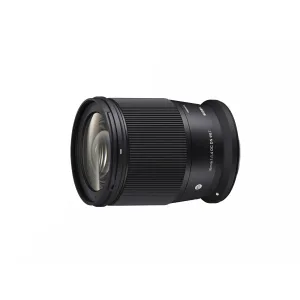
SIGMA 16mm F1.4 DC DN Contemporary for Canon RF