Quick answer
If you shoot on a Canon RF-mount mirrorless body and want native autofocus with built-in stabilization, choose the Canon RF 24-70mm f/2.8L. If you're on a budget or use an EF-mount DSLR (with adapter), the Sigma 24-70mm f/2.8 Art offers excellent optical quality at a lower price.
Optical design and sharpness
Both lenses are designed for full-frame sensors and share a fast f/2.8 aperture, making them versatile for low-light and portrait work. The Sigma Art lens uses three SLD (Special Low Dispersion) elements and four aspherical elements to reduce chromatic and spherical aberrations, which helps control color fringing and maintain sharpness across the frame.
The Canon RF lens also emphasizes sharpness, but its key advantage is the integrated 5-stop image stabilization, which lets you shoot at slower shutter speeds without a tripod. The Sigma lens lacks built-in stabilization, so you'll need to rely on your camera body's IBIS (if available) or a monopod in low light.
Autofocus performance
Autofocus is a major differentiator. The Canon RF lens uses a Nano USM motor, which delivers fast and silent AF with exceptional smoothness—ideal for both stills and video. The Sigma Art lens uses a conventional HSM (Hyper Sonic Motor), which is reliable but not as quick or quiet as the Nano USM system.
Additionally, the Canon RF lens is a native RF-mount design, so it communicates directly with Canon's mirrorless cameras for optimal AF tracking and lens corrections. The Sigma lens is designed for Canon EF mount, meaning you'll need an adapter on RF bodies, which can slightly slow autofocus and add bulk.
Trade-off decision guide
- Budget vs. performance: The Sigma Art lens is significantly cheaper (catalog price USD 1409.40 vs. USD 2479.38) and offers comparable optical quality, but you lose stabilization and native RF autofocus. If budget is a priority and you can live without stabilization, the Sigma is the better value.
- Stabilization vs. weight: The Canon RF lens has 5-stop IS, which is a huge advantage for handheld video and low-light stills, but it comes at a higher price and likely more weight. If you shoot handheld video or often forget your tripod, the Canon's IS is worth the premium.
- Autofocus speed and silence: The Canon RF's Nano USM is faster and quieter than the Sigma's HSM, making it the better choice for video and fast-action photography. If you rely on autofocus for sports or wildlife, the Canon RF is the safer bet.
Product facts
-
Sigma 24-70mm f/2.8 DG OS HSM Art Lens Canon Mount: The Sigma 24-70mm f/2.8 DG OS HSM Art Lens features three SLD elements and four aspherical elements to reduce chromatic and spherical aberrations. This optical design helps deliver sharp, well-corrected images across the zoom range, making it a strong choice for landscape and portrait photographers who prioritize image quality.
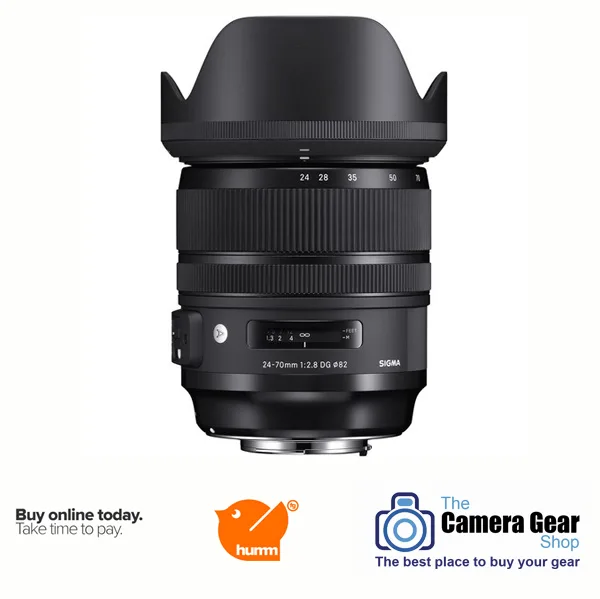
Sigma 24-70mm f/2.8 DG OS HSM Art Lens Canon Mount
-
Canon RF 24-70mm f/2.8L IS USM Lens: The Canon RF 24-70mm f/2.8L IS USM lens has 5-stop image stabilization and a Nano USM motor for fast, silent autofocus. The built-in stabilization lets you shoot handheld in low light with slower shutter speeds, while the quiet AF is ideal for video recording without distracting noise.
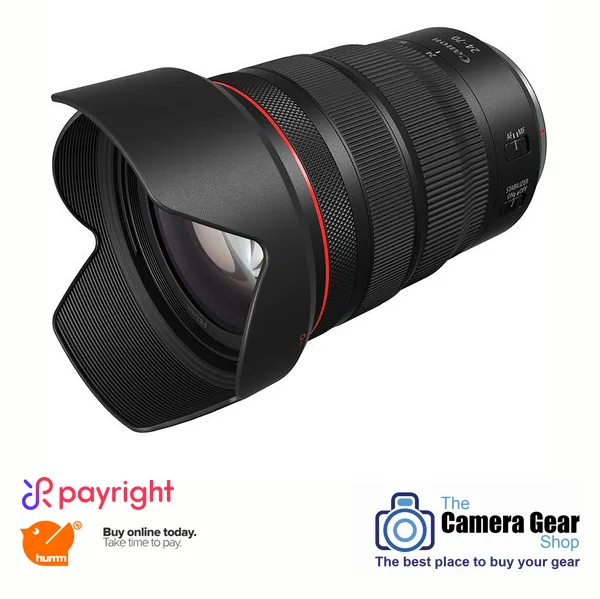
Canon RF 24-70mm f/2.8L IS USM Lens
Which lens should you choose?
Best for
- Photographers on a budget who want a versatile f/2.8 zoom for EF-mount DSLRs or adapted mirrorless bodies.
- Anyone who prioritizes optical quality and doesn't need built-in stabilization.
Not for
- Video shooters who need silent, continuous autofocus and built-in stabilization.
- Canon RF mirrorless users who want native mount performance without an adapter.