Quick answer
For most commercial sight glass and instrument window applications, Borofloat 33 offers the best value, while fused silica provides superior thermal stability and transmission into the near-infrared.
What matters in a square window substrate
Square windows are common in sight glasses, instrument housings, and beamsplitter substrates. The substrate choice affects transmission range, thermal performance, and cost. All three options here share a 60-40 scratch-dig surface quality and 85% clear aperture, so the differences come down to material properties and tolerance specs.
Trade-offs to consider
- Budget-friendly choice: Choose Borofloat 33 when cost is the primary concern and the application does not need tight surface accuracy or extended IR transmission. Its 5λ/inch surface accuracy and +/- 0.250 mm thickness tolerance are sufficient for basic sight glasses and protective windows.
- Precision and IR transmission: Choose low OH fused silica when you need ≤2λ/inch surface accuracy, low thermal expansion, or transmission beyond 2.5 microns. The higher cost is justified for laser windows, thermal imaging covers, or any setup that experiences temperature swings.
- Middle ground: Choose G1 fused quartz when you want better surface accuracy than Borofloat without paying the full fused silica premium. It works well for instrument windows and beamsplitter substrates that need decent flatness but do not require NIR transmission.
Substrate facts at a glance
-
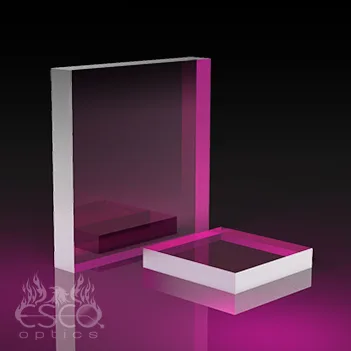
Commercial Quality Windows, Square, Borofloat 33: Borofloat 33 has a thickness tolerance of +/- 0.250 mm and surface accuracy of 5λ per inch. The looser tolerances keep cost low, making it ideal for non-critical sight glass and vacuum window applications where precision is secondary.
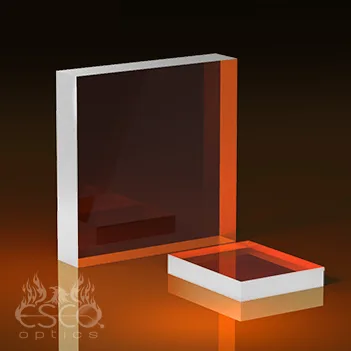
Commercial Quality Windows, Square, Borofloat 33
-
Commercial Quality Windows, Square, I2-IR Low OH Grade Fused Silica: Low OH IR grade fused silica provides exceptional transmission up to 3 microns and a low coefficient of thermal expansion. This substrate handles thermal cycling and NIR applications without distorting, suitable for laser windows and high-temperature environments.
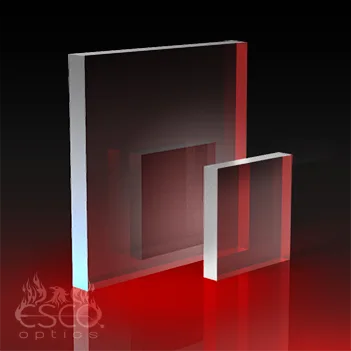
Commercial Quality Windows, Square, I2-IR Low OH Grade Fused Silica
-
Commercial Quality Windows, Square, G1 Commercial Grade Fused Quartz: G1 commercial grade fused quartz offers ≤2λ per inch surface accuracy and a lower price than fused silica. It bridges the gap between Borofloat 33 and fused silica, giving better surface accuracy than Borofloat at a moderate cost.
Which substrate fits your project?
Best for
- Borofloat 33: Cost-sensitive sight glasses, vacuum windows, and welding window substrates where precision is not critical.
- Fused silica: Applications needing NIR transmission up to 3 microns, thermal stability, or tight surface flatness.
- Fused quartz: General instrument windows and beamsplitter substrates that require better accuracy than Borofloat at a moderate price.
Not for
- Borofloat 33 is not suitable for high-precision optics or applications requiring transmission beyond 2.5 microns.
- Fused silica may be overkill for simple protective windows where Borofloat 33 would suffice.