Quick answer
Do a stair gate safety check once a month and after any move, tighten every fitting, and test the latch one-handed while holding something bulky. Pair that with a fixed fireguard around any open heat source and re-measure your openings before you buy. Safety hardware only works when it is fitted to the right width and checked on a schedule.
Measure the opening before you buy anything
Baby gate width measuring is the step most parents rush, and it is the reason gates wobble or refuse to latch. Measure the narrowest point of the opening, not the widest, and measure at the height where the gate will actually sit. Skirting boards, door frames and uneven walls can shave centimetres off a gap that looked fine at floor level.
Write the number down and compare it with the stated fit range on the box. A gate rated to a maximum width is not automatically safe at that maximum, so check the lower limit too. If your opening sits right at the top of a range, expect more flex and more frequent tightening.
Stair gate pressure fit vs screw fit: pick by location, not price
Stair gate pressure fit models wedge against the walls and suit doorways and room dividers where you want to move the gate later. Screw fit gates are fixed into the wall or banister and are the safer choice at the top of stairs, because there is no pressure bar to trip over and no chance of the gate shifting when a toddler leans on it.
At the bottom of stairs, either type can work if the gate opens away from the stairs. At the top, use fixed fittings and never a pressure-mounted gate. If you rent and cannot drill, look for a screw-fit gate with wall cups that spread the load, and ask your landlord first.
Set up the fireguard before the fire is ever lit
A fireguard for toddler-proofing should be fixed to the wall or surround rather than resting loose, because a free-standing guard becomes something to climb. Fit it with a gap of at least 75cm between the guard and the heat source where the manufacturer specifies a clearance, and check that the mesh is fine enough that small fingers cannot reach through.
Treat the fireplace as a two-part job: the guard stops contact, and a working smoke alarm plus a carbon monoxide alarm covers the rest. Test both alarms on the same day you do your gate check so the routine stays together.
Keep the check realistic for your home
Not every home needs a gate at every doorway. Focus on stairs, kitchens and any room with a heat source, then leave the rest open so your toddler can move and explore safely. A gate that is constantly being unlatched by adults in a hurry is more likely to be left open, which defeats the purpose.
If your opening is wider than a standard gate, a retractable fabric gate can cover a wider span without a rigid frame. That flexibility is useful, but it still needs the same monthly tension and latch checks as any other gate.
Monthly safety check in five steps
- Measure the opening again: Re-measure the narrowest point at gate height. Walls settle and fittings can shift, so a gate that fitted perfectly in spring may now sit slightly loose. Checkpoint: if the gap has changed by more than a centimetre, re-check the gate's stated fit range before trusting it.
- Test the latch one-handed: Close the gate and open it with one hand while holding something bulky in the other, the way you would with a baby on your hip. A latch that needs two hands or a firm shove will get left open. Common mistake: adjusting the latch so tightly that adults stop using it properly.
- Tighten every fitting: Go around wall cups, screws and pressure pads with the correct tool. Pressure-fit gates need re-tightening more often than screw-fit gates, especially in humid weather. Checkpoint: if a fitting spins freely by hand, it is not doing its job.
- Check the fireguard fixings and clearance: Push the guard gently to confirm it is anchored, and confirm the clearance between the guard and the heat source matches the manufacturer's instruction. Look for loose mesh or bent frame sections. Common mistake: treating a free-standing guard as fixed and never checking it again.
- Test alarms and note the date: Press the test button on your smoke and carbon monoxide alarms, then write the date of the check somewhere you will see it, such as inside a cupboard door. Next step: replace alarm batteries at the same time each year so the routine stays automatic.
Products that fit this routine
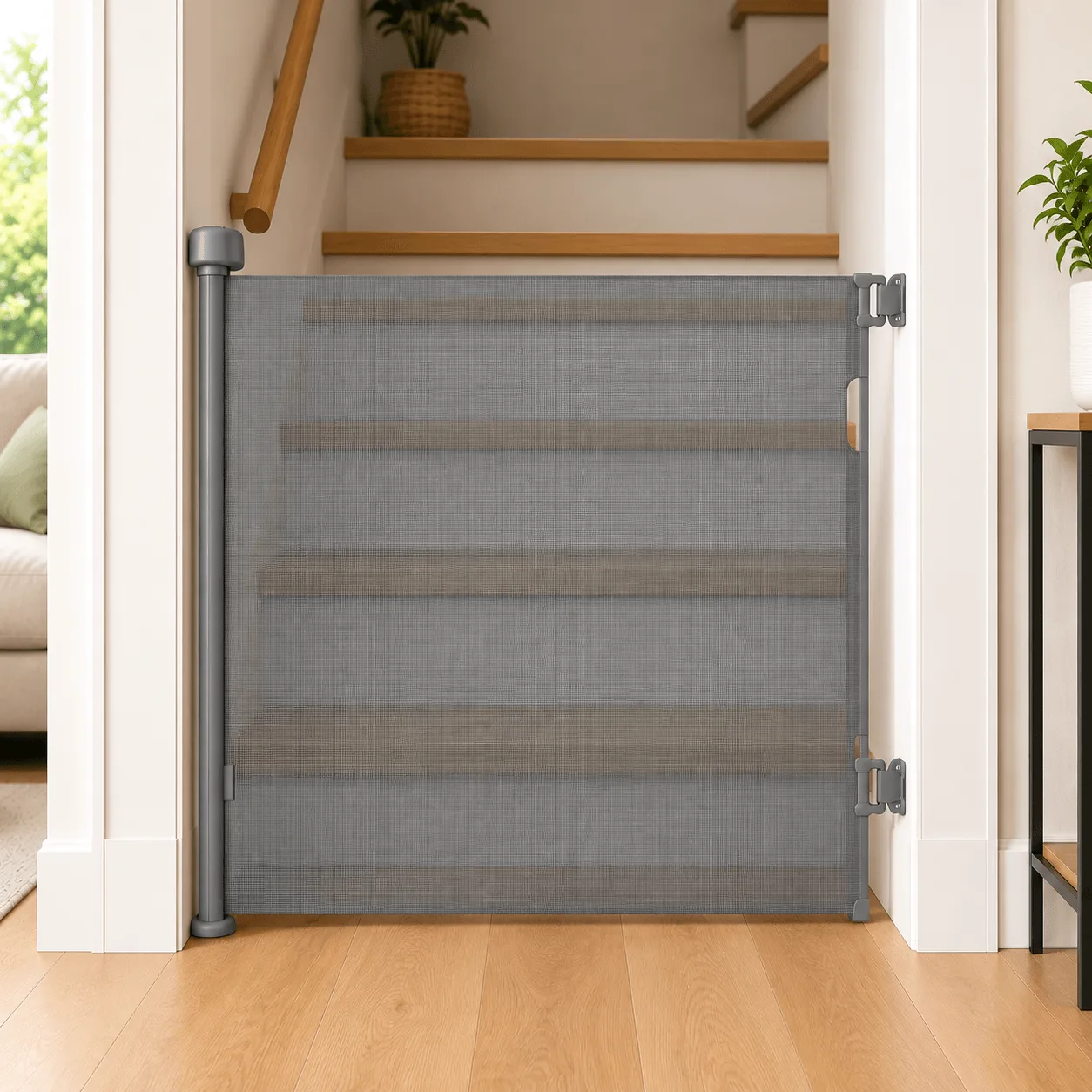
- FYLO Premium Baby Fabric Safety Retractable Stair Gate - Black (Upto 120cm Width): FYLO Premium Baby Fabric Safety Retractable Stair Gate - Black fits openings up to 120cm wide and stands 86cm high, with a soft-close retractable mechanism. A retractable design covers wider or awkward openings where a rigid gate will not fit, and the 86cm height gives a useful barrier for a climbing toddler.
- Baby Parasol / Umbrella Compatible With Maclaren - Fits All Models: Baby Parasol / Umbrella Compatible With Maclaren fits all Maclaren models and is made from UV-protected, waterproof fabric. Useful for the pram you keep by the front door, so shade is handled on the way out while the safety checks stay focused on the house.
- Animal Print Car Seat Footmuff / Cosy Toes Compatible with Bebecar - Fits All Models: Animal Print Car Seat Footmuff / Cosy Toes Compatible with Bebecar fits all Bebecar models and has a weather-resistant outer shell. A warm, weather-resistant layer for car seats keeps the school-run and errand trips comfortable while you keep the home safety routine on schedule.