Quick answer
Stitch the Octopus canvas by working from the outer tentacles inward, using a darker thread for the underside and a lighter one for the top, then fill the mantle last. This order keeps the tentacle curves readable and prevents thread from crossing over areas you have already stitched.
Why stitch the tentacles before the mantle
The Octopus canvas is small (3.25 x 4.25 inches design on 7.25 x 8.25 canvas), so every stitch choice shows. If you fill the mantle first, you may later need to squeeze tentacle stitches into tight spaces and risk distorting the curve. Working outward-in also lets you adjust thread color as you see how the tentacles overlap.
Thread colors that read as octopus, not fish
Octopus skin shifts from pale to deep, so a single solid color can look flat. The canvas suggests Pepper Pot Silk in 197, 104, 102, 022, 224, 243, and 002. Use the darkest (197) for the underside of tentacles and the lightest (002) for highlights on the mantle. Mid-tones like 104 and 102 blend the transition. If you prefer a cooler palette, swap 022 for a muted blue-green, but keep the value contrast between light and dark.
Stitch choices for small 18 mesh areas
On 18 mesh, a single tentacle may be only a few threads wide. Tentacle Stitch (a padded satin variation) works well for the thicker arms, while a simple Continental or Basketweave fills the narrower tips without bulk. Use a light coverage stitch like Nobuko for the mantle if you want to show the painted shading underneath. Avoid long stitches that span more than three canvas threads across a curve, as they can snag.
Step-by-step stitching plan for the Octopus canvas
- 1. Bind and mount the canvas: Tape the edges with artist tape or zigzag-stitch them to prevent fraying, then mount the canvas on stretcher bars or a frame. Check that the design is square and not distorted. Common mistake: skipping this step and discovering the canvas warps as you stitch. A taut, square canvas makes small tentacle curves easier to follow.
- 2. Color-match threads to your canvas: Lay the suggested Pepper Pot Silk colors (197, 104, 102, 022, 224, 243, 002) on the canvas in daylight. Assign the darkest to the underside, mid-tones to the body, and the lightest to highlights. Common mistake: choosing colors from a screen; the hand-painted canvas may vary. Write your final thread assignments on the canvas margin so you don't second-guess mid-project.
- 3. Stitch the outer tentacle tips first: Using a single strand of the darkest thread, work the narrow tips with Continental or Basketweave, following the painted curve. Keep stitches perpendicular to the tentacle edge. Common mistake: pulling thread too tight and puckering the canvas; let the stitch sit on top. Work from tip toward the body on each tentacle, not the reverse.
- 4. Fill the thicker tentacle sections with Tentacle Stitch: Switch to a mid-tone thread and use Tentacle Stitch (padded satin) on the wider parts of the arms, padding only where the area is at least three threads wide. Common mistake: using Tentacle Stitch on narrow tips, which causes bulk and distortion. Reserve padded stitches for areas wide enough to support them.
- 5. Stitch the mantle with a light-coverage stitch: Use a Nobuko or similar open stitch in a mid-tone or light thread over the mantle, allowing the painted shading to show through. Work from the center outward. Common mistake: covering the entire mantle with a solid stitch and losing the painted depth. Let the canvas paint do some of the work; you don't need to cover every thread.
- 6. Add highlights and details last: With the lightest thread (002), add a few straight stitches or French knots for eye highlights or suckers if the canvas shows them. Common mistake: over-embellishing and obscuring the octopus shape. Step back before adding each detail; less is more on a small canvas.
- 7. Block and finish: Once all stitching is complete, block the canvas to square it, then finish as a ornament, small framed piece, or pillow. Common mistake: finishing without blocking, which leaves wavy edges. Blocking is not optional on 18 mesh; it corrects minor tension issues.
Canvas facts that affect your stitching
-
Octopus - Needlepoint Canvas (Wholesale): The design area is 3.25 x 4.25 inches on 7.25 x 8.25 canvas with 18 mesh. The small scale means each tentacle is only a few stitches wide, so choose low-profile stitches and avoid bulky threads.
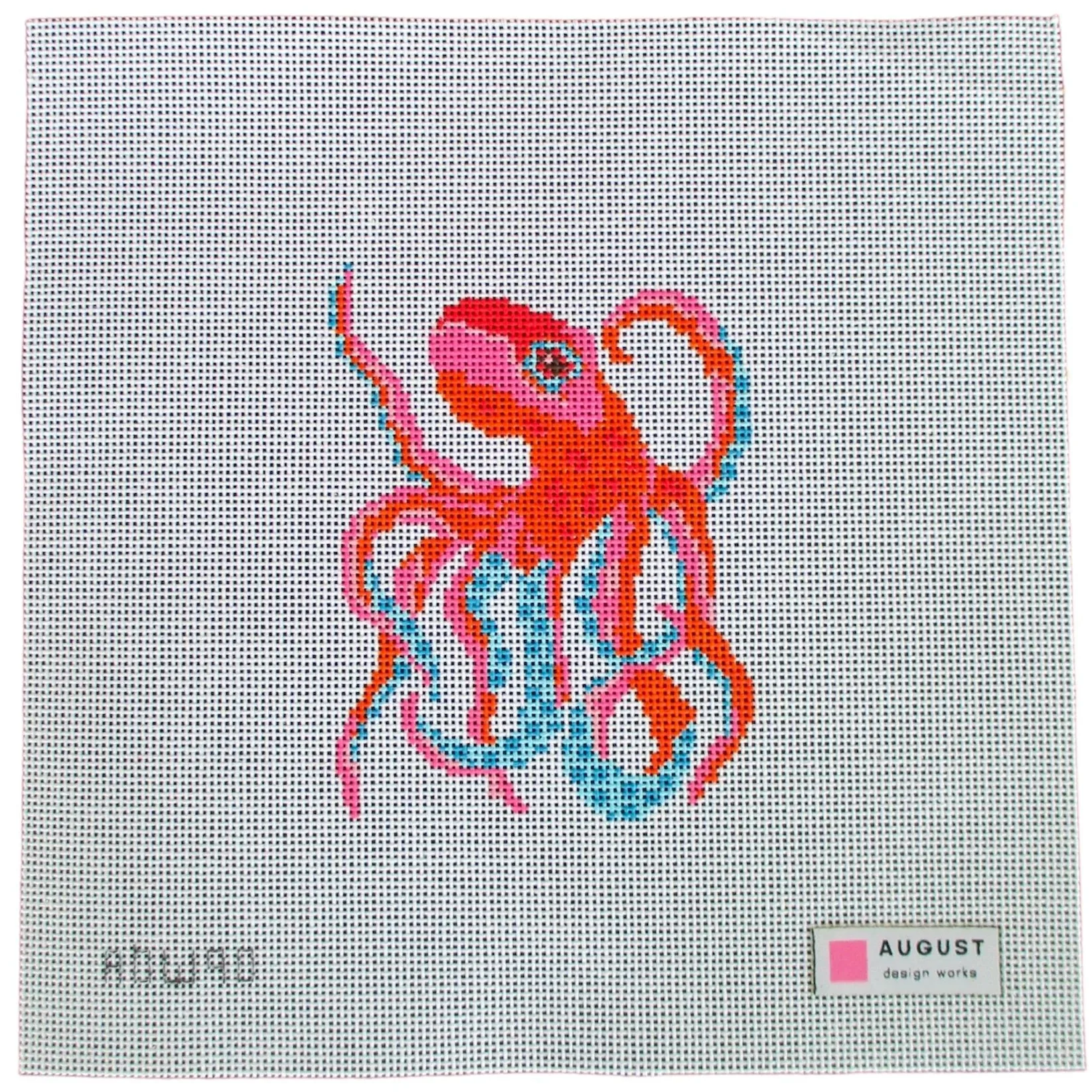
Octopus - Needlepoint Canvas (Wholesale)
-
Octopus - Needlepoint Canvas (Wholesale): The canvas is hand-painted and may vary; thread is not included. You will need to purchase threads separately, and the painted shading may differ slightly from the product photo, so match your thread colors to your actual canvas.