Quick answer
Protect counters first with compartment trays and a stable, low-humidity shelf, because loose counters are what you lose. Protect paper maps with flat storage or a rigid portfolio. If your game uses a paper map you play often, a tear-resistant, water-resistant canvas map that rolls without creasing removes the folding problem entirely.
Decide what you are protecting before you buy anything
Storage advice fails when it treats a wargame as one object. Counters, paper maps, rulebooks, and cards fail in different ways. Counters chip, fade, and disappear into carpet. Paper maps crease along fold lines and soak up moisture. Books warp at the spine when they sit in a damp box. Decide which of those actually happens in your home before you spend money on a system.
A useful order of operations: count how many counter sheets you own, measure your largest unfolded map, and check whether the room where you store games swings in temperature or humidity. Those three answers point to a specific setup instead of a generic one.
- Under about 400 counters: one or two compartment trays are enough.
- Paper maps you unfold every session: flat storage beats folding.
- A room that feels damp or gets direct sun: fix the location before buying organizers.
Counter tray organization that survives repeat play
The goal of counter tray organization is not neatness, it is setup speed. Trays with fixed small compartments force you to sort by type, which is exactly what you want when a scenario tells you to pull every infantry unit. Trays with a few large compartments hold more counters but slow you down because everything mixes.
Match compartment size to counter size, not to sheet size. If a compartment is much wider than the counters, they slide and corner-chip. If it is too tight, you cannot get a finger in and you will dump the tray. Buy one tray, load a single scenario into it, and play that scenario before buying more. You will learn more from one session than from any comparison chart.
- Sort by unit type and formation, not by the order they came on the sheet.
- Label trays on the outside so you can pull the right one without opening it.
- Keep a small spare tray for the counters currently in play, so the main trays stay closed.
Flat storage, humidity, and the paper map problem
Paper maps fail at the folds. Every time you refold along the same line, the printed surface weakens, and eventually you get a white stripe through a hex. Flat storage in a shallow drawer, portfolio, or map tube avoids that, but it costs shelf space and it is awkward if your table is small.
Humidity matters more than most players expect. Paper and cardboard absorb moisture, swell, and then dry unevenly, which is how counters warp and maps develop waves. Keep games off concrete floors, away from exterior walls, and out of rooms with a running dehumidifier or dryer. A simple hygrometer is a cheap way to find out whether your storage room is the problem.
- Store maps flat, or rolled, but not repeatedly folded along the same crease.
- Keep boxes off the floor and off outside walls.
- If you use silica packs, replace them on a schedule rather than leaving them in forever.
When a canvas map replaces the paper one
If a game gets played often enough that the fold lines are already showing, a canvas replacement map is the cleaner answer than a storage workaround. Canvas maps are printed on a tear-resistant, water-resistant material that wipes clean, and they roll up between sessions without holding a crease. That removes both the folding damage and the flat-storage space problem at once.
The tradeoff is that a canvas map is an accessory, not a new game. It replaces the map included in the board game edition, so it only makes sense for a title you already own and expect to keep playing. Buy it for the game on your table every month, not for the one on your shelf.
Decision rules for a wargame storage setup
- Rule 1: Counters before maps: If you are losing or chipping counters, fix trays first. Loose counters are the failure you notice every session, while map wear shows up slowly. Buy one tray, play one scenario, then buy the rest.
- Rule 2: Paper map, low play count: For a game you play a few times a year, flat storage or careful rolling is enough. Do not buy a replacement map for a title that rarely hits the table. Storage first, replacement only when the fold lines are already visible.
- Rule 3: Paper map, high play count: If the same map unfolds every month, a canvas replacement removes the fold and the flat-storage requirement together, which is usually cheaper than reorganizing a shelf. Reserve canvas upgrades for the games you actually keep playing.
- Rule 4: Fix the room before the box: No organizer fixes a damp room. Move storage off the floor and away from exterior walls, and measure humidity before spending on dividers or sleeves. A hygrometer costs less than replacing a warped counter sheet.
Products that solve specific storage problems
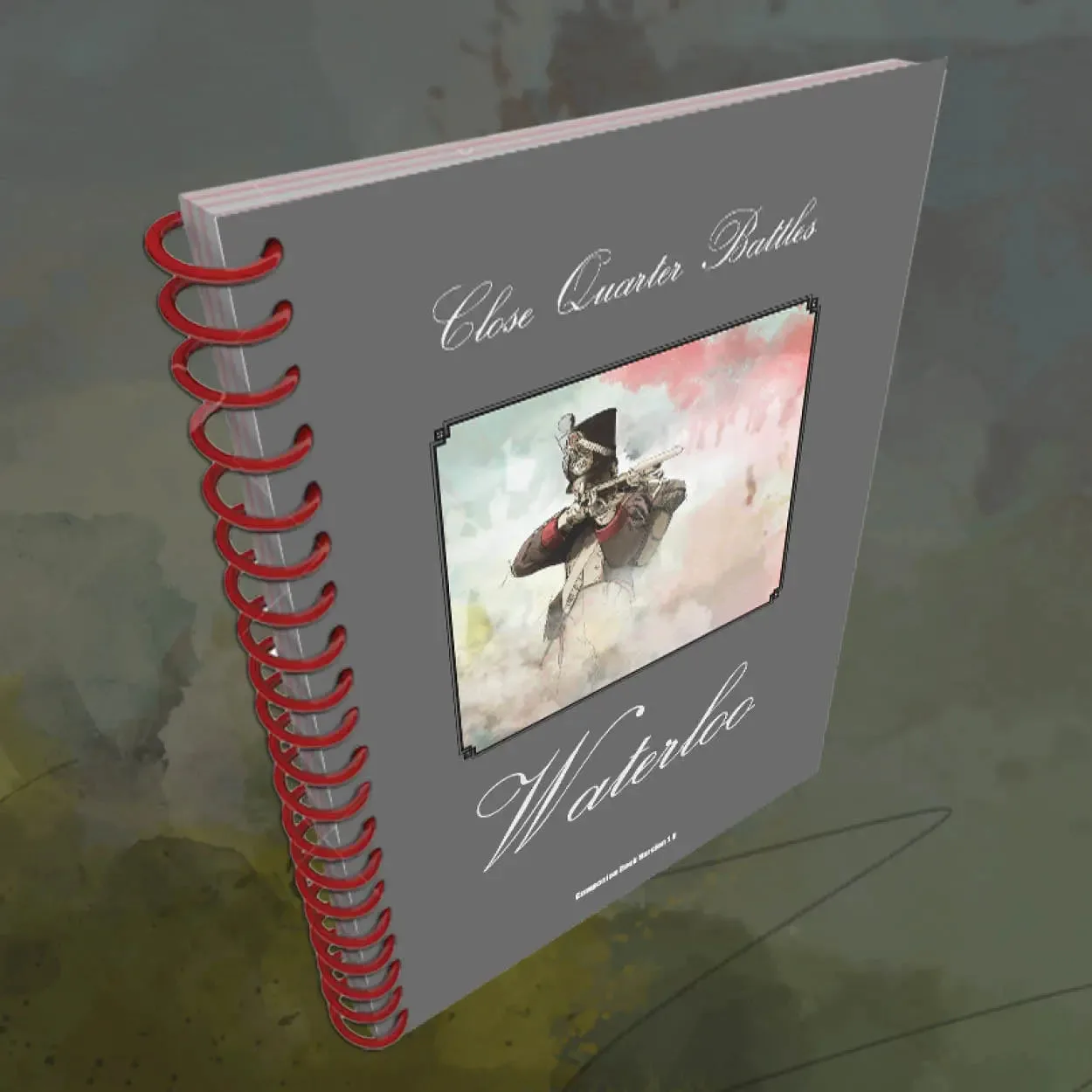
- Close Quarter Battles - Waterloo Premium Canvas Maps: Close Quarter Battles - Waterloo Premium Canvas Maps are printed on tear-resistant, water-resistant canvas paper that wipes clean, and they roll up between sessions without creasing. If your Waterloo paper map is already showing fold wear, this replaces the folding problem rather than working around it, and it removes the need for flat map storage.

Close Quarter Battles - Waterloo
- Close Quarter Battles Waterloo Companion Book: Close Quarter Battles Waterloo Companion Book covers tactical Napoleonic warfare at Waterloo on 18 June 1815, down at the orchard, sunken road, and gate level. A companion book is a bound reference you will open repeatedly during play, so it belongs on a shelf or in a box that stays dry and out of direct sun rather than loose in a counter tray.
- Close Quarter Battles Waterloo Core Rules Book: Close Quarter Battles Waterloo Core Rules Book contains the core mechanics for skirmish play, including unit activation, command and morale, written for squads, officers, and elite troops rather than divisions. Because the rules get consulted mid-scenario, keep this book where you can reach it without unpacking counters, and store it flat so the spine does not take the load.
Who this setup fits
Best for
- Players with several counter-heavy wargames who lose setup time sorting loose counters
- Owners of a frequently played Napoleonic title whose paper map is already creasing
- Anyone storing games in a garage, basement, or room with noticeable humidity swings
Not for
- Collectors who keep games sealed and never open the counters
- Players with one small game who only need a single bag, not a tray system
- Anyone expecting a canvas map to work with a different game than the one it was made for