Quick answer
For most 0-3 month babies, start with a small/medium swaddle sized for 7-14 pounds and up to 26 inches long. If your baby is under 7 pounds or shorter than about 20 inches, a size 0-3 month swaddle may still be roomy, so check the weight and length range before buying. How tight should a swaddle be? Snug across the chest and arms, but loose enough that you can slide two fingers between the fabric and your baby's chest.
Why weight and length matter more than age
Age alone is a rough guide. A 6-week-old who weighs 6 pounds and a 10-week-old who weighs 13 pounds need different fits even though both are technically 0-3 months. Always match the swaddle's stated weight and length range to your baby's current measurements, not the month label. If your baby is between sizes, size up only if the swaddle still allows a snug chest fit; a too-large swaddle can ride up over the face.
How to check the fit in three steps
First, lay the swaddle flat and place your baby on it with shoulders aligned to the top edge. Second, bring the wings across the chest and secure the closures so the fabric sits flat, not bunched. Third, test the chest: you should be able to slide two fingers under the top layer. If you can fit more, it is too loose; if you cannot fit two fingers, it is too tight. Arms can be snug, but hips should have room to bend.
Small vs large swaddle: what changes
Small/medium swaddles typically fit 7-14 pounds and up to 26 inches, which covers most newborns through about 3 months. Larger sizes are usually for babies over 14 pounds or longer than 26 inches, and they often come with arms-free options for transition. If your baby is still under 7 pounds, a small/medium may gap at the neck; consider a newborn-specific size or a swaddle with an adjustable inner band. Do not size up just to get more months of use, because a loose swaddle is a safety risk.
TOG and fabric: match to room temperature, not size
TOG measures warmth, not fit. A 1.0 TOG swaddle is a single layer for warmer rooms, while a 2.5 TOG adds insulation for cooler rooms. Choose the TOG based on your nursery temperature, then choose the size based on weight and length. If you are unsure, a 1.0 TOG swaddle plus a comfortable room temperature is a flexible starting point for most 0-3 month babies.
Decision rules for choosing a swaddle size
- If your baby weighs 7-14 pounds and is up to 26 inches: Choose a small/medium swaddle labeled for 0-3 months. This range covers most babies in this age group, so it is the safest starting point. Check the weight and length on the label, not just the month range.
- If your baby is under 7 pounds: A small/medium may be too loose at the neck and chest. Look for a newborn-specific size or an adjustable swaddle that lets you tighten the inner band. A loose swaddle can ride up; fit matters more than longevity.
- If your baby is over 14 pounds or longer than 26 inches: Move to a larger size or a transition swaddle with arms-free options. Continuing to use a too-small swaddle can restrict leg movement and hip development. Size up when the weight or length limit is reached, even if the month label says otherwise.
- If you are unsure about tightness: Do the two-finger test across the chest. You should be able to slide two fingers under the top layer, and the fabric should lie flat without bunching. Snug chest, roomy hips, two fingers of space.
Product facts to compare
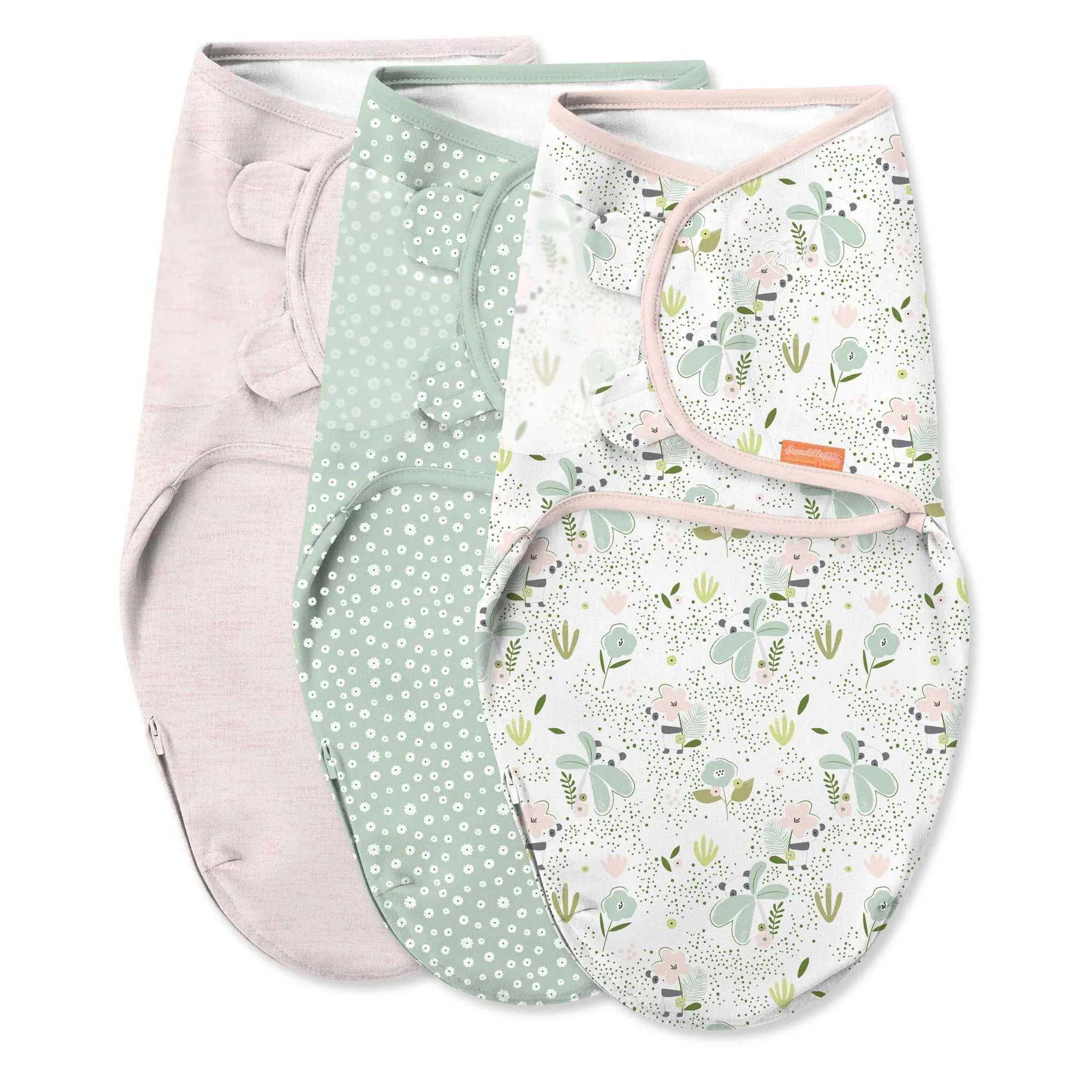
- SwaddleMe by Ingenuity All Season Swaddle, Size 0-3 Months, 1pk - Stardust: All Season Swaddle with a quick-flip design that gives 1.0 TOG in one layer and 2.5 TOG when the second layer is added; 100% cotton; size 0-3 months. One swaddle can cover warmer and cooler nights, so you may not need separate TOG sizes as your baby grows through the 0-3 month range.
- SwaddleMe by Ingenuity Velboa Original Swaddle, Size SM, 0-3 months, 1PK (Hugs & Kisses): Velboa Original Swaddle in size small/medium, designed for 0-3 months, 7-14 pounds, and up to 26 inches long; hook-and-loop closures. The stated weight and length range gives you a clear fit checkpoint, and the hook-and-loop closure makes it easy to adjust tightness night after night.
- SwaddleMe by Ingenuity Original Swaddle, Size SM, 0-3 months, 2pk - I Heart You: Original Swaddle 2-pack in size small/medium, 1.0 TOG, designed for 0-3 months, 7-14 pounds, and up to 26 inches long. A 2-pack keeps a clean swaddle available during middle-of-the-night changes without changing the fit you have already dialed in.
- SwaddleMe by Ingenuity Original Swaddle, Size SM, 0-3 months, 3pk (Criss Cross): Original Swaddle 3-pack in size small/medium, 1.0 TOG, designed for 0-3 months, 7-14 pounds, and up to 26 inches long. The 3-pack is a practical choice if you want one consistent size for the whole 0-3 month window and fewer laundry emergencies.
Who this size guidance is for
Best for
- Parents of babies 0-3 months who weigh 7-14 pounds and are up to 26 inches long
- Caregivers who want a consistent swaddle size for overnight sleep
- Anyone deciding between a small/medium and a larger swaddle
Not for
- Babies under 7 pounds who need a newborn-specific or adjustable fit
- Babies over 14 pounds or longer than 26 inches who need a larger size
- Parents looking for an arms-free sleep sack for a baby already rolling